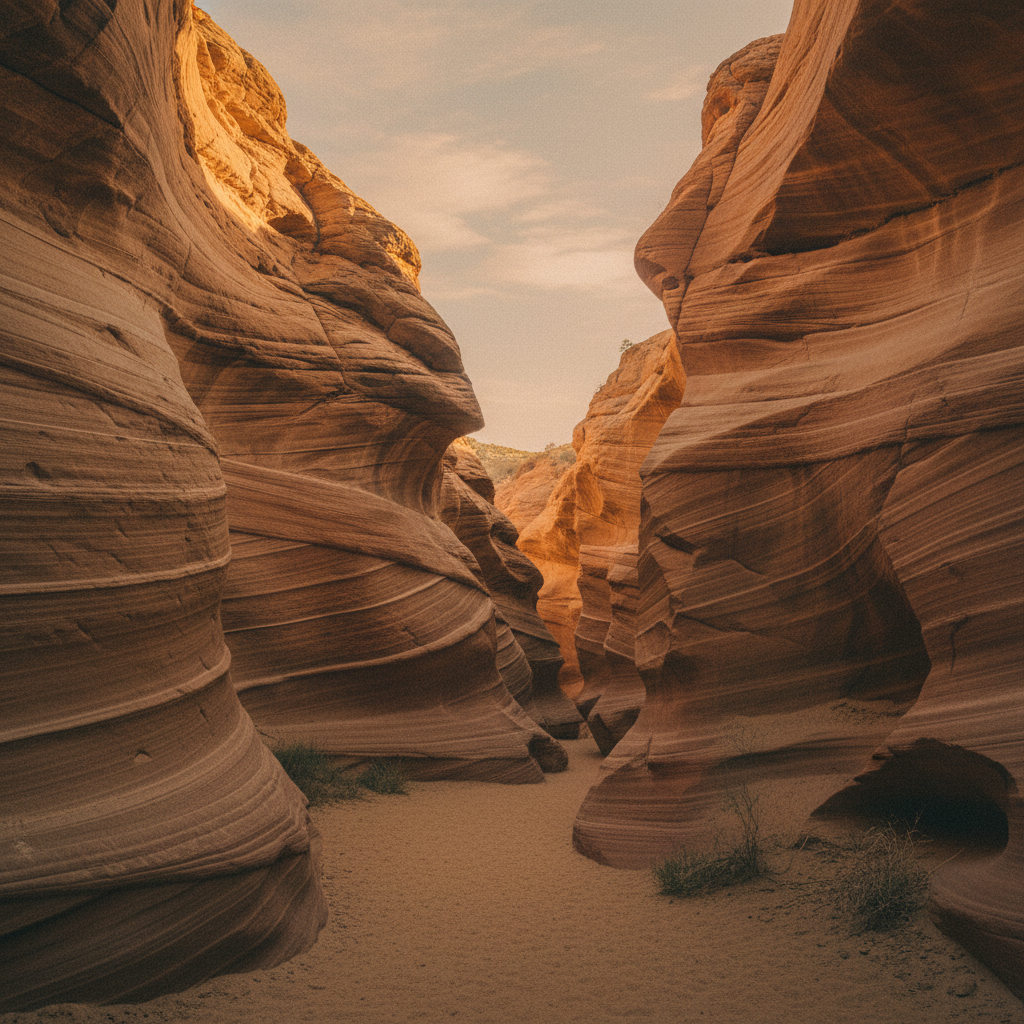
Carved into the coastal bluffs of Solana Beach, this narrow sandstone slot canyon offers a labyrinthine climb through wave-like walls to a panoramic ocean viewpoint.
Annie's Canyon, a narrow sandstone slot canyon located in Solana Beach, is a rare geological feature on the Southern California coast. Formed over millions of years, the canyon is carved into the delicate, golden-hued Del Mar Sandstone, which was once submerged beneath the Pacific Ocean as an ancient marine terrace. As the land rose and sea levels shifted, concentrated runoff from seasonal rains funneled into small cracks, gradually carving out the deep, winding passages and smooth, wave-like walls that exist today. The canyon sits within the southwestern portion of the San Elijo Lagoon Ecological Reserve, a 979-acre coastal wetland where the Escondido and La Orilla creeks meet the ocean. For thousands of years before European contact, the Kumeyaay and Luiseño peoples lived along these upland areas, harvesting the rich estuarine and marine resources of the lagoon, leaving behind shell middens as a testament to their deep connection to this coastal landscape.
Before its official designation, the canyon was known to locals as the Mushroom Caves, a clandestine and technically off-limits destination. Over decades, the lack of management led to severe ecological degradation, with the soft sandstone walls heavily scarred by carved graffiti, trash, and fire damage from unauthorized gatherings. The site's trajectory changed in 2015 when Annie Kavanaugh, a local Solana Beach resident and dedicated supporter of the San Elijo Lagoon Conservancy (now known as Nature Collective), made a generous donation to help acquire the land. A massive volunteer effort followed, involving the removal of layers of spray paint, the clearing of debris, and the construction of a sustainable trail system. In June 2016, the area officially opened to the public as Annie's Canyon Trail, named in honor of Kavanaugh's pivotal role in its preservation, transforming a vandalized hazard into a carefully managed ecological showcase.
The physical experience of navigating the canyon is a dramatic departure from the flat, marshy trails of the surrounding reserve. Accessible via the North Rios Avenue or Solana Hills trailheads, the approach path winds through coastal sage scrub before entering the mouth of the canyon. The path quickly transitions from a wide sandy wash into a shadowed, vertical cleft where the sandstone walls press close, narrowing to shoulder-width and requiring hikers to turn sideways to squeeze through the serpentine corridor. The textured rock is cool to the touch and highly sensitive to erosion, which is why the trail is strictly designated as a one-way, upward-only loop. The final ascent requires scrambling up a steep section and climbing an anchored metal ladder bolted directly into the rock face. Emerging from this tight squeeze at the summit rewards hikers with an expansive, panoramic view of the San Elijo Lagoon, the Pacific Ocean, and the coastal bluffs of Cardiff-by-the-Sea.
The slot canyon is strictly a one-way, upward-only route to prevent bottlenecks. Leashed dogs are welcome on the reserve's main trails, but they are not permitted inside the narrow slot canyon or on the ladder. If you are hiking with a dog, carrying a large backpack, or prefer to avoid tight spaces, take the exterior switchback trail to the left of the canyon entrance to reach the summit viewpoint.