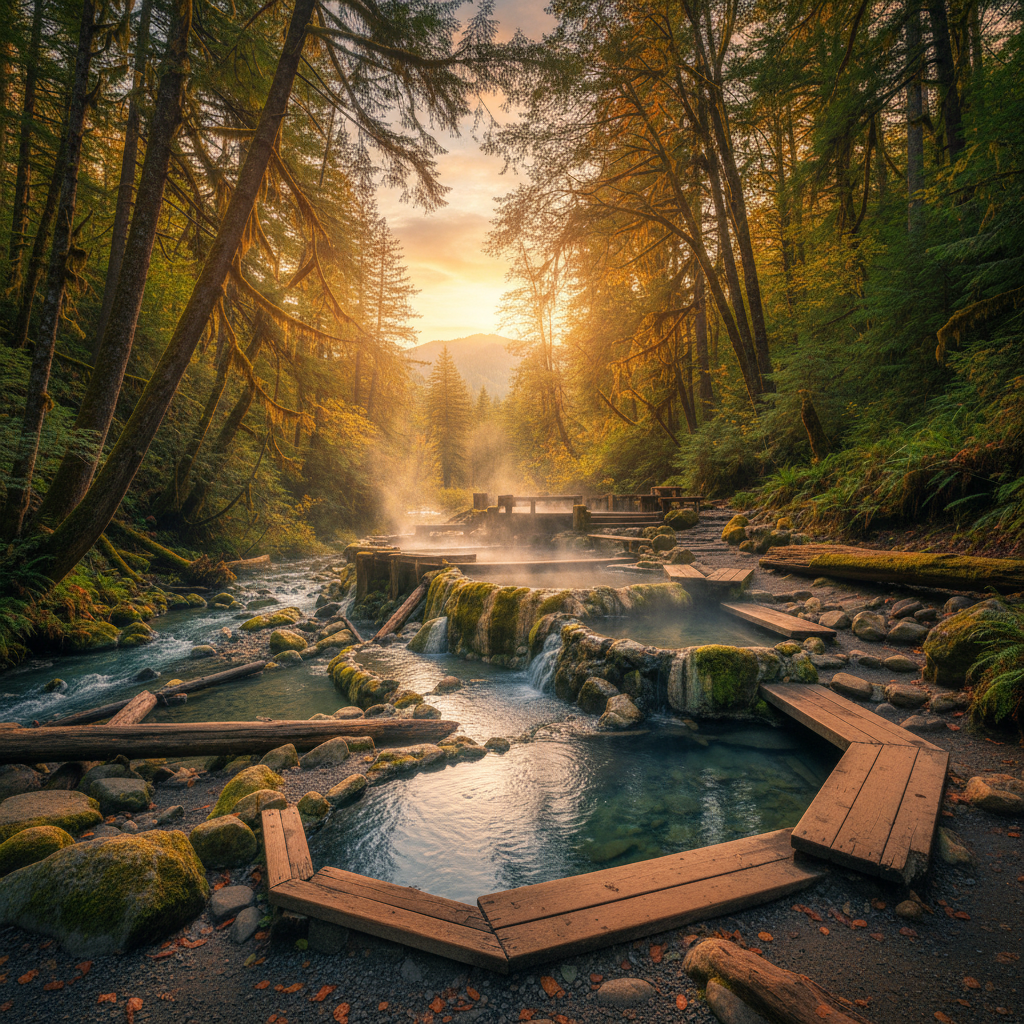
Historic forest soaking tubs and mineral springs in Mount Hood National Forest.
Bagby Hot Springs, located in the Mount Hood National Forest, sits deep in the Cascade Range along the Hot Springs Fork of the Collawash River. The journey to the springs begins with a 1.5-mile hike through an old-growth canopy of ancient Douglas firs, western hemlocks, and giant red cedars. This trail, which gains about 260 feet of elevation, crosses several footbridges over Nohorn Creek and the Collawash River, where the air smells of damp moss, ferns, and decaying cedar. Discovered in 1880 by hunter and prospector Robert "Bob" Bagby, this geothermal area has drawn visitors for over a century. The first permanent structure was a rustic log cabin guard station built in 1913 by Forest Service employee Phillip Putz, which still stands near the bathhouses and is listed on the National Register of Historic Places.
The geothermal water rises from three major springs and several minor seeps, discharging at a scalding 138 degrees Fahrenheit from the largest source. Rich in minerals like silica, sodium, sulfate, and carbonate, the water is naturally piped through a gravity-fed plumbing system made of hollowed-out cedar flumes. Historically, the site featured three distinct bathhouses rebuilt by the volunteer group Friends of Bagby in the mid-1980s after a devastating fire in 1979. Today, the complex is managed under a long-term contract by Bagby Preservation, a private concessionaire founded by Mike and Tamarah Rysavy, who first met at the hot springs in 2001. Under their stewardship, the site has undergone extensive restoration to address years of vandalism, storm damage, and decay, including plans to reconstruct the iconic main bathhouse (the "Private Deck"), which was closed in late 2018 due to severe wood rot.
Soaking at Bagby remains a rustic, low-tech, and clothing-optional experience. While the historic private rooms with their ten-foot hollowed-out cedar log tubs are currently out of commission, bathers can still soak in the communal decks. The lower bathhouse features three small Japanese-style yellow pine tubs and a large, six-foot round communal tub that comfortably holds up to eight people. Another large whiskey-barrel-style tub sits on the open-air upper deck, about 100 yards up the trail. Because the mineral water arrives at the decks too hot for immediate soaking, visitors use wooden buckets to haul cold water from a nearby mountain spring to achieve the perfect temperature. It is a slow, tactile ritual where the sound of rushing river water, rising steam, and the quiet rustle of the ancient forest create a deeply grounding backcountry retreat.
Arrive early on a weekday morning to secure a tub without a long wait, especially during the busy summer season. Bring exactly $5 cash per person for the soaking fee, as the trailhead pay box does not accept cards, and remember that alcohol, glass containers, and pets are strictly prohibited in the bathing area.