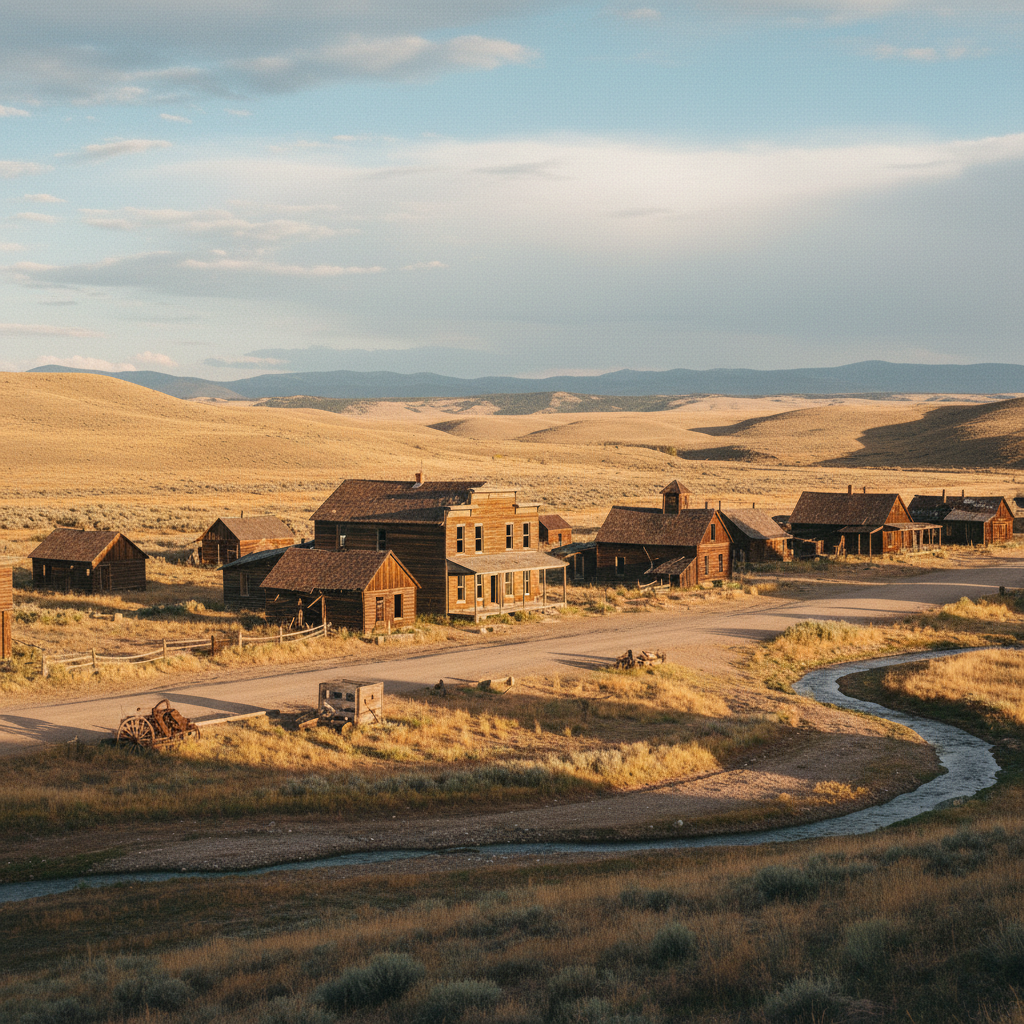
A remarkably preserved 1860s gold-rush ghost town and Montana's first territorial capital, featuring over sixty historic structures.
Bannack State Park preserves the weathered timber and quiet brick facades of Montana's first major gold rush town, standing as an exceptionally intact relic of the 1860s frontier. Founded in 1862 after John White and his party discovered placer gold in Grasshopper Creek, the settlement quickly ballooned to a population of over three thousand prospectors, merchants, and saloon keepers. It briefly served as the first territorial capital of Montana before the gold dried up and the seat of power shifted. Today, the park protects more than sixty historic structures along the dirt stretch of Main Street, managed under a philosophy of preservation rather than restoration. Visitors can walk directly into these abandoned buildings, where the dry mountain air carries the scent of aged pine, sagebrush, and historic dust.
The architectural anchors of the town tell stories of civic ambition and sudden decline. The Hotel Meade, a two-story brick structure with an elegant Italianate facade, was originally constructed in 1875 as the Beaverhead County Courthouse. When the county seat moved to Dillon in 1881, the building sat vacant until 1890, when Dr. John Singleton Meade remodeled it into a luxury hotel featuring velvet draperies and polished floors. Across the street stands the Masonic Lodge No. 16, built in 1874, which housed the local school on its ground floor for over seventy years while Masons met upstairs. Nearby, the Roe and Graves House, built in 1867 by William Roe, stands as the town's first frame house. Peeling layers of its interior walls reveal historic newspapers, including pages from a 1915 edition of the San Francisco Chronicle, which residents pasted over cracks to keep out the harsh winter drafts.
Violent frontier justice is etched into the very topography of the park. In Hangman's Gulch, a reconstructed wooden gallows marks the spot where the town's controversial sheriff, Henry Plummer, was hanged in January 1864 by the Montana Vigilance Committee, who accused him of leading a ruthless gang of road agents. For most of the year, the park remains quiet, but during the third weekend of July, the annual Bannack Days celebration temporarily revives the ghost town with historic re-enactors, pioneer craft demonstrations, and a traditional breakfast served inside the Hotel Meade. In the winter, the park opens a frozen dredge pond for public ice skating from January through early March. The park is open year-round, charging an eight-dollar daily entrance fee for out-of-state vehicles, and features a twenty-eight-site campground along Grasshopper Creek, complete with a rental tipi for overnight stays.
To experience the town's eerie quiet, visit in late spring or early autumn when the crowds thin out. If you visit during the winter, pack ice skates to glide across the frozen dredge pond, and always bring a flashlight to explore the dark, unlit interiors of the historic schoolhouse and Hotel Meade.