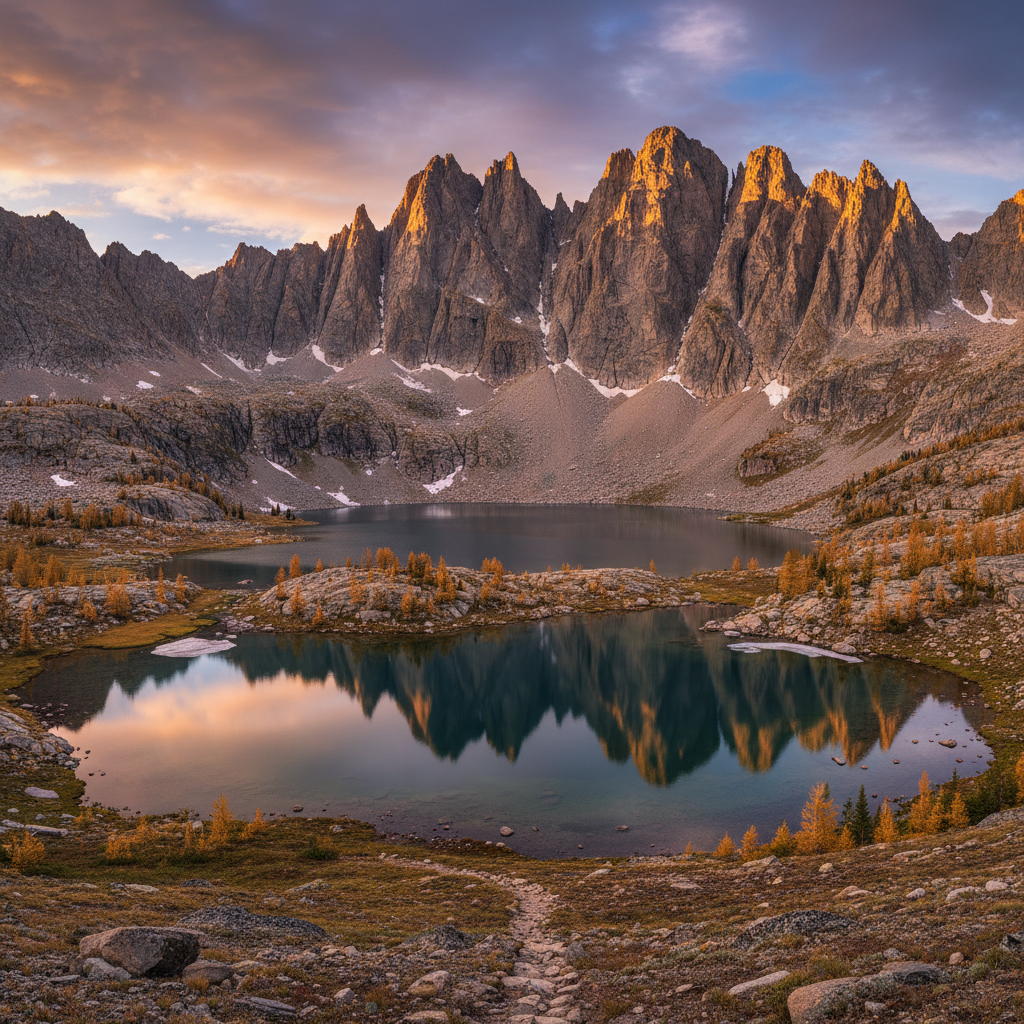
A colossal granite amphitheater of jagged 12,000-foot peaks and alpine tarns along the Continental Divide.
The Cirque of the Towers is a colossal, semi-circular amphitheater of sheer granite peaks rising from the southern Wind River Range along the Continental Divide in Wyoming. Carved by massive glaciers during the last ice age roughly 10,000 years ago, this geological marvel stands as one of North America's premier alpine destinations, where raw vertical rock faces tower nearly 2,000 feet above the valley floor. The cirque is defined by a ring of jagged, 12,000-foot summits, including the prominent spires of Pingora Peak, Wolf’s Head, Mitchell Peak, and the Watchtower. At the center of this high-altitude basin lies Lonesome Lake, a cold, glacial tarn that reflects the surrounding gray monoliths. The air here is thin and sharp, carrying the scent of subalpine lodgepole pine and alpine wildflowers like sky pilot and alpine forget-me-nots that cling to the rocky talus slopes.
The geology of the Cirque is rooted in Precambrian granite and gneiss, some of the oldest exposed rock on the continent, which was uplifted over millions of years and subsequently sculpted by ice sheets more than a mile thick. This exceptionally solid, high-friction rock has made the Cirque a legendary arena for alpine rock climbing since the mid-20th century. Climbers from around the world are drawn to iconic lines like the Northeast Face of Pingora Peak, a classic multi-pitch route rated 5.8+ that is celebrated for its clean cracks and striking exposure. Immediately adjacent, the East Ridge of Wolf’s Head offers a highly exposed, knife-edge traverse rated 5.6 that tests a climber's route-finding and tolerance for vertical drop-offs. Other formidable formations, such as Warbonnet Peak, the Warrior Peaks, and Shark's Nose, hem in the basin, providing technical routes on pristine, unpolished stone.
Accessing the Cirque requires a serious backcountry commitment, typically beginning at the Big Sandy Trailhead at an elevation of 9,100 feet. Backpackers generally follow the Big Sandy River past Big Sandy Lake before climbing steeply over the 11,480-foot Jackass Pass, which serves as the southern gateway into the Cirque. Because of the area's immense popularity and fragile subalpine ecology, strict wilderness regulations are in place to preserve the watershed. Camping and campfires are strictly prohibited within a quarter-mile of Lonesome Lake to protect the delicate ecosystem, and visitors must camp at least 200 feet from all other water sources and trails. Those who make the trek are rewarded with a profound wilderness experience, where the granite walls glow in shades of deep orange and fiery red during the late-afternoon golden hour before giving way to some of the darkest, star-filled night skies in the American West.
Allow at least three days for the trek from Big Sandy Trailhead. Remember that camping is strictly prohibited within a quarter-mile of Lonesome Lake, and all food must be stored in approved bear-resistant containers.