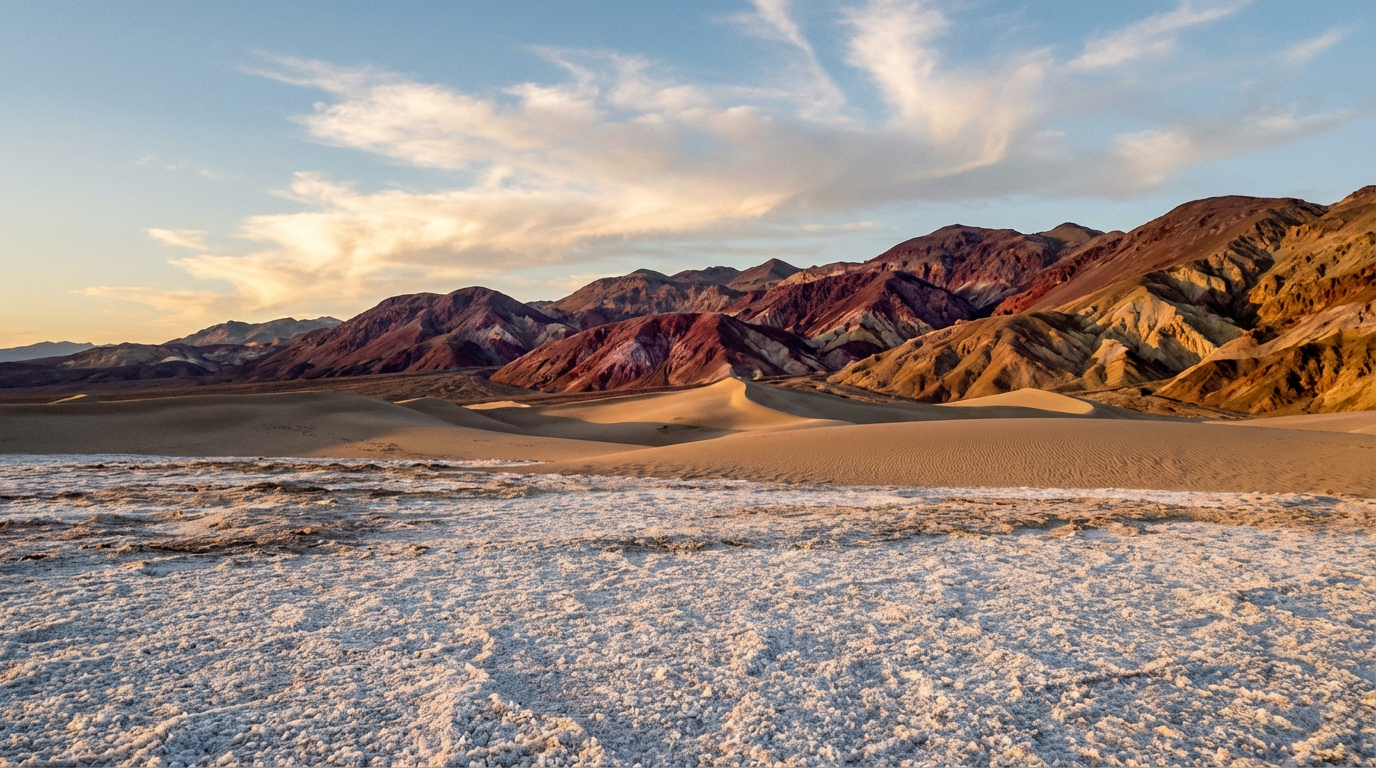
The largest national park in the lower 48 at ~3.4 million acres, Death Valley spans from Badwater Basin at -282 ft (lowest point in North America) to Telescope Peak at 11,049 ft. A fault-bounded hot desert basin with salt flats, sand dunes, and extreme vertical relief.
October through May is the core visiting season — avoid summer extreme heat. The best 3 months for mild weather at the valley baseline are November, December, and January (highs 65–77°F at Furnace Creek). Spring (March–April) is busiest but offers wildflower potential.
Death Valley offers the largest national park area in the lower 48 (~3.4 million acres) and the lowest point in North America (Badwater Basin at -282 ft). The limiting factors are operational hazard in heat season, large driving distances inside the park, and limited cell coverage.
Because the park is extremely large and destinations are car-separated, a minimum of 2 days is required for major frontcountry nodes (Badwater Basin, Zabriskie Point, Mesquite Flat Dunes). 3+ days supports remote destinations if you have suitable vehicles and current road-status confirmation.
October is substantially cooler than summer and part of the "popular season" ramp. Heat is still possible early in the month but risks decline significantly relative to June–August. Visitation builds through October and November.
NPS publishes two seasonal route sets: ~5 hours / 270 miles when the cross-Sierra pass is open (summer–fall), and ~9 hours / 450 miles via the winter routing when the high pass is closed.