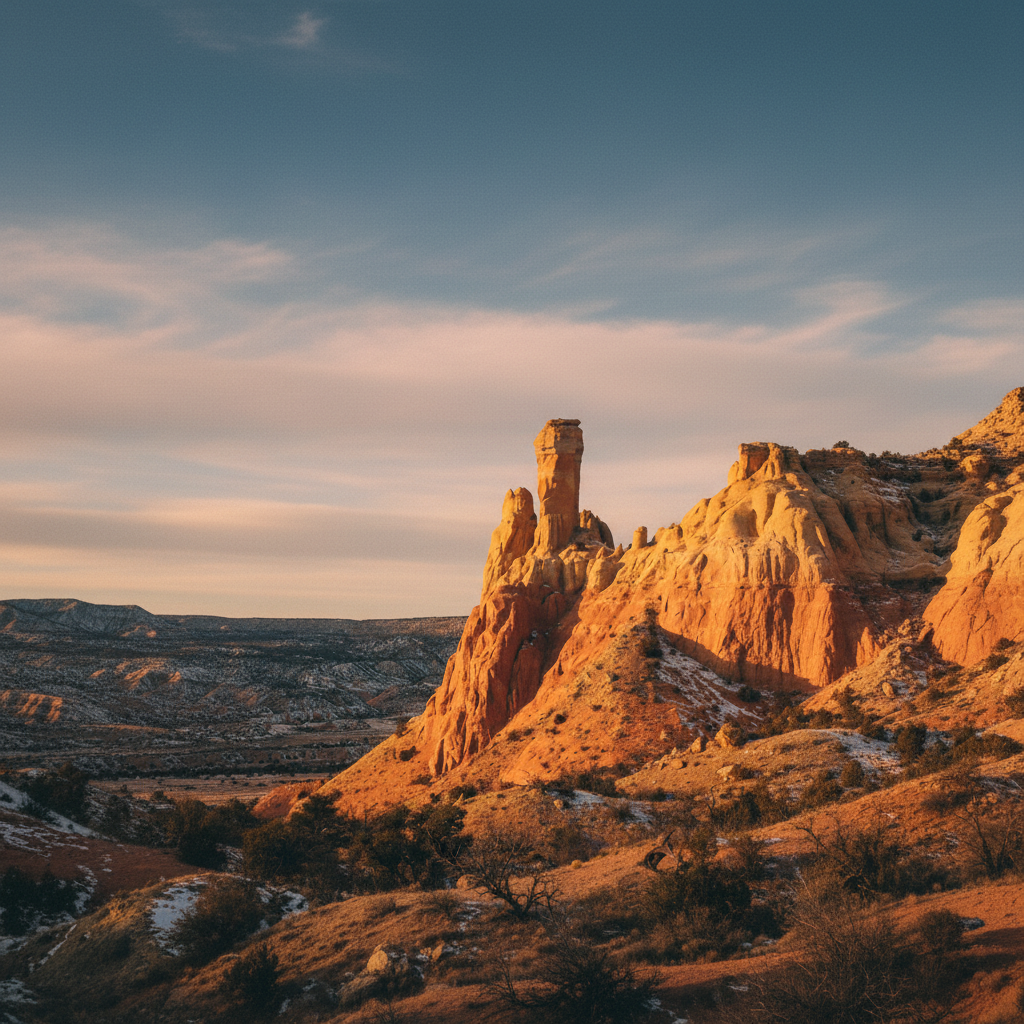
Sleep beneath the towering sandstone cliffs of the Piedra Lumbre basin at this historic 21,000-acre high-desert retreat that inspired Georgia O'Keeffe.
Ghost Ranch is a 21,000-acre retreat and education center located in the Piedra Lumbre basin of northern New Mexico, where towering cliffs of red, yellow, and white sandstone dominate the horizon. Originally part of a 1766 Spanish land grant known as Piedra Lumbre, or "Shining Stone," the property has evolved from a territory of Navajo and Ute hunters, to a hideout for late-nineteenth-century cattle rustlers, to a celebrated dude ranch, and finally to its current role as a sanctuary for spiritual, artistic, and ecological study. Today, the Presbyterian Church owns the land, which is operated by the non-profit National Ghost Ranch Foundation. The immediate sensation of arrival is one of deep silence, punctuated only by the dry rattle of cottonwood leaves along the Rito del Yeso and the occasional call of a raven. The high-desert air carries the scent of sun-baked earth, sagebrush, and the resinous aroma of piñon pine, setting a contemplative tone that feels entirely removed from a typical resort.
The geological history of the ranch is written directly into its sheer cliffs, which serve as a vertical archive of the Mesozoic Era. These vibrant bands of ocher, carnelian, and pale cream preserve ancient floodplains and riverbeds from over two hundred million years ago. Notably, the property is home to one of the most significant paleontological sites in the Northern Hemisphere, yielding thousands of fossilized specimens of the Triassic dinosaur Coelophysis. Visitors can explore these discoveries at the on-site Ruth Hall Museum of Paleontology, while the neighboring Florence Hawley Ellis Museum of Anthropology showcases prehistoric artifacts from Paleo-Indian cultures alongside works by local Southwestern artists. This rich scientific legacy is matched by the artistic history of Georgia O’Keeffe, who bought a seven-acre parcel and a home here from then-owners Arthur and Phoebe Pack in 1940. O'Keeffe spent her summers painting the dramatic landforms, most famously the flat-topped silhouette of Cerro Pedernal, which stands as a constant sentinel across the valley.
A stay at the ranch is designed around simplicity, community, and direct contact with the landscape. Accommodations are deliberately rustic, ranging from basic campsites with electrical hookups to simple, historic rooms like the Coyote rooms, which feature private verandas overlooking the canyon walls. Overnight lodging includes three daily meals served buffet-style in the communal Dining Hall, where guests gather to share stories over hearty, regional fare. Days are shaped by the rhythms of the high desert: mornings are ideal for hiking the Chimney Rock Trail to see the first light strike the sandstone spires, or exploring the shaded, sculpted narrows of the Box Canyon Trail. Summer afternoons often bring dramatic monsoon storms that sweep across the basin, painting the sky in deep purples and releasing the sharp fragrance of wet sage. When night falls, the absence of light pollution reveals an exceptionally clear canopy of stars, where the Milky Way arches over the ancient, quiet landscape.
Book the Georgia O'Keeffe Landscape Tour for the late afternoon slot when the low sun illuminates the orange and yellow sandstone cliffs. Afterward, sit on the veranda of the library to watch the alpenglow settle on Cerro Pedernal, the flat-topped mesa the artist made famous.
Where to Stay — Curated accommodations hand-picked by Basecamp West. Glamping, boutique hotels, historic lodges, and unique stays across the American West.