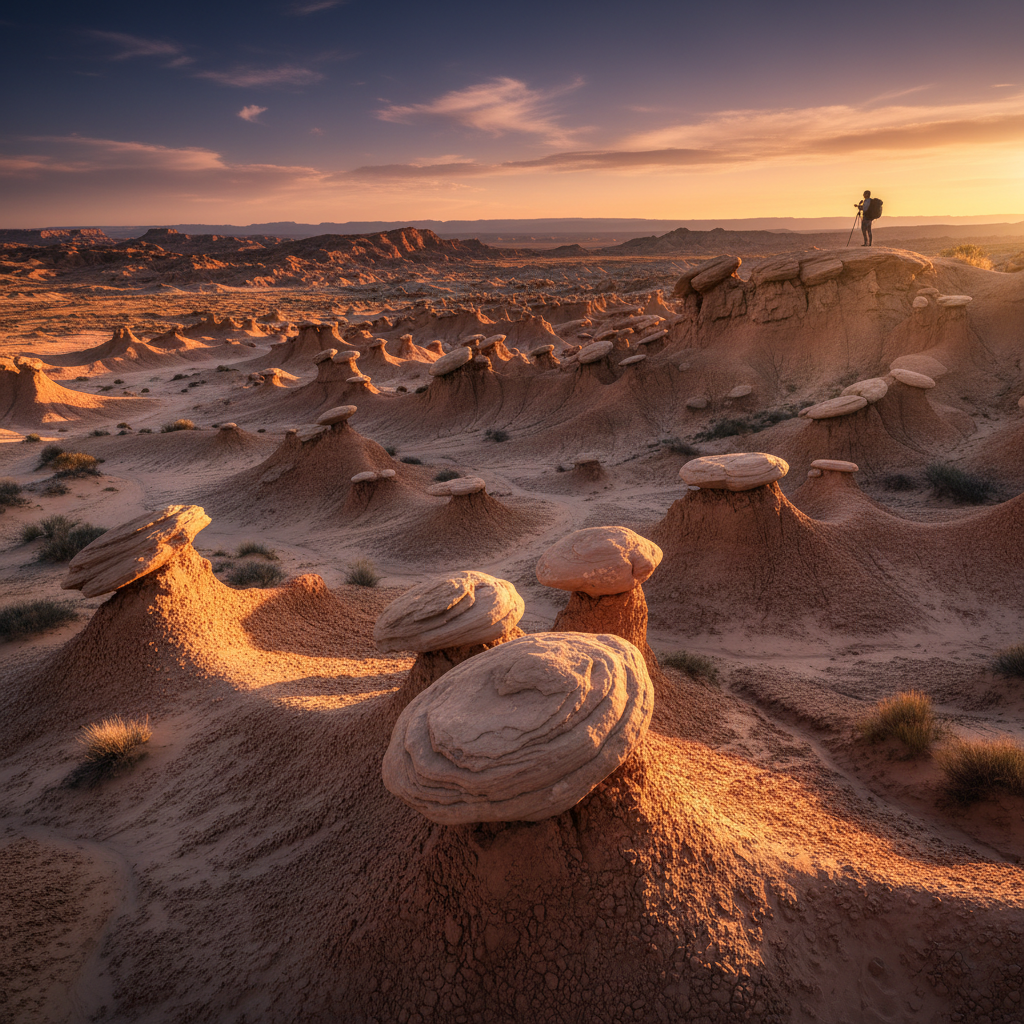
A surreal labyrinth of thousands of red-brown, mushroom-shaped hoodoos carved from the earthy Entrada Sandstone of the San Rafael Desert.
Goblin Valley State Park presents a labyrinth of thousands of red-brown, mushroom-shaped hoodoos rising from the floor of the San Rafael Desert. Known locally as goblins, these bizarre geological figures cluster in three distinct valleys, creating a dense sandstone wilderness that invites open-ended exploration. The park was first brought to wider attention in the late 1920s by Arthur Chaffin, an operator of the Hite Ferry, who encountered the region while searching for an alternative route between Green River and Caineville. Captivated by the strange shapes, Chaffin called it Mushroom Valley, though he did not return to thoroughly document it until 1949, accompanied by Philip Tompkins. Tompkins suggested the name Goblin Valley, a moniker that captured the public imagination and eventually led the state of Utah to establish a reserve here in 1954, officially designating it a state park in 1964. Today, the park serves as a sanctuary of quiet, ancient forces, where the silence is broken only by the desert wind and the occasional call of a soaring raptor.
The formation of these whimsical stone figures is a lesson in millions of years of deposition and erosion. During the Middle Jurassic period, roughly 170 million years ago, this region sat at the edge of an ancient inland sea, where tidal flats and sabkhas deposited alternating layers of sand, silt, and clay. These sediment layers eventually consolidated into the earthy facies of the Entrada Sandstone, a formation characterized by its fine-grained, reddish-brown composition. Over millennia, tectonic forces fractured the rock, creating a grid of vertical joints. Rainwater, wind, and frost wedged into these cracks, initiating a process called spheroidal weathering that rounded off the sharp corners of the sandstone blocks. Because the Entrada Sandstone contains alternating beds of soft siltstone and slightly harder, more resistant sandstone, the softer layers eroded at a much faster rate. The harder sandstone beds remained on top, acting as protective caps that shielded the softer pedestals beneath, resulting in the classic top-heavy, mushroom-like profiles. Above the valley floor, the light-colored, greenish-gray Curtis Formation and the thin-bedded Summerville Formation cap prominent local landmarks like Wild Horse Butte and Mollys Castle, providing a stark color contrast to the deep orange of the goblins.
While the park encourages visitors to wander freely off-trail through the three main valleys, several established paths offer structured ways to experience the terrain. The Carmel Canyon Trail winds through a 1.5-mile loop, leading hikers deep into a narrow, sculpted passage, while the Curtis Bench Trail follows a higher ridge to provide panoramic views of the goblin-filled basins below. For those seeking a more adventurous trek, the three-mile round-trip trail to Goblin's Lair leads to a massive, dark cavern on the eastern edge of the park, where advanced explorers can obtain a permit to rappel eighty feet through a natural skylight into the chamber's sandy floor. Beyond hiking, the park features the Wild Horse Trail System, which offers seven miles of singletrack mountain biking across the mesa west of the campground. As night falls, the remote location reveals another of its wonders: designated as an International Dark Sky Park in 2016, the valley becomes one of the premier stargazing spots in the American West, where the lack of light pollution reveals the dense band of the Milky Way arching over the silent stone sentinels. Accommodations within the park include a 24-site campground that accommodates both tents and RVs, along with two heated and air-conditioned Mongolian-style yurts that allow guests to spend the night immersed in this otherworldly landscape.
To experience the park's deepest recesses, hike the three-mile trail to Goblin's Lair and secure a permit in advance if you plan to rappel into the cavern. If staying overnight, reserve one of the two Mongolian-style yurts months ahead, and bring a red-light headlamp to preserve your night vision under the certified dark skies.