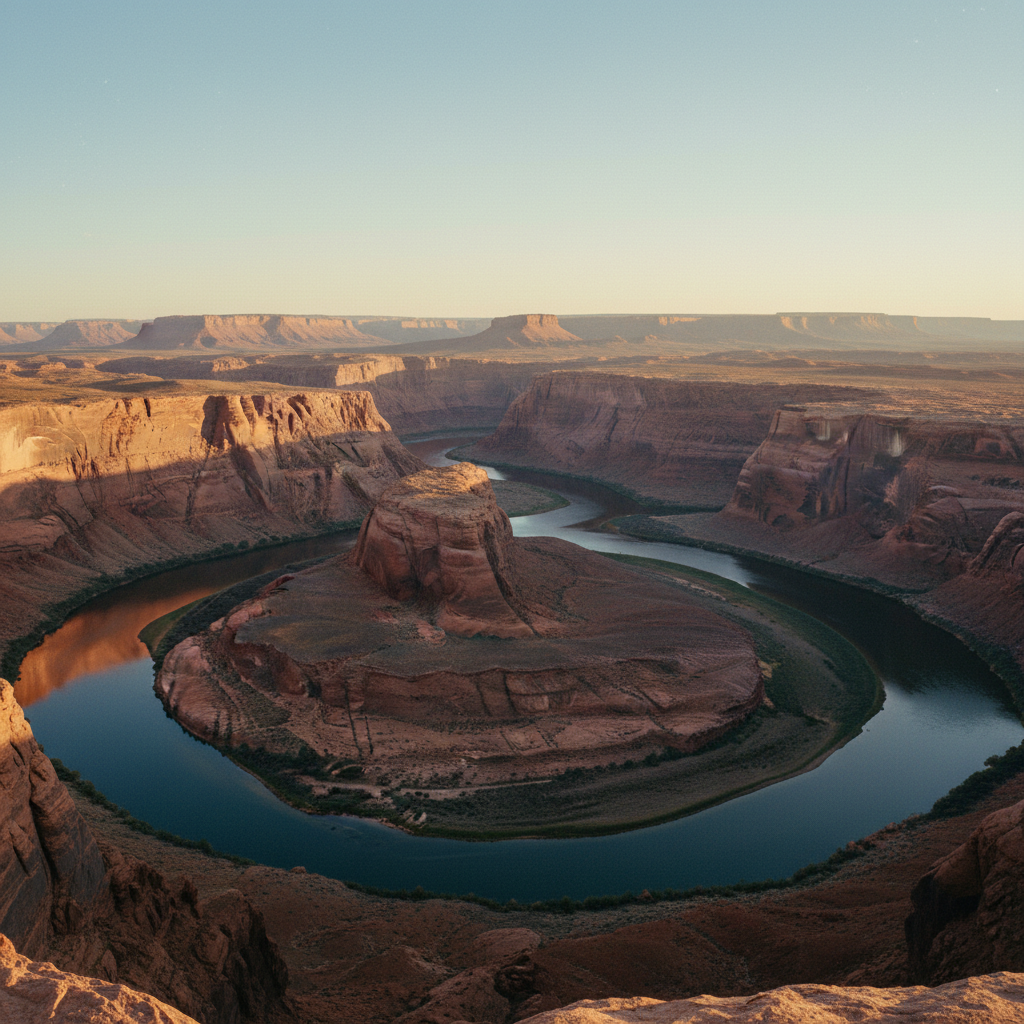
A dramatic, windswept overlook in southeastern Utah offering a 1,000-foot drop-off above the tightly wound, ancient meanders of the San Juan River.
Goosenecks State Park occupies a stark, windswept plateau in southeastern Utah, perched directly on the edge of a precipitous 1,000-foot drop. Below this overlook, the San Juan River, known to the Diné as Tooh or Sá Bitooh (Old Age River), has carved one of the most striking examples of an entrenched meander on the North American continent. The river twists and turns through a series of tight, serpentine loops, flowing a distance of over six miles while advancing a mere one and a half miles westward on its journey toward Lake Powell. This dramatic geological formation, resembling the curved neck of a giant bird, offers a raw and unvarnished look at the power of fluvial erosion. Standing at the unfenced rim, visitors look down into a deep, terraced gorge where the silence is broken only by the rush of the wind and the distant, muffled murmur of the water far below.
The layered canyon walls of the park serve as a textbook of deep time, exposing roughly 300 million years of geological history. The deep cuts of the gorge reveal the ancient marine environments of the Pennsylvanian Period, specifically showcasing the limestone, shale, and siltstone of the Honaker Trail Formation and the underlying Paradox Formation. These rock layers were deposited during an era when ancient seas repeatedly rose and fell across a flat basin. After the seas receded, the ancestral San Juan River established a lazy, meandering path across the level plains. When the Colorado Plateau began its massive tectonic uplift millions of years ago, the river maintained its winding course, cutting straight down into the rising bedrock like a saw. The result is a series of sheer, stepped cliffs where gray limestone ledges alternate with softer, eroding shale slopes, dropping steeply to the muddy ribbon of the river.
Experiencing this remote park requires a willingness to embrace its primitive, exposed nature. There are no visitor centers, manicured trails, or running water here: only a small paved parking area, vault toilets, and a handful of basic picnic shelters. For those who want to linger, the park offers eight first-come, first-served primitive camping sites scattered directly along the rocky rim. While the constant desert winds make tent camping a challenge, those in robust setups are rewarded with unparalleled solitude and some of the darkest nights in the country. Designated as an International Dark Sky Park in 2021, Goosenecks boasts a Bortle Class 1 rating, meaning the Milky Way, the Andromeda Galaxy, and the Sagittarius star clouds are easily visible to the naked eye. As night falls, the canyon walls fade into deep black silhouettes, and the sky transforms into a brilliant, crowded field of starlight undisturbed by the glow of distant cities.
Arrive with a full tank of gas, plenty of drinking water, and firewood, as the park has zero hookups or potable water. If you camp on the rim, secure your gear carefully: the winds sweep across the plateau with sudden, intense force, and tent camping is highly discouraged.