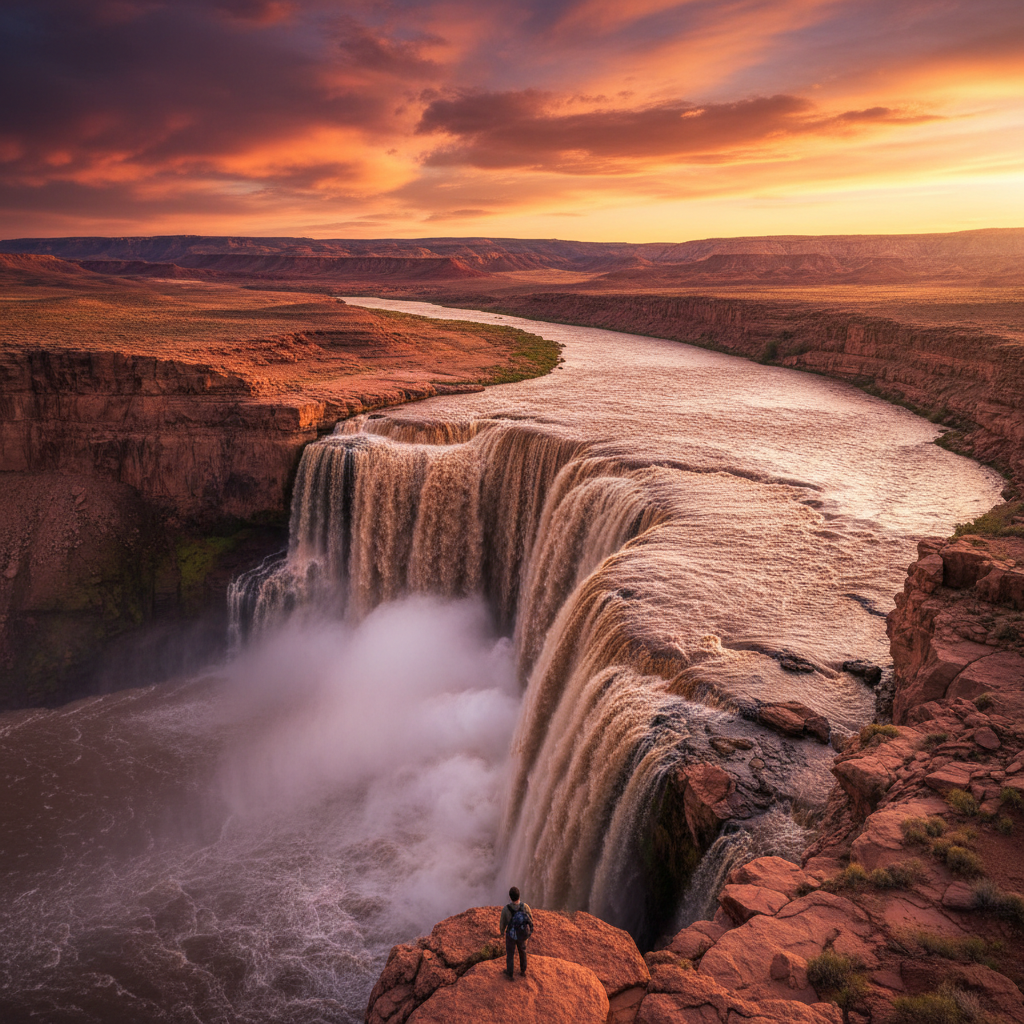
An extraordinary 185-foot waterfall on the Navajo Nation, currently closed to the public to protect sacred tribal lands.
*Adah'iilíní* (Grand Falls), often called Chocolate Falls, is an extraordinary 185-foot-tall natural waterfall located on the Navajo Nation in the Painted Desert of northern Arizona. Taller than Niagara Falls, this massive geological wonder is fed by the seasonal snowmelt and rainfall from the White Mountains, specifically originating near Mount Baldy (*Dził Łigai Sí'án*). The water travels hundreds of miles along the Little Colorado River, picking up vast quantities of fine silt and clay from the Painted Desert, which transforms the river into a thick, opaque, cocoa-colored torrent. This dramatic cascade was formed during the late Pleistocene era, roughly 20,000 years ago, when a volcanic eruption at nearby Merriam Crater sent a massive lava flow into the canyon of the Little Colorado River. The cooling basalt created a natural dam, forcing the river to carve a new path around the lava flow before plunging back into its original canyon, creating the multi-tiered, terraced drops that define the falls today.
Historically, the cascading waters of *Adah'iilíní* have held deep spiritual significance for the Diné (Navajo) people and neighboring Southwestern tribes, who have utilized the surrounding ecosystem and held the site sacred for generations. The first documented non-Indigenous encounter occurred in October 1851, when Captain Lorenzo Sitgreaves and his expedition party, guided by trapper Antoine Leroux, mapped the area and described the falls as a beautiful cascade of horizontal sandstone ledges. For many decades, the waterfall remained a remote, undeveloped destination, lacking guardrails, paved roads, or commercial gift shops. Visitors who made the trek across the unpaved Navajo Route 70 would find only a few simple ramadas and pit toilets, experiencing the raw power of the river as it dropped into the deep canyon below.
In March 2023, the local residents of the Leupp Chapter and the Grand Falls Coalition, with the support of the Navajo Nation Parks and Recreation Department, made the decision to close *Adah'iilíní* to the public indefinitely. This closure was the direct result of a massive surge in tourism that led to widespread disrespect of the sacred land, including off-road vehicle trespassing on private homesteads, littering, and the disruption of local livestock. Today, the area is strictly closed to all non-Navajo visitors, and entering the site without an authorized permit is considered trespassing under federal and tribal law. While the roaring, chocolate-colored waters remain a powerful symbol of the desert's unpredictable hydrology, the current closure serves as a vital period of rest and recovery for the local community, the fragile ecosystem, and the sacred ancestral grounds.
Respect the indefinite closure enacted by the Leupp Chapter of the Navajo Nation. Do not attempt to visit, trespass, or drive the unpaved roads leading to the falls, as tribal and federal laws are strictly enforced to protect this sacred site.