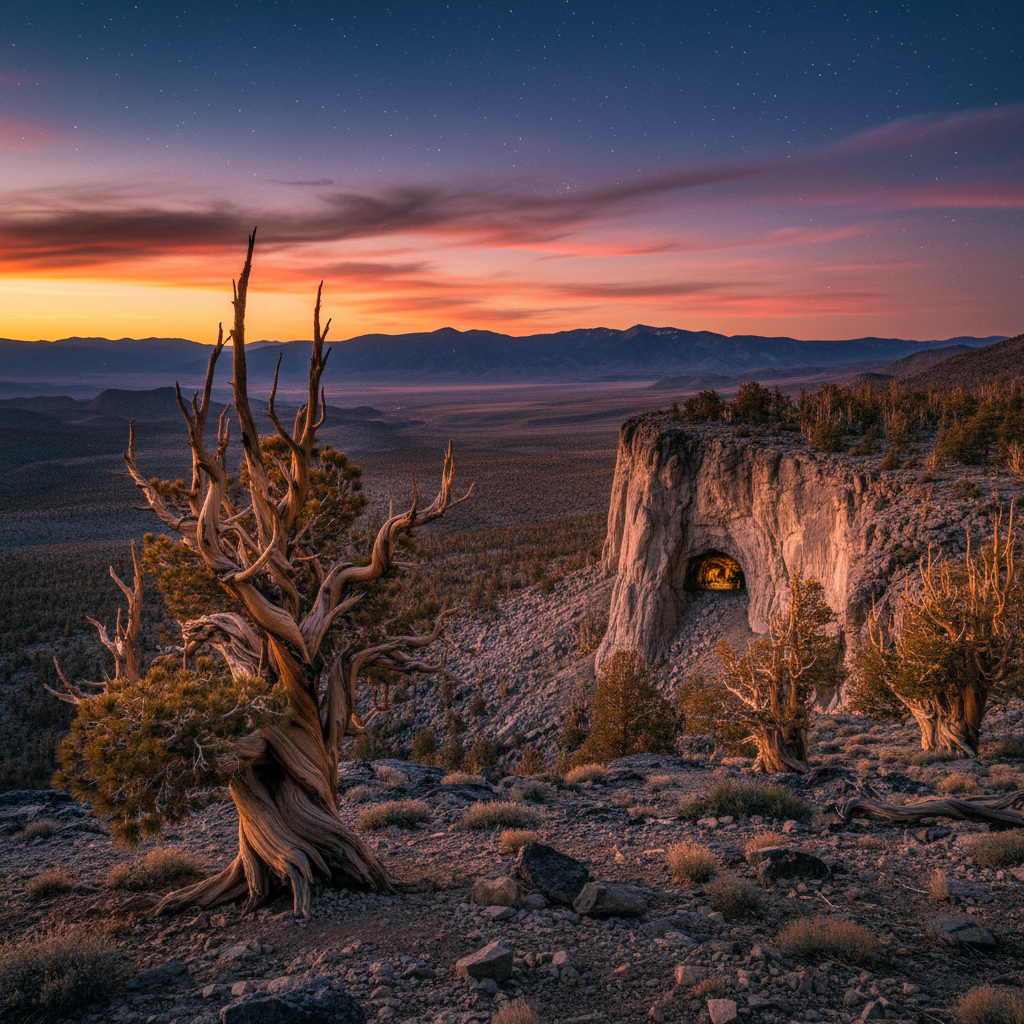
Ancient bristlecone pines, deep marble caverns, and some of the darkest night skies in the country, rising high above the Nevada desert.
Great Basin National Park rises like a massive, isolated island of granite and limestone from the sagebrush desert of eastern Nevada. Established on October 27, 1986, the park encompasses 77,180 acres of the southern Snake Range, dominated by the 13,063-foot Wheeler Peak, the second-tallest mountain in the state. This dramatic topography creates a series of stacked ecosystems, where the dry desert floor transitions rapidly into pinyon-juniper woodlands, mountain mahogany groves, and eventually cold alpine meadows. The park is famous for its extreme elevation gradient, spanning over 6,200 vertical feet between its lowest trails and its highest summits. It protects the southernmost permanent glacier in the United States, Lehman Rock Glacier, which sits in a high cirque beneath Wheeler Peak, a remnant of the massive ice sheets that carved these canyons 10,000 years ago.
Beneath the surface, the park contains a complex subterranean world, most notably Lehman Caves. Discovered in the 1880s by rancher Absalom Lehman, this marble cavern extends for over two miles and is filled with a dense concentration of rare geological features, including delicate helictites, flowstone, and more than 300 rare shield formations like the famous Parachute Shield. Currently, the cave system is undergoing a major 5.8-million-dollar electrical upgrade to replace its decades-old wiring with modern, low-impact lighting. While the full Grand Palace and Lodge Room tours are paused during this construction, the park has introduced special 30-minute Gothic Palace Lantern Tours, allowing visitors to explore the majestic Gothic Palace and Rose Trellis Room by the flicker of hand-held rechargeable lanterns. This sensitive work, funded by the Southern Nevada Public Land Management Act, aims to protect the cave's fragile ecosystem, which is home to unique endemic species such as the tiny Great Basin pseudoscorpion.
High above the subterranean caverns, on the wind-swept ridges of Wheeler Peak, grow the park's most venerable residents: the Great Basin bristlecone pines (Pinus longaeva). These ancient, slow-growing conifers thrive in the harsh, cold conditions near the tree line, surviving for thousands of years by twisting into highly polished, sculptural forms of dense, resinous wood. Some trees in the Wheeler Peak grove are nearly 5,000 years old, having witnessed millennia of changing climates. The park was once home to the Prometheus tree, which was determined to be at least 4,862 years old when it was cut down for research in 1964. Today, visitors can hike the Bristlecone Trail to stand in the presence of these living elders. As day turns to night, the park reveals another of its defining features: its designation as an International Dark Sky Park. Because of its extreme remoteness, far from any major metropolitan area, the night skies here are among the darkest in the contiguous United States, offering a clear, textured view of the Milky Way that stretches from horizon to horizon.
Due to a major electrical upgrade, Lehman Caves tours are currently limited to the 30-minute Gothic Palace Lantern Tour, which must be reserved up to 30 days in advance on Recreation.gov. If you plan to hike the Wheeler Peak trails, remember that the trailhead sits above 9,800 feet, so spend your first day at lower elevations to help acclimate.