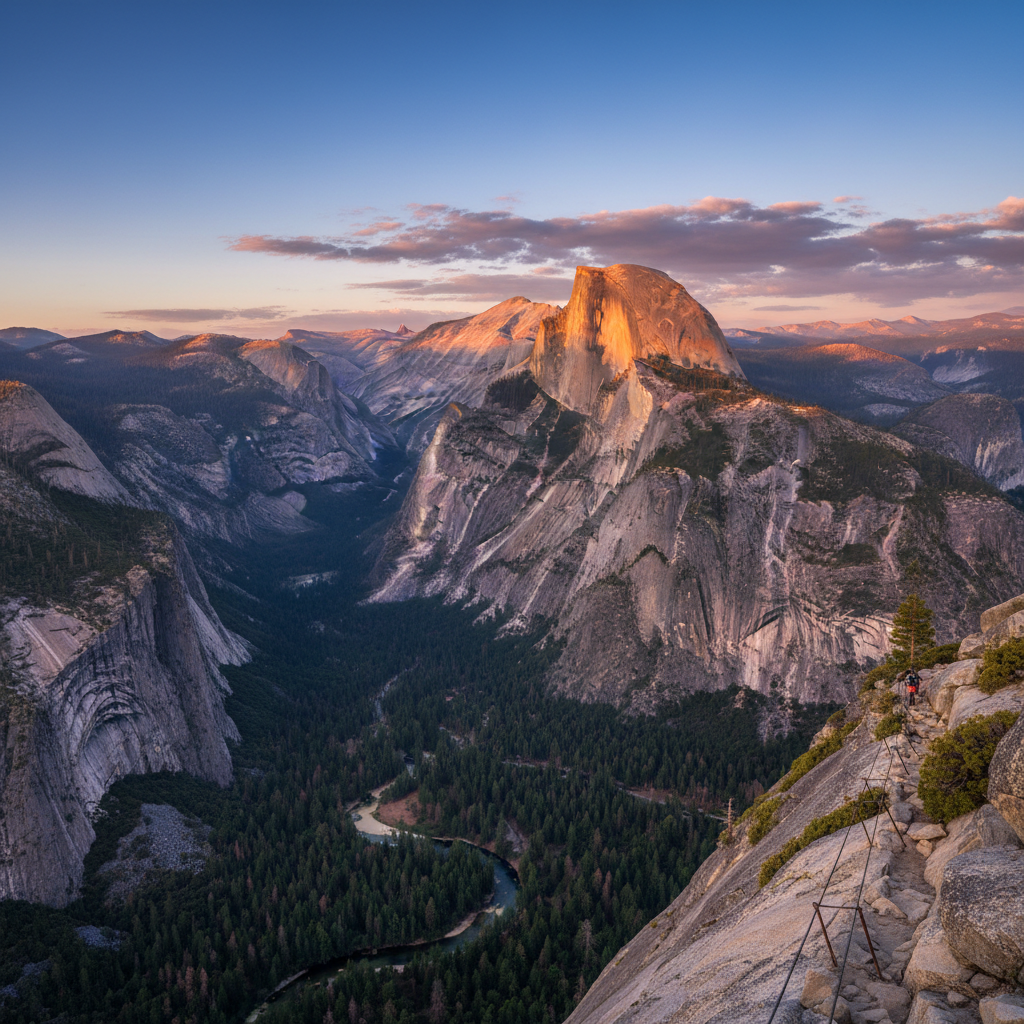
Yosemite Valley's iconic granite monolith, reached via a challenging 14-mile hike and a famous cable route.
Half Dome, known as *Tis-sa-ack* (Cleft Rock) to the Ahwahnechee people, rises 4,737 feet above the floor of Yosemite Valley, reaching an absolute elevation of 8,844 feet above sea level. This massive quartz monzonite batholith dominates the eastern end of the valley, a sheer northwest face paired with three rounded, smooth sides that create the illusion of a colossal dome sliced cleanly in half. The rock itself is a Cretaceous-era intrusion, part of the Sierra Nevada batholith that solidified several miles beneath the Earth's surface approximately 93 million years ago. Over millennia, the pressure of overlying rock was released as the surface eroded, causing the granite to peel away in concentric layers, a process known as exfoliation, while Pleistocene glaciers polished its curves. Today, the sheer face catches the shifting light of the Sierra, glowing deep orange and gold at sunset, while its summit remains one of the most recognizable geological profiles in North America.
For decades, early surveyors declared the summit of Half Dome completely inaccessible to human feet. That narrative changed on October 12, 1875, when a Scottish-born Yosemite resident and blacksmith named George Anderson completed the first documented ascent. Anderson worked barefoot and used pine pitch on his feet to grip the slick, 45-degree granite slope on the dome's eastern flank. When traction failed, he painstakingly hand-drilled holes six inches deep into the rock, driving in iron eyebolts he had forged himself, and threaded a rope through them to pull himself up. Only weeks later, Sally Dutcher became the first woman to reach the summit using Anderson's rope route. In 1919, the Sierra Club built upon Anderson's original path by installing the first iteration of the modern cable route, using double steel cables and metal posts to allow hikers to ascend the final 400 feet of polished granite without technical climbing gear.
Reaching the summit of Half Dome today is a grueling 14- to 16-mile round-trip journey that demands nearly 4,800 feet of elevation gain, typically starting from the Happy Isles trailhead before dawn. Hikers ascend past the mist of Vernal and Nevada Falls, climbing through the pines of Little Yosemite Valley before tackling the steep, switchbacking steps of the Subdome. The climax of the trek is the final cable route, where hikers pull themselves hand over hand up the 45-degree granite slope, relying on wooden planks placed as footholds along the steel lines. The cables are typically raised from late May (usually Memorial Day weekend) through mid-October (Columbus Day weekend), and a strict permit lottery system regulates access to prevent dangerous crowding on the rock. At the top, a flat, windswept summit plateau about the size of seventeen football fields offers a panoramic view of Clouds Rest, the High Sierra peaks, and the miniature valley floor far below, a reward that has remained unchanged since Anderson first stood here.
Apply for the preseason permit lottery in March, or try the daily lottery two days before your planned hike. Sturdy leather or rubber-grip gloves are essential for handling the steel cables, and carrying a water filter allows you to refill at the Merced River in Little Yosemite Valley, saving you from packing heavy weight on the grueling lower switchbacks.