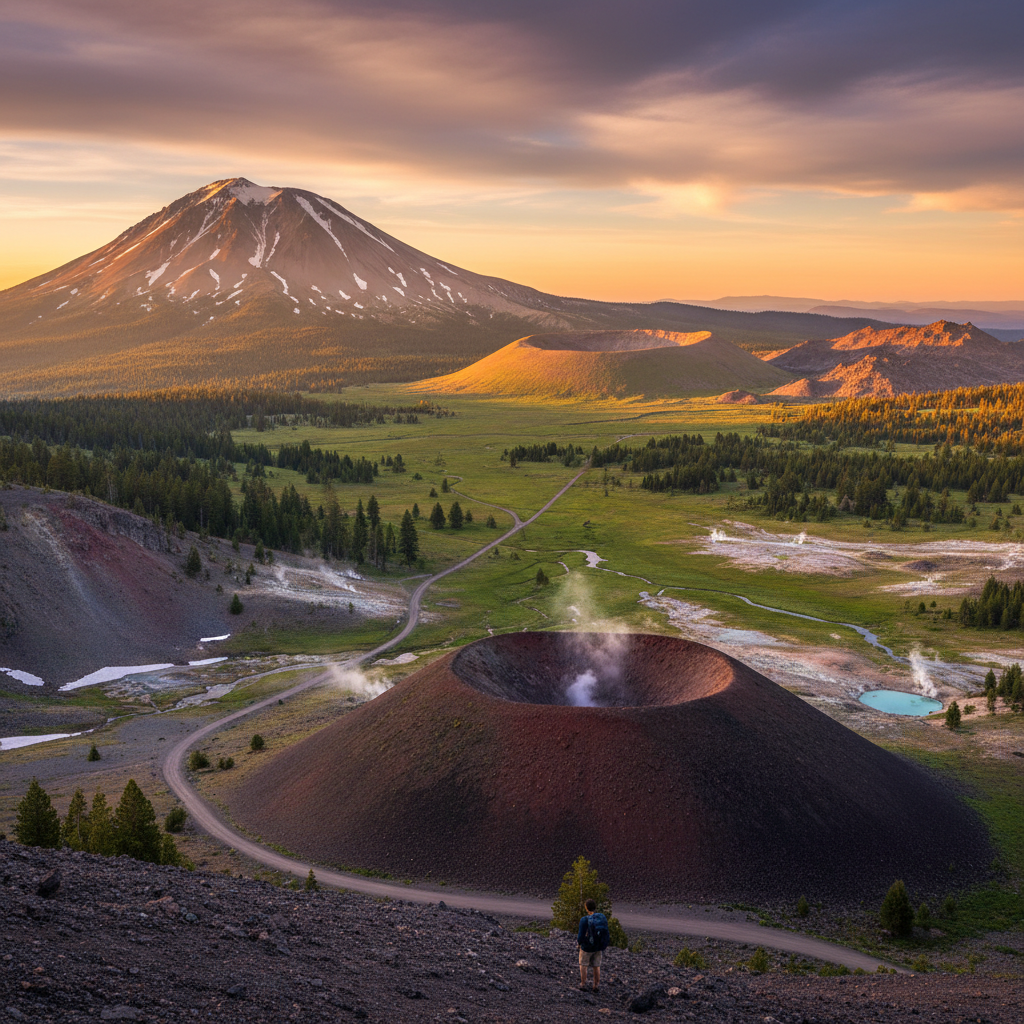
All four volcano types coexist in this active geothermal landscape of boiling mud pots, steaming fumaroles, and resilient volcanic peaks.
Lassen Volcanic National Park preserves a restless, steaming landscape at the southern terminus of the Cascade Range, where the earth's molten interior remains remarkably close to the surface. The park's defining feature is Lassen Peak, known to the Mountain Maidu as Kohm Yah-mah-nee, meaning "Snow Mountain". This massive plug dome volcano is the center of a highly active geothermal system that fills the mountain air with the sharp, earthy scent of sulfur. Throughout the park's hydrothermal basins, boiling mud pots gurgle, steam vents hiss, and thermal springs paint the surrounding clay in vivid shades of yellow, red, and orange. This is not a static monument to ancient history, but a dynamic environment shaped by ongoing geological forces and the ancestral lands of the Atsugewi, Yana, Yahi, and Mountain Maidu peoples.
The park is one of the few places on Earth where all four primary volcano types can be found in close proximity: shield, cinder cone, composite, and plug dome. Lassen Peak itself erupted violently between 1914 and 1921, a series of blasts that devastated the surrounding forest, sent ash plumes miles into the atmosphere, and created the stark landscape known today as the Devastated Area. Further east, the symmetrical gravel slopes of Cinder Cone rise above the Fantastic Lava Beds and the Painted Dunes, where oxidized volcanic ash has created a surreal, multi-colored desert of red and orange pumice. In the park's southern reaches, Sulphur Works and Bumpass Hell showcase the raw power of the hydrothermal system, where visitors can walk along boardwalks suspended just feet above boiling pools and roaring fumaroles.
In recent years, the park has entered a new chapter of ecological transformation following the 2021 Dixie Fire, which swept through nearly seventy percent of the park's footprint. While the high-severity burn altered the dense forests of red fir and lodgepole pine, especially in the eastern and southern sectors, the west side of the park highway remained largely untouched. Today, scientific research and park monitoring show a landscape in active recovery, with green shoots, wildflowers, and pine seedlings emerging from the blackened soil, creating a striking mosaic of destruction and rebirth. Hiking the steep trail to the summit of Lassen Peak or exploring the quiet waters of Manzanita Lake offers a firsthand look at how both fire and volcanic activity continuously reshape this wild corner of California.
Check the park's trail status before arriving, as post-fire restoration and heavy winter snowpacks can delay trail openings. For an iconic day, hike the Bumpass Hell boardwalk to see the turquoise boiling pools, then head north to Manzanita Lake for a late-afternoon paddle with a clear view of Lassen Peak reflected in the water.