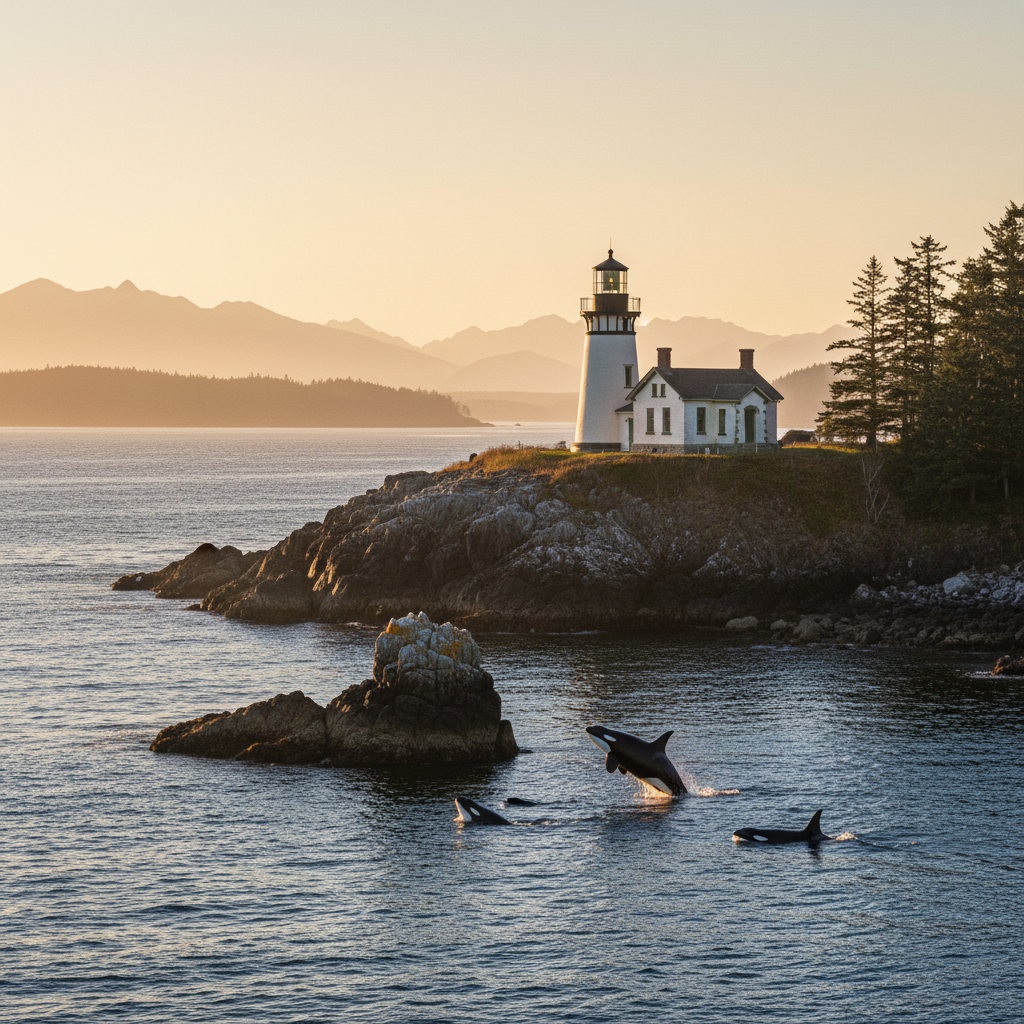
A historic lighthouse and restored 19th-century lime kiln on San Juan Island, renowned as one of the world's premier land-based whale-watching destinations.
Lime Kiln Point State Park occupies a dramatic, 42-acre rocky bluff on the western shore of San Juan Island, overlooking the deep waters of Haro Strait. Long before it became a park, these waters and shorelines served as the traditional territories of Coast Salish Indigenous peoples, including the Lummi, Samish, Swinomish, and Suquamish, who relied on the rich marine life of the strait. Dedicated in 1985 as the first park in the United States specifically set aside for land-based whale watching, this day-use destination is defined by its unique underwater topography. Just 25 feet from the shoreline's glacially smoothed rocks, the seafloor drops precipitously to a depth of nearly 960 feet. This steep bathymetric drop-off creates a natural funnel, allowing marine mammals to swim remarkably close to the shore. Visitors sitting on the volcanic rocks can often watch orcas, minke whales, humpbacks, and harbor porpoises passing by just 20 feet away as they forage for migrating Chinook salmon.
At the heart of the park stands the historic Lime Kiln Light Station, a functional maritime beacon that has stood watch over Haro Strait since the early 20th century. First established as a basic light in 1914, the current octagonal concrete tower and keeper's quarters were completed in 1919. The lighthouse was the last major beacon in Washington State to be electrified, operating with a kerosene lamp and a fourth-order Fresnel lens until the early 1960s. Today, the whitewashed tower with its classic red roof is listed on the National Register of Historic Places, serving both as an active Coast Guard aid to navigation and a vital shore-based marine research laboratory. In partnership with the Whale Museum in Friday Harbor, researchers use the lighthouse to conduct acoustic and behavioral studies on the endangered Southern Resident killer whales (the J, K, and L pods) and transient orcas. An underwater hydrophone array, part of the SeaSound Remote Sensing Network, captures the clicks, whistles, and calls of passing pods, which are often broadcast live to visitors at the park's interpretive center.
The park's name preserves a different, noisier era of San Juan Island history. Beginning in 1860, the San Juan Lime Company, originally founded by Lyman Cutlar, began quarrying the abundant limestone deposits found in the local bedrock. For decades, workers heated the quarried stone in massive wood-fired kilns to produce quicklime, a key ingredient in mortar and cement, which was then shipped to growing cities along the Pacific Coast. This industrial operation continued until the mid-1930s, leaving behind a scarred landscape that has since been reclaimed by nature. Today, a short, quarter-mile trail leads north from the lighthouse to a beautifully restored 19th-century lime kiln, complete with interpretive panels detailing the lives of the historic lime workers. Beyond this industrial relic, the park's 1.8 miles of hiking trails wind through upland forests of Douglas fir and peeling, red-barked Pacific madrone trees. The shoreline trails lead to quiet viewpoints like the Karen Munro Outlook, where visitors can scan the water for harbor seals, Steller sea lions, and bald eagles. Every June on the Saturday closest to the summer solstice, the park hosts OrcaSing, a beloved local tradition where a choir performs on the cliffs, hoping to serenade the passing pods as they migrate through the strait.
Check the local Orca Network or Whale Museum sightings map before visiting, and bring a warm windbreaker. Even on warm summer afternoons, the marine breeze blowing off the deep waters of Haro Strait can be remarkably chilly.