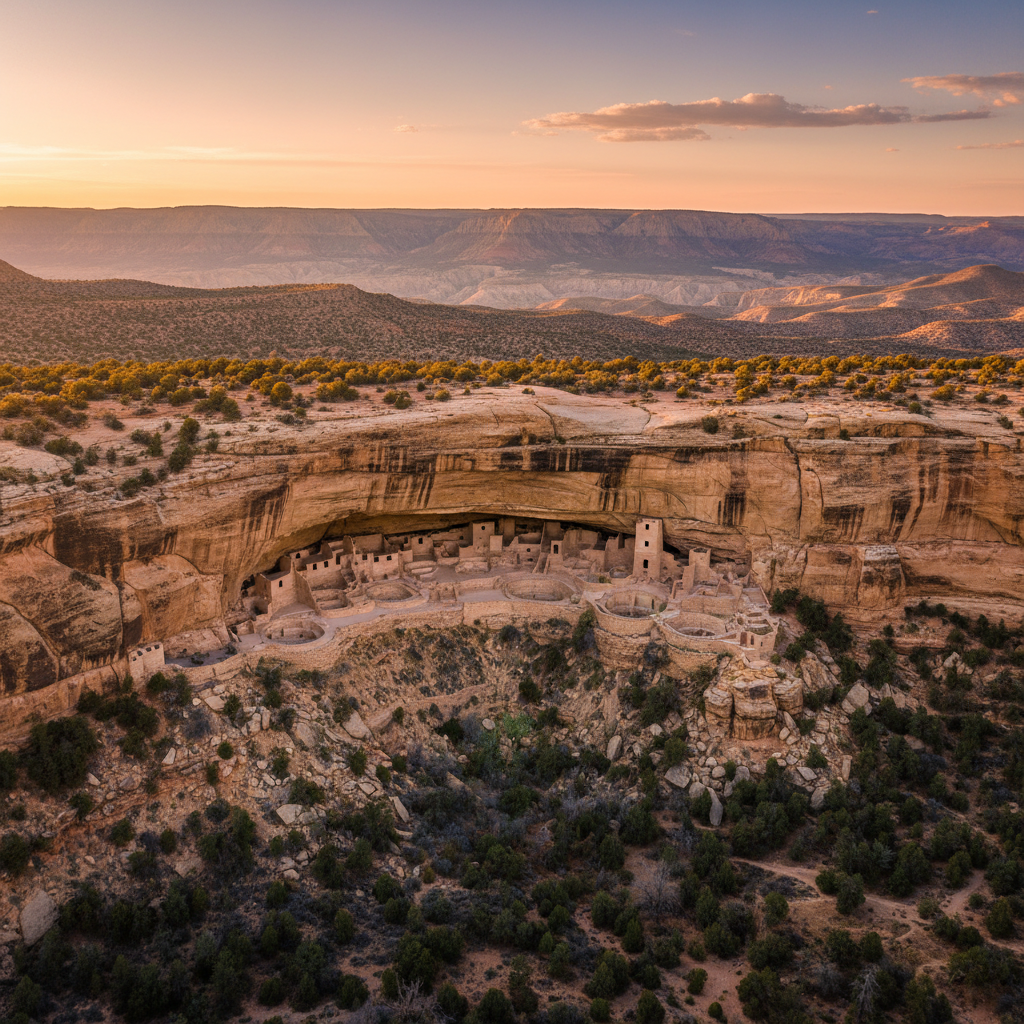
Six hundred ancient cliff dwellings carved into sandstone alcoves, preserving the legendary stone cities of the Ancestral Pueblo people.
Mesa Verde National Park preserves more than five thousand archaeological sites, including six hundred ancient cliff dwellings, across more than fifty-two thousand acres of southwestern Colorado high desert. Established in 1906 by President Theodore Roosevelt, this protected landscape is the largest archaeological preserve in the United States and the only cultural UNESCO World Heritage Site in Colorado. The park centers on a massive sandstone plateau dissected by steep canyons, where Ancestral Pueblo people constructed elaborate stone villages within natural alcoves. These dwellings, built primarily from hand-cut sandstone blocks, wooden beams, and adobe mortar, represent some of the most sophisticated pre-Columbian architecture in North America. The sheer ingenuity of these structures, built into the Cliff House Sandstone formation, showcases a profound understanding of local geology, solar angles, and structural engineering.
The human history of Mesa Verde spans over seven centuries, beginning around AD 600 when Ancestral Puebloans, the ancestors of modern Pueblo tribes including the Hopi, Zuni, and Rio Grande Pueblos, lived in subterranean pithouses on the sun-baked mesa tops. Over generations, their architecture evolved into multi-room masonry pueblos as they cultivated corn, beans, and squash on the fertile plateau. By the late 1190s, a dramatic social and architectural shift occurred, prompting the population to relocate their homes from the mesa tops into the deep alcoves of the canyon walls. In these sheltered spaces, they constructed legendary sites like Cliff Palace, a sprawling complex containing one hundred and fifty rooms and twenty-one kivas, which served as the social and ceremonial heart of the community. Other significant structures, such as Balcony House with its defensible tunnels and Spruce Tree House with its remarkably intact roofs, demonstrate how these communities adapted to changing environmental and social pressures before eventually migrating south to modern-day Arizona and New Mexico around 1300.
Exploring the park today requires navigating the dramatic topography of Chapin Mesa and Wetherill Mesa, where modern visitors can witness these ancient structures from spectacular rim overlooks or descend directly into the alcoves. Ranger-guided tours, which are required to enter the dwellings, offer an immersive experience that involves climbing wooden ladders, squeezing through narrow stone passages, and standing within the cool shadows of prehistoric rooms. The Mesa Top Loop Road provides a chronological self-guided tour of the park's architectural evolution, leading past early pithouses to views of Square Tower House and the enigmatic Sun Temple. On the quieter Wetherill Mesa, accessible during the summer season, visitors can explore Long House, the second-largest cliff dwelling in the park, or walk the quiet trails of Step House, where a pithouse and a cliff dwelling coexist in the same alcove. As the afternoon light deepens, casting long shadows across the sandstone canyons, the enduring masonry of Mesa Verde stands as a silent, powerful testament to a vibrant society that thrived in this rugged landscape for hundreds of years.
Ranger-led tour tickets for Cliff Palace, Balcony House, and Square Tower House must be booked online at Recreation.gov exactly 14 days in advance starting at 8:00 AM MDT, while Wetherill Mesa tours like Long House open 7 days in advance. To avoid the crowds and experience a unique self-guided cliff dwelling without a reservation, head to Step House on Wetherill Mesa where a ranger is stationed to answer questions.