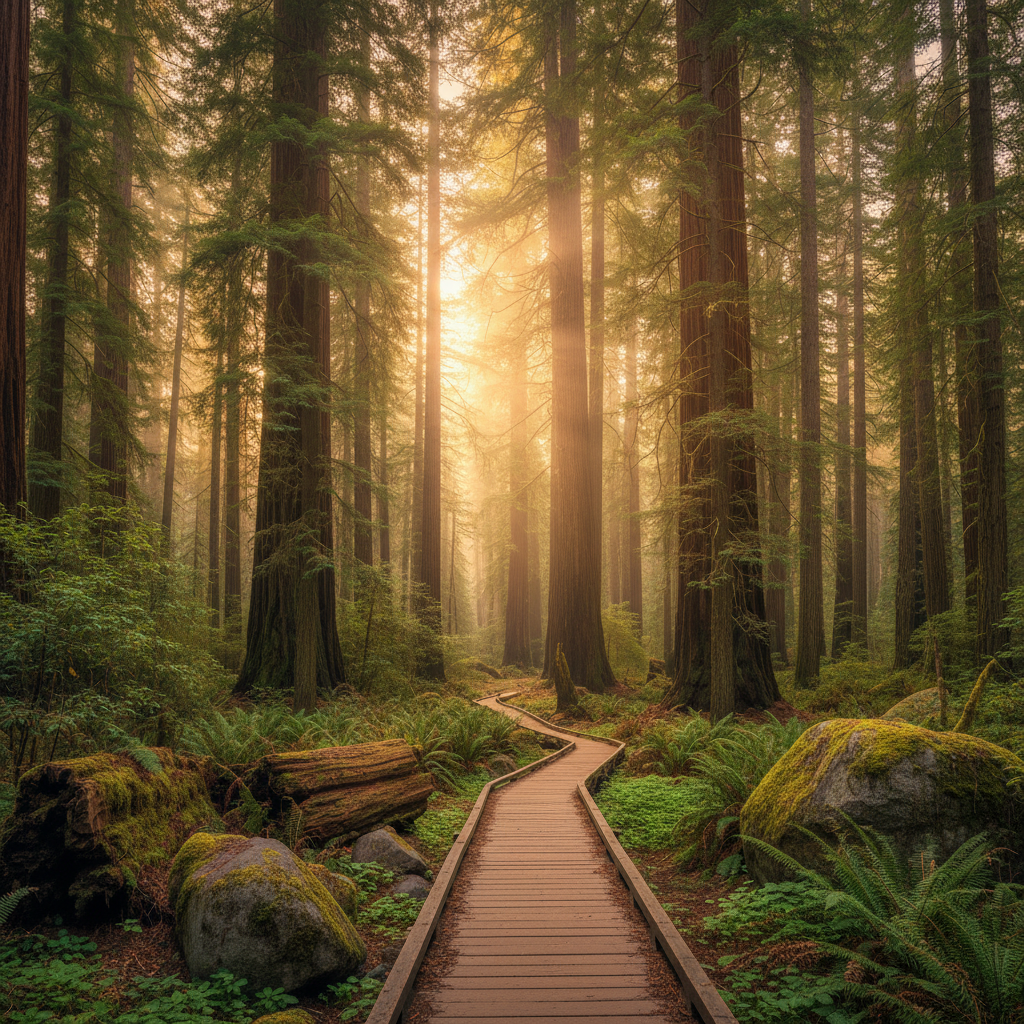
Ancient coast redwood forest just north of the Golden Gate. Cathedral groves where fog drips from 250-foot giants and silence swallows your footsteps.
Muir Woods National Monument preserves one of the last remaining old-growth coast redwood (Sequoia sempervirens) forests in the San Francisco Bay Area, a sanctuary where ancient giants rise from a deep, fog-cooled canyon. Long before the arrival of Spanish settlers and American loggers, the Coast Miwok people cared for this watershed, which drains into the Pacific at nearby Muir Beach. The microclimate here is defined by a dramatic temperature drop as the coastal marine layer rolls in from the ocean. This persistent summer fog is vital to the survival of the redwoods: it condenses on their high needles and drips to the forest floor, providing up to half of the trees' annual water supply during the dry season. Walking along the shaded floor of Redwood Canyon, visitors are surrounded by trees that average between 500 and 800 years old, with the oldest specimens having stood for more than 1,200 years. The tallest tree in the monument reaches 258 feet, rising from a root system that, while only ten to thirteen feet deep, spreads up to one hundred feet wide to interlace with neighboring trees for mutual support.
The preservation of this old-growth grove is the result of a fierce conservation battle at the turn of the twentieth century. By the early 1900s, intensive logging had decimated nearly all of the Bay Area's redwood forests, and the North Coast Water Company planned to dam Redwood Canyon to create a domestic water reservoir. To thwart this development, local conservationist and future congressman William Kent, along with his wife Elizabeth Thacher Kent, purchased 611 acres of the canyon in 1905 for $45,000. To permanently protect the forest from the water company's eminent domain lawsuits, Kent donated 295 acres of the land directly to the federal government. On January 9, 1908, President Theodore Roosevelt declared the site a national monument. At Kent's request, the park was named in honor of naturalist John Muir, whose writings had galvanized the early American conservation movement. Today, the park's history is presented with modern complexity, acknowledging both Kent's preservation achievements and his later support for exclusionary, anti-immigrant legislation.
Exploring the monument today centers around a network of well-maintained trails that showcase the canyon's distinct ecological zones. The main corridor is the Redwood Creek Trail, a flat, accessible boardwalk loop that winds through Cathedral Grove and Bohemian Grove, crossing over Redwood Creek on rustic wooden bridges. This creek serves as a critical spawning habitat for federally threatened coho salmon and steelhead trout, which rely on the cool, shaded waters and fallen logs. Under the towering canopy, a lush understory of giant sword ferns, delicate redwood sorrel, and seasonal blooms like the fetid adder's tongue thrives in the perpetual shade. For those seeking to escape the crowds on the valley floor, steeper trails climb the canyon walls. The Canopy View Trail and the Ben Johnson Trail ascend through stands of Douglas fir, tanoak, and California bay laurel, eventually connecting with the historic Dipsea Trail. Climbing these quiet switchbacks offers a dramatic shift in perspective, looking down onto the dense, dark canopy before descending back into the quiet of the canyon floor.
Reservations for both parking and the park shuttle are mandatory and fill up weeks in advance, so book online as soon as you know your dates. To find some solitude, take any of the trails that climb the canyon walls; most visitors stick to the flat loop at the bottom.