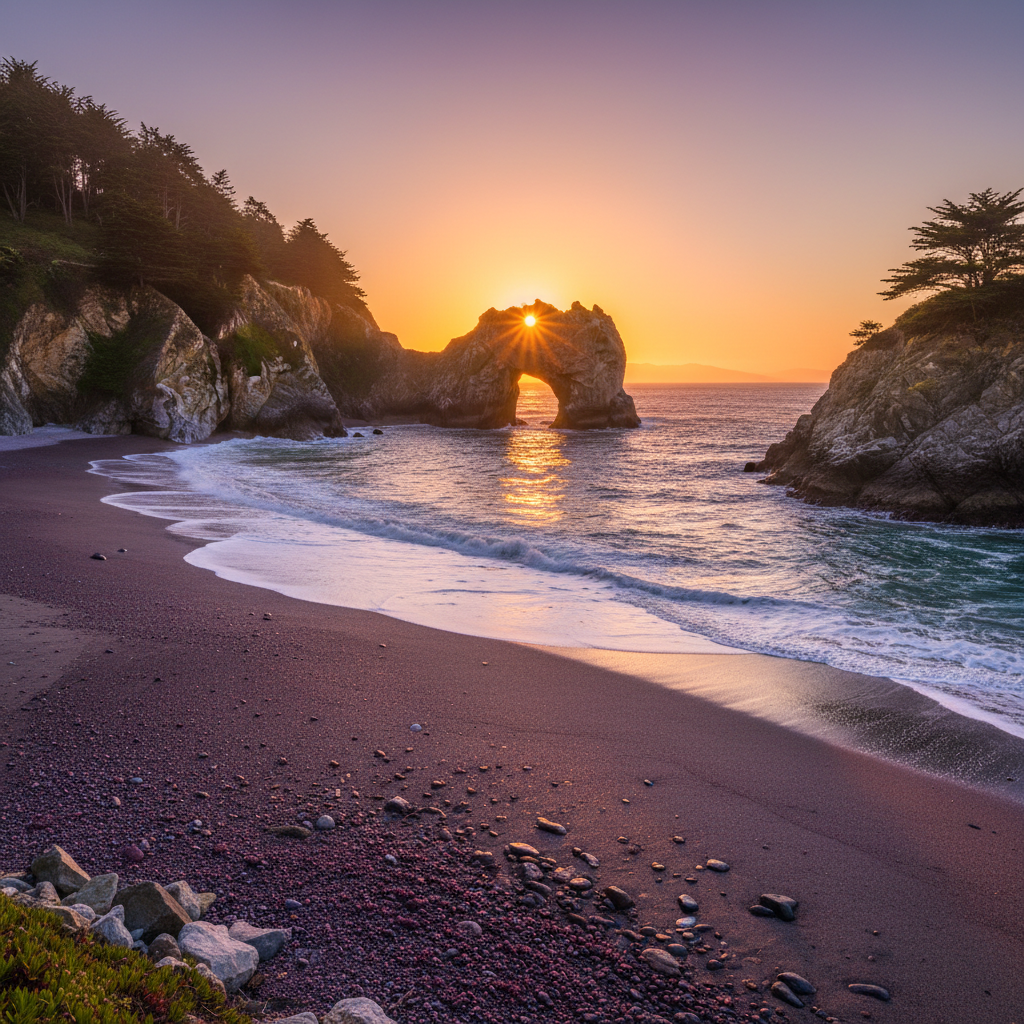
A rugged Big Sur beach famous for its purple spessartine garnet sands and the wave-carved Keyhole Arch.
Pfeiffer Beach is a rugged, crescent-shaped expanse of the Big Sur coastline defined by its unusual geology and dramatic offshore rock formations. Located within the Monterey Ranger District of the Los Padres National Forest, this day-use area is famously characterized by patches of deep violet and magenta sand. The coloration is not uniform across the entire beach, but rather appears in shifting, swirling patterns, particularly concentrated near the mouth of Sycamore Canyon Creek and along the northern cliffs. This phenomenon is caused by the erosion of spessartine garnet, a dense, manganese-rich mineral embedded in the surrounding hillsides. As winter storms and rain runoff wash these heavy garnet crystals down the slopes, the ocean waves sort them by density, leaving concentrated purple bands that contrast sharply with the lighter quartz sand.
The defining architectural feature of the beach is Keyhole Arch, a massive, wave-sculpted sea stack standing just offshore. For most of the year, the arch is a dramatic focal point for crashing waves and swirling sea foam. However, during a brief window surrounding the winter solstice, from mid-November through January, the setting sun aligns precisely with the natural opening. Under clear skies, this alignment produces a concentrated beam of amber light that pierces through the arch, illuminating the misty surf and wet sand in a dramatic, fiery glow. Because the beach is managed by the Parks Management Company under a concession agreement with the U.S. Forest Service, standard federal passes like the America the Beautiful interagency pass are not accepted for entry. A fifteen-dollar day-use fee is required at the entry kiosk, and cash is preferred, though credit cards are accepted with a small convenience fee.
Accessing the beach requires navigating Sycamore Canyon Road, a narrow, winding, single-lane road with turnouts that descends for over two miles from Highway 1. Due to the road's tight turns and narrow bottlenecks, recreational vehicles, trailers, and buses are strictly prohibited, and pedestrian traffic along the road is banned by the Forest Service for safety. The parking lot at the end of the road accommodates only sixty-five vehicles, meaning that staff will turn drivers away once the lot is full, a frequent occurrence on summer weekends and during the winter solstice light show. Visitors who secure a spot will find a short, tree-shaded path leading directly to the sand, where the cool, windswept air and powerful shorebreak offer a sensory immersion into Big Sur's raw coastal environment. Exploring the northern end reveals intricate tide pools filled with sea anemones, crabs, and purple sea urchins, though swimming is highly discouraged due to hazardous rip currents and frigid waters.
To witness the sun shining directly through Keyhole Arch, plan your visit for late afternoon between mid-December and January. Arrive early in the day because the sixty-five-car parking lot fills quickly, and note that federal lands passes are not accepted for the fifteen-dollar day-use fee.