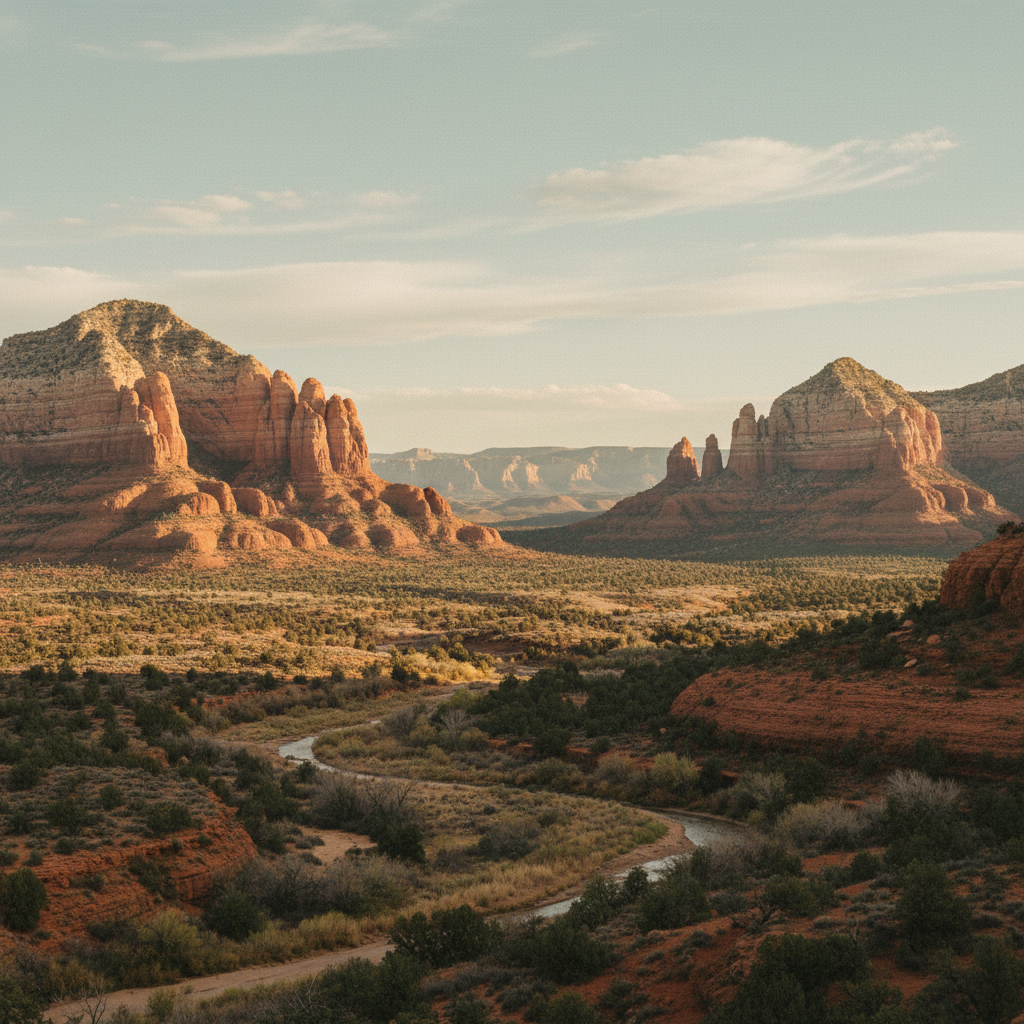
A 286-acre nature preserve near Sedona protecting a lush riparian corridor along Oak Creek beneath towering red sandstone cliffs.
Red Rock State Park spans 286 acres of high-desert and riparian terrain along the lower reaches of Oak Creek, southwest of Sedona. Unlike the dry, exposed sandstone formations that dominate the surrounding landscape, this protected nature preserve centers on a 1.4-mile stretch of flowing water. The contrast between the deep vermilion cliffs of the Schnebly Hill Formation, composed of 280-million-year-old oxidized coastal dunes, and the lush green canopy of the creek corridor defines the visual character of the park. Beneath the shade of Fremont cottonwoods, Arizona sycamores, Goodding's willows, and velvet ash, the air remains remarkably cool and damp. This critical riparian habitat supports a high density of desert wildlife, including mule deer, javelina, bobcats, and coyotes, alongside a diverse avian population. Birdwatchers regularly spot the rare Common Black Hawk nesting in the spring, as well as Lucy's warblers, yellow-breasted chats, and bridled titmice.
Human history here stretches back several millennia, beginning with the pre-Columbian Sinagua culture, who farmed and traveled through this canyon between 1100 and 1425 AD. In the modern era, the land was divided into five separate homesteads before being consolidated in 1941 by Jack Frye, the president of Trans World Airlines, and his wife Helen Varner Vanderbilt Frye. The couple established the 700-acre Smoke Trail Ranch as a private retreat from the East Coast. Between 1947 and 1950, they commissioned renowned Santa Fe architect John Gaw Meem to design the House of Apache Fires. Built from local red sandstone and timber with the help of Yavapai-Apache laborers, the 3,000-square-foot Pueblo Revival home stands on a ridge overlooking the creek. The house featured innovative touches for its time, including a rooftop patio with an outdoor fireplace and a bed suspended from the ceiling in the master bedroom. Though the interior of the house is currently closed to the public as restoration efforts continue, the exterior remains a prominent historical landmark visible from the park trails.
Exploring the park is done entirely on foot across a five-mile network of interconnected loop trails, as pets, horses, and mountain bikes are strictly prohibited to protect the fragile ecosystem. The Smoke Trail offers an easy, short walk directly along the water, while the Kisva Trail provides a longer route through the dense riparian forest. For those seeking a panoramic perspective, the Eagle's Nest Trail climbs 300 feet to the highest point in the park, offering sweeping views of the entire valley and the distant profile of Cathedral Rock. The Apache Fire Trail leads hikers directly to the ridge below the historic Frye home, passing through transition zones of pinyon-juniper woodland where Woodhouse's scrub-jays and juniper titmice flit through the branches. Daily guided nature walks led by volunteer naturalists depart from the Miller Visitor Center, which also features interpretive exhibits, a theater playing regional documentaries, and a park store.
To experience the park's dramatic transition zones, hike the Eagle's Nest Trail for a 300-foot climb to the highest overlook, then descend via the Apache Fire Trail to view the exterior of the historic 1940s House of Apache Fires. Note that pets are strictly prohibited inside this nature preserve.