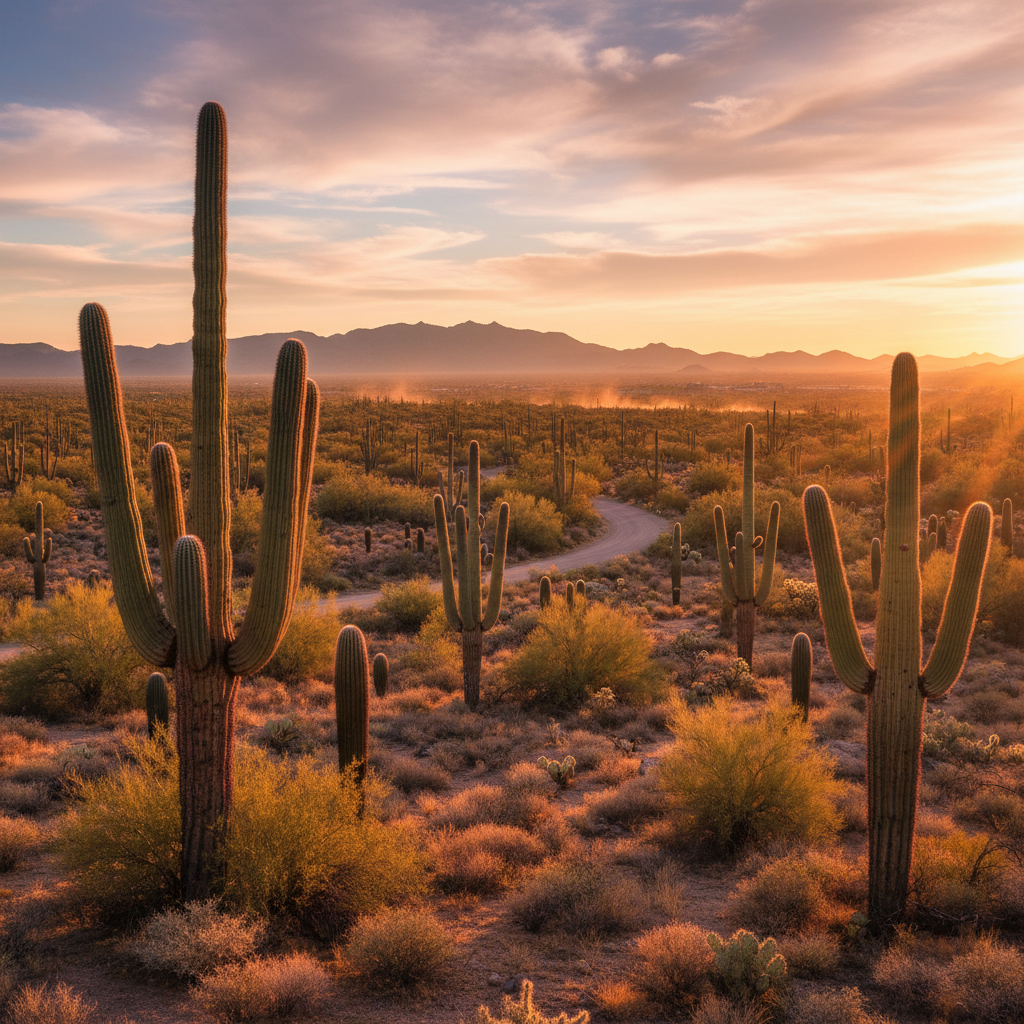
Iconic cacti forests flanking Tucson. The giant saguaro is the symbol of the American West, taking up to 75 years to sprout its first arm.
Saguaro National Park protects some of the most impressive stands of the giant saguaro cactus (Carnegiea gigantea) in the world, split across two distinct districts flanking the city of Tucson. Established as a national monument by President Herbert Hoover on March 1, 1933, and elevated to national park status on October 14, 1994, this preserve spans over 91,000 acres of the Sonoran Desert. The park is divided into Saguaro West (the Tucson Mountain District) and Saguaro East (the Rincon Mountain District), separated by about thirty miles of urban development. While both districts protect the iconic columnar cactus, they differ dramatically in geology, elevation, and ecology. The western district encompasses roughly 24,000 acres of volcanic rock and lower-elevation desert scrub, where saguaros grow in dense, dramatic concentrations across the bajadas. In contrast, the eastern district covers over 67,000 acres of metamorphic rock, rising from the desert floor to the 8,666-foot summit of Mica Mountain. This dramatic elevation gradient in the Rincons supports six distinct biotic communities, transitioning from desert scrub and semi-desert grassland to oak woodlands, pine-oak forests, and mixed conifer forests at the highest peaks.
The giant saguaro itself is a marvel of evolutionary adaptation and a keystone species of this arid landscape. As North America's largest cactus, a mature specimen can reach heights of over fifty feet, weigh up to eight tons, and live for more than one hundred and fifty years. Its growth is remarkably slow: a ten-year-old saguaro might stand only a few inches tall, and it typically takes between fifty and seventy-five years to sprout its first characteristic arm. The cactus acts as a vertical reservoir, using a shallow, radiating root system to quickly absorb rainwater, which expands the accordion-like pleats of its trunk. A single heavy rainstorm can allow a mature saguaro to soak up to two hundred gallons of water, sustaining it through months of drought. This massive plant serves as a critical desert oasis for local wildlife. Gila woodpeckers and gilded flickers excavate nesting cavities in the fleshy inner pulp, which heals into a hard, woody shell known as a saguaro boot. Once the woodpeckers abandon these cavities, they are claimed by secondary nesters like elf owls, screech owls, ash-throated flycatchers, and purple martins. For centuries, the Tohono O'odham people have maintained a deep cultural connection to the saguaro, harvesting the sweet, ruby-red fruit (bahidaj) in the heat of early summer using long poles (kuipad) fashioned from fallen saguaro ribs.
Exploring the park reveals distinct experiences on each side of the city. In the Tucson Mountain District, visitors can drive the five-mile, unpaved Bajada Loop Drive, which winds through a dense saguaro forest and provides access to several key trails. The half-mile, wheelchair-accessible Desert Discovery Nature Trail offers an easy introduction to the desert flora, while the short Signal Hill Trail leads to a rocky outcrop covered in dozens of ancient petroglyphs etched into the dark desert varnish by the Hohokam people between 450 and 1450 CE. For panoramic views of the Avra Valley, the Valley View Overlook Trail is a popular choice, especially as the late-afternoon sun casts long, dramatic shadows across the desert floor. On the eastern side, the Rincon Mountain District features the paved, eight-mile Cactus Forest Loop Drive, which offers views of the rugged mountain backdrop and access to the Mica View Trail. The eastern district is also a haven for backpackers, containing over one hundred miles of trails that climb into the high-elevation wilderness, where hikers can camp in cool pine forests that feel a world away from the desert below.
To experience the park's dual personalities, visit the western Tucson Mountain District for dense cactus forests and Hohokam petroglyphs at Signal Hill, or head to the eastern Rincon Mountain District for deep wilderness hiking. If you visit in late May or June, look for the waxy, white saguaro blossoms crowning the tips of the cacti, which open at night and are pollinated by bats and moths.