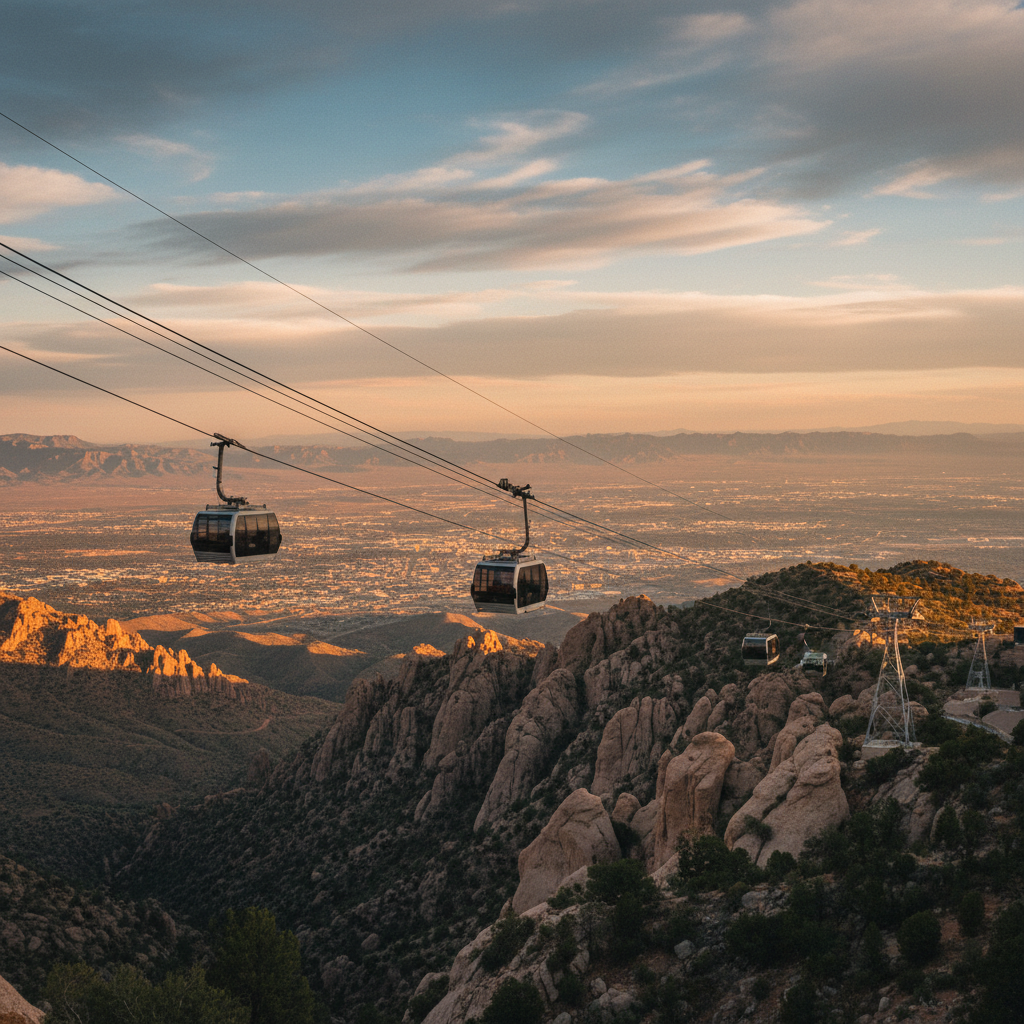
The world's third-longest single-span tramway climbs nearly four thousand vertical feet from the high desert floor to the crest of the Sandia Mountains. Below, the Rio Grande Valley and the city of Albuquerque spread out like a vast, rumpled blanket.
Sandia Peak Tramway has operated as a marvel of high-altitude engineering since its maiden voyage on May 7, 1966. Conceived by Robert Nordhaus, co-founder of the Sandia Peak Ski Company, after a trip to Switzerland, the double-reversible jigback aerial tramway was designed by Bell Engineering of Lucerne. The construction was a monumental feat, requiring more than five thousand helicopter trips to transport workers and materials up the rugged western face of the Sandia Mountains, known to the Tiwa-speaking Pueblo people as Bien Mur, or big mountain. In early 2024, the system underwent a comprehensive modernization. Engineers replaced the original 1966 DC motor with a highly efficient AC motor and installed a state-of-the-art, touchscreen-controlled drive system. This upgrade, paired with new tower-mounted camera systems to monitor cable deflection, has made the ascent smoother than ever, particularly as the cabins glide past the support towers.
The journey begins at the lower terminal, situated at an elevation of 6,559 feet, and climbs 3,819 vertical feet to the upper terminal at 10,378 feet. The tramway spans 2.7 diagonal miles, suspended by four massive steel track cables and guided by two intermediate towers. Tower Two, perched precariously on a rocky ridge at 8,750 feet, required over two thousand helicopter flights alone during its mid-1960s construction. The span between Tower Two and the summit terminal measures an astonishing 7,720 feet, ranking as the third-longest single span in the world. The Swiss-manufactured CWA cabins, introduced in 2016, carry up to fifty passengers at a steady speed of about twelve miles per hour. During the fifteen-minute flight, the high-desert terrain of scrubby arroyos and volcanic rocks drops away, replaced by dense stands of ponderosa pine and Douglas fir, while the vast expanse of the Rio Grande Valley unfolds below.
At the 10,378-foot summit, the temperature is often twenty degrees cooler than the valley floor, and the air carries the scent of alpine fir and high-altitude stone. The upper terminal serves as a gateway to both wilderness trails and elevated dining. Perched on the cliffside is Ten 3, a striking restaurant designed by Bull Stockwell Allen to mimic the limestone outcroppings of the peak. Named for its elevation of 10,300 feet, the venue features floor-to-ceiling glass windows designed to minimize glare while offering views that stretch to the Sangre de Cristo Mountains on clear days. Visitors can choose between a casual lounge experience or a refined fine-dining menu featuring regional flavors. Outside, the rocky pathways lead to the historic Kiwanis Cabin, a stone structure built by the Civilian Conservation Corps in the 1930s, or connect with the South Crest Trail for those wishing to explore deeper into the Cibola National Forest before catching the tramcar back down.
Purchase tram tickets online in advance to secure your boarding time, and plan to arrive at least forty-five minutes before any dinner reservations at Ten 3. Bring a windbreaker or light jacket, as the summit temperature is typically twenty degrees cooler than the valley floor.