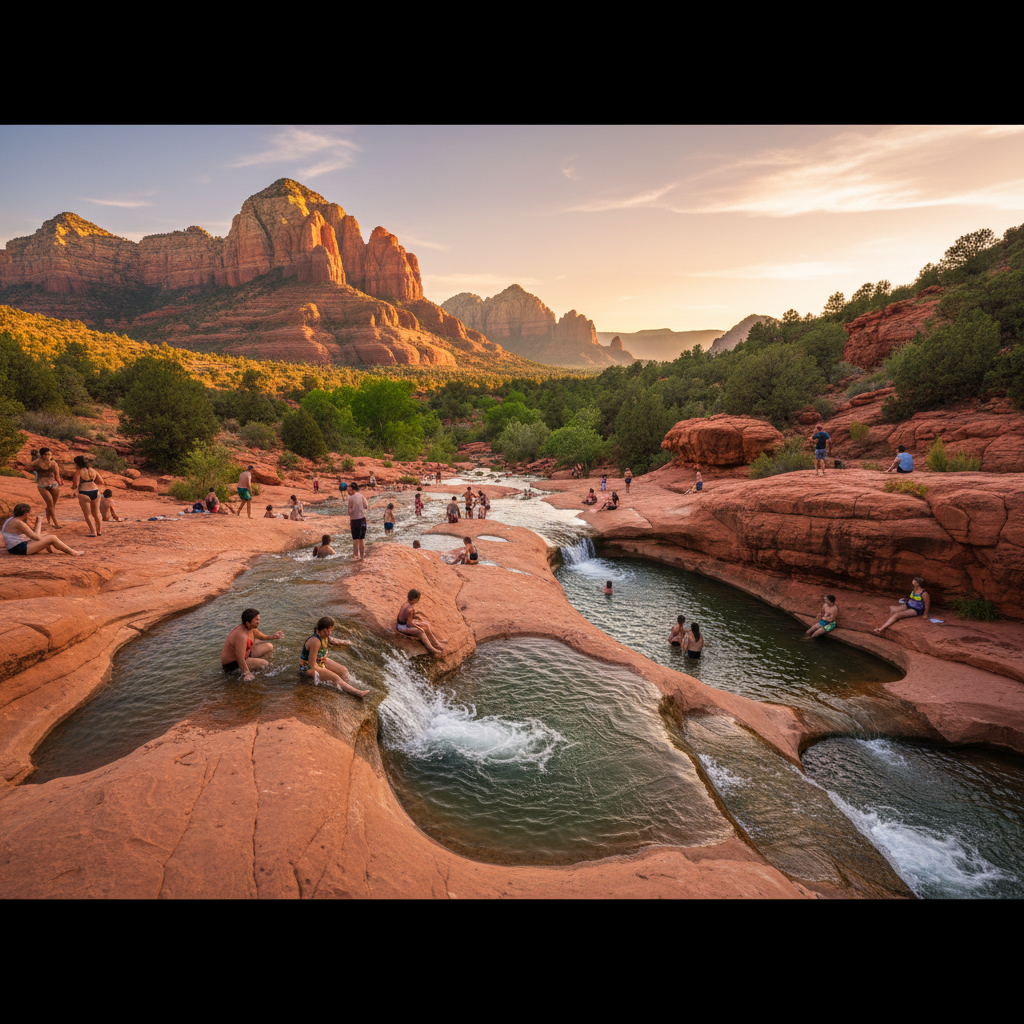
An 80-foot natural water slide carved into the rust-red Schnebly Hill sandstone of Oak Creek Canyon.
Slide Rock State Park preserves a 43-acre historic homestead and a world-famous natural water slide carved into the red sandstone of Oak Creek Canyon. The slide itself is an 80-foot-long slippery chute, roughly 2.5 to 4 feet wide, with a seven percent decline from top to bottom. It is carved into the dark red sandstone of the Permian-age Schnebly Hill Formation, a geologic layer rich in hematite that gives the region its signature rust-red color. The slickness of the slide comes from a naturally occurring, thin layer of algae coating the sandstone, which allows visitors to glide effortlessly down the stream into a deeper, churning pool of cold mountain water.
Before it was patented as a homestead, this fertile canyon bottom was part of the traditional homeland of the Wi:pukba (People from the Foot of the Red Rock), a band of the Yavapai who, alongside the Dilzhę́'é (Tonto Apache), cultivated crops and gathered wild plants along the banks of Oak Creek for generations before their forced removal in 1875. In 1907, Frank L. Pendley arrived in the canyon, formally acquiring the 43-acre property under the Homestead Act in 1910. He succeeded where other settlers had failed by engineering a gravity-fed irrigation system that is still partially in use by the park today. In 1912, Pendley planted his first apple orchard, establishing an agricultural legacy that remains a core feature of the park. To support the growing tourism industry spurred by the completion of the canyon road in 1914, Pendley built several rustic tourist cabins in 1933, which still stand today alongside vintage farming equipment. The property was purchased by the Arizona State Parks Board in 1985 and was officially dedicated as a state park in October 1987, with the Pendley Homestead Historic District added to the National Register of Historic Places in 1991.
Beyond the main slide, the park offers a half-mile stretch of Oak Creek open for wading, swimming, and sunbathing on flat, sun-warmed sandstone ledges. Tall canyon walls lined with Arizona sycamores, box elders, and ponderosa pines provide pockets of shade, while three short trails, including the Pendley Homestead Trail and the Clifftop Nature Trail, allow visitors to explore the riparian habitat. As a designated Leave No Trace Gold Standard Site, the park maintains strict rules to protect the delicate creek ecosystem, including a seasonal ban on pets in the park between May 1 and September 30. During the peak summer season, the park operates as a vibrant, high-energy swimming hole, drawing hundreds of thousands of visitors annually who come to experience the contrast of the hot Arizona sun and the bracingly cold creek water.
Arrive at least 30 minutes before the gates open at 8:00 a.m. during summer weekends, as the vehicle-only queue forms early and the lot often fills to capacity by mid-morning. Pack sturdy water shoes with excellent rubber grip: the algae coating the sandstone slide is incredibly slick, and bare feet or cheap flip-flops will lead to bruises. Note that pets are strictly prohibited in the water and are completely banned from the park during the peak season from May 1 to September 30.