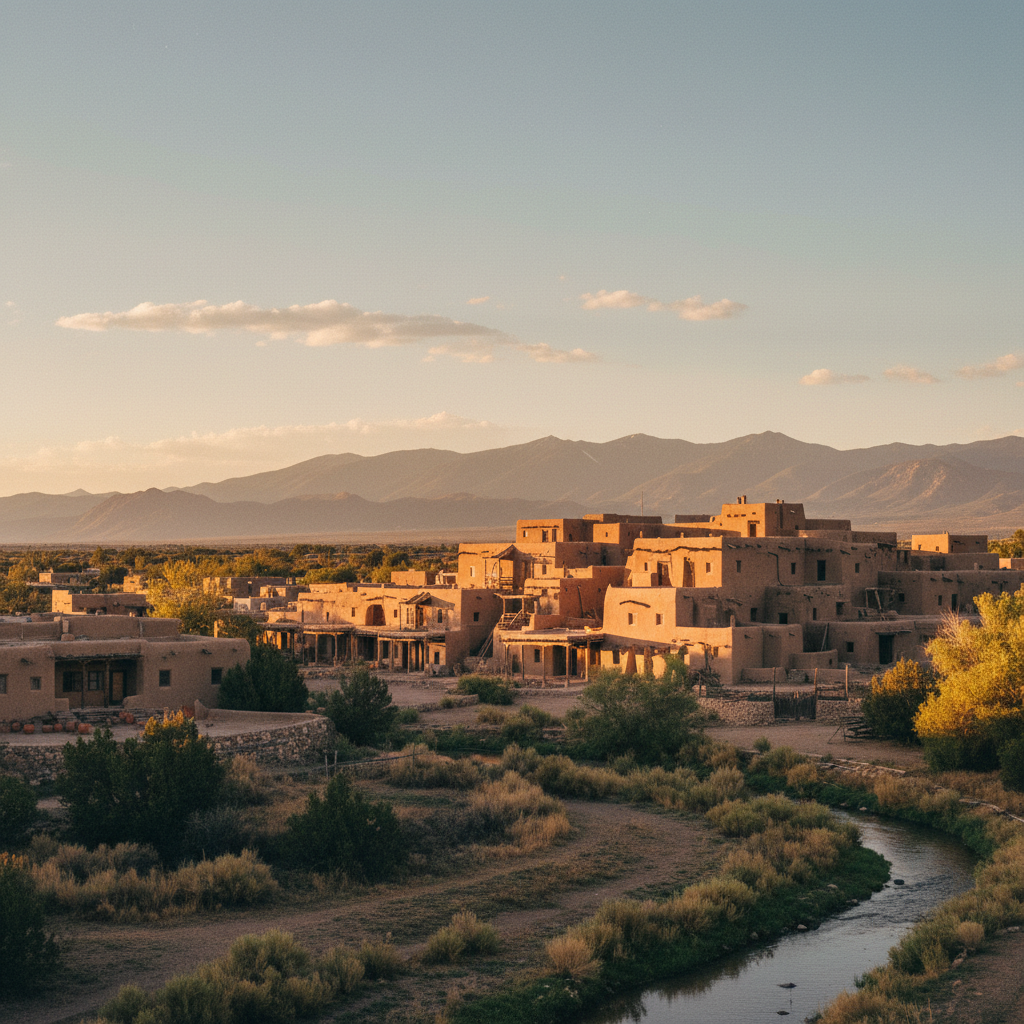
The scent of piñon smoke clings to thousand-year-old adobe walls at Taos Pueblo, the oldest continuously inhabited community in the United States.
Taos Pueblo stands as the only living Native American community designated as both a UNESCO World Heritage Site and a National Historic Landmark. Situated at the base of the Sangre de Cristo Mountains in northern New Mexico, this remarkable adobe village has been continuously inhabited by the Taos people for over a millennium. The heart of the pueblo consists of two monumental multi-story structural complexes: Hlauuma (the North House) and Hlaukwima (the South House). These buildings, constructed primarily between 1000 and 1450 C.E., are made entirely of sun-dried adobe bricks, a mixture of local earth, straw, and water. The thick walls, which can measure several feet deep at their base, are supported by heavy wooden vigas hauled down from the mountain forests, topped with aspen latillas and packed earth. Every year, community members replaster the exterior walls with a fresh layer of local mud to protect the structures from winter snows and summer rains.
The Rio Pueblo de Taos, historically known as Red Willow Creek, divides the village into northern and southern halves. This clean, mountain-fed waterway flows directly from Blue Lake, a deeply sacred site located high in the mountains within the tribe's 100,000-acre reservation. Because the creek serves as the community's sole source of drinking water, visitors are strictly forbidden from wading in it or polluting it in any way. Traditional life here persists without modern utilities; there is no running water, electricity, or indoor plumbing within the historic walled village. Instead, residents cook and bake using outdoor hornos, the dome-shaped adobe ovens that dot the plazas, and heat their homes with wood-burning fireplaces that fill the air with the sweet scent of piñon smoke. Visitors can purchase traditional fry bread, micaceous clay pottery, and hand-crafted silver jewelry directly from tribal members who operate small shops out of their ground-floor rooms.
Respecting the privacy and sovereignty of the Taos people is paramount when visiting their home. The present-day San Geronimo Chapel, completed in 1850, features a striking white-plastered facade and is open to visitors, though photography is strictly prohibited inside. Nearby, the walled cemetery encloses the ruins of the original 1619 mission church, which was destroyed during the Taos Revolt of 1847; this area is entirely off-limits to outsiders. Visitors must carefully observe all "Restricted Area" signs, which protect private residential spaces and sacred ceremonial grounds. While the pueblo welcomes guests daily, it frequently closes for several weeks in the late winter or early spring for quiet tribal ceremonies, as well as during unexpected community events. Checking the official calendar before traveling ensures that you can experience this irreplaceable cultural treasure with the reverence it deserves.
Admission is $25 for adults, $22 for seniors, students, and military, and free for children 10 and under. Cash is highly recommended for buying fry bread and handmade crafts from local artisans. Always respect the community's privacy by asking before taking photos of residents, and never photograph inside San Geronimo Chapel or during ceremonial dances.