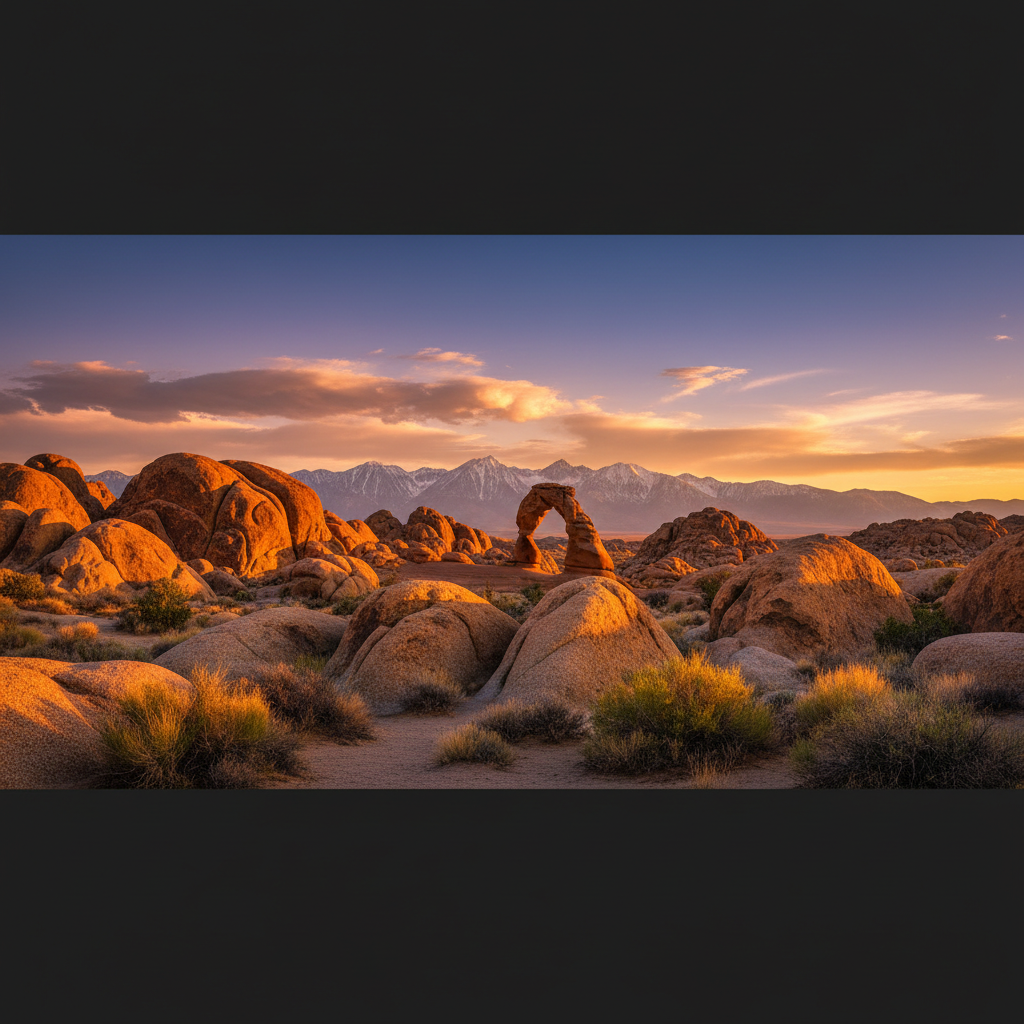
A labyrinth of rounded granite boulders and natural arches at the foot of Mount Whitney, famous as Hollywood's premier desert film location.
The Alabama Hills National Scenic Area, managed by the Bureau of Land Management, presents a maze of rounded, ochre-hued biotite monzogranite boulders sitting at the base of the Eastern Sierra Nevada. While these bulbous formations appear far older than the jagged, snow-dusted granite spires of Mount Whitney looming directly to the west, they are actually of a similar age, dating back roughly 100 million years to the Cretaceous period. The stark visual contrast between the two landscapes is a result of differing erosion patterns: while the high peaks of the Sierra underwent mechanical frost wedging, the low-lying Alabama Hills experienced spheroidal chemical weathering under a layer of moist soil eons ago. Today, this process of decomposition has left behind a playground of natural arches, including the famous Mobius Arch, Lathe Arch, and the Eye of Alabama, which frame the high peaks of the Sierra in smooth, amber stone.
The cultural history of the hills spans thousands of years, beginning with the Indigenous Paiute people who have long inhabited the Owens Valley, drawing sustenance from the seasonal plants and wildlife of the high desert. The modern name of the range dates back to the American Civil War, when Southern-sympathizing prospectors named their mining claims after the Confederate warship CSS Alabama. When the vessel was eventually sunk by the USS Kearsarge in 1864, Union-sympathizers retaliated by naming nearby Kearsarge Pass and Kearsarge Peak. By the 1920s, Hollywood discovered the dramatic terrain, turning the hills into a cinematic stand-in for the American West, the Gobi Desert, and the Middle East. More than 400 films and television shows have been shot along these dirt tracks, starting with the 1920 silent film *The Round-Up* and continuing through classics like *Gunga Din* and *High Sierra*, as well as modern blockbusters like *Tremors*, *Gladiator*, *Iron Man*, and *Django Unchained*.
Navigating this landscape is centered around Movie Road, a well-graded dirt route that winds northward through the heart of the formations, offering access to numerous trailheads and climbing routes. Because of the area's surging popularity and fragile desert ecosystem, the Bureau of Land Management has implemented strict conservation measures to protect the native vegetation and soils. Dispersed camping is no longer permitted anywhere you please: visitors wishing to camp must obtain a free Alabama Hills Designated Camping Permit and are restricted to roughly two dozen designated, marked campsites marked with a tent icon. For those who secure a spot or choose to stay at nearby Tuttle Creek or Portuguese Joe campgrounds, the rewards are immense, featuring dark night skies ideal for stargazing, quiet desert winds, and the scent of sagebrush under the shadow of the Sierra crest.
If you plan to camp, secure your free BLM permit online or at the Eastern Sierra Visitor Center in Lone Pine ahead of time. Designated sites are limited and fill up quickly, so have Tuttle Creek Campground as a backup.