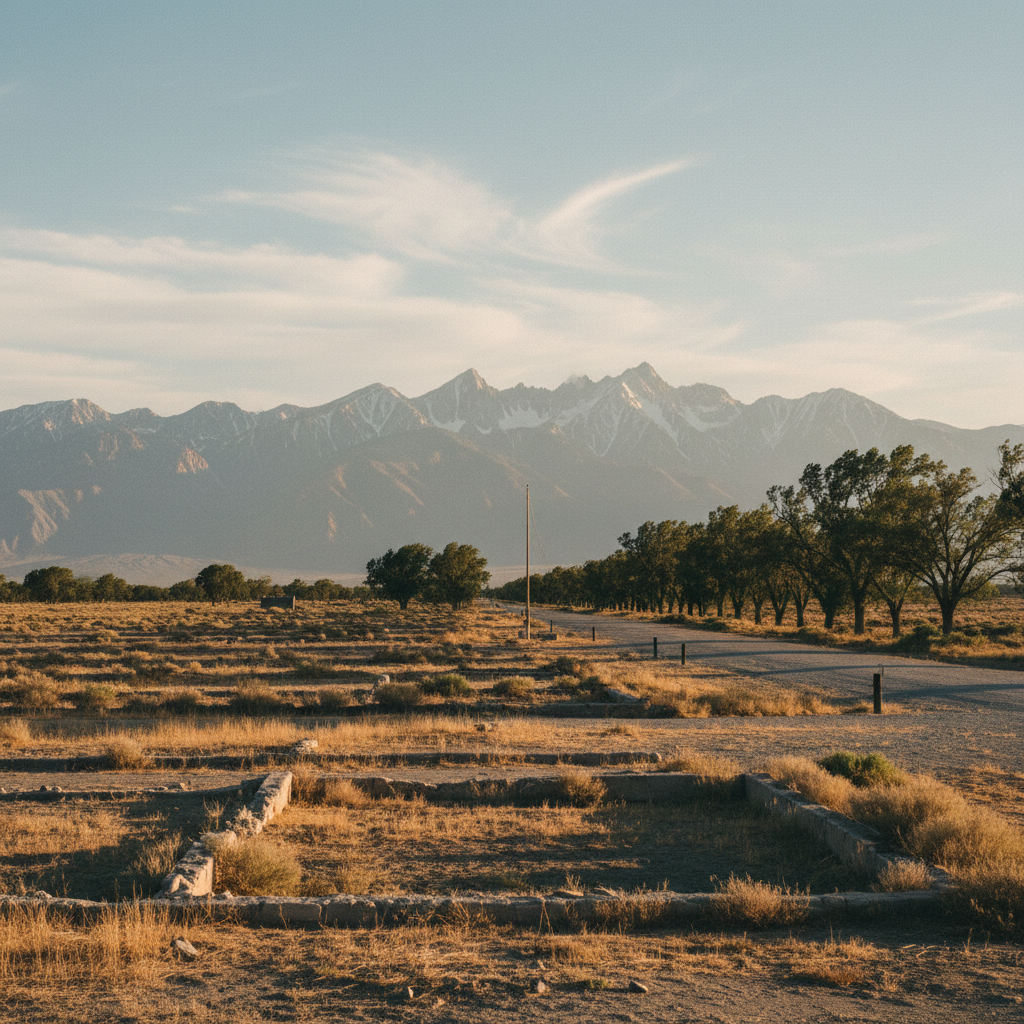
Located in the Owens Valley, Manzanar National Historic Site preserves the barracks, gardens, and poignant stories of the 11,000 Japanese Americans incarcerated here during World War II.
Manzanar National Historic Site preserves the physical remnants and the complex history of the Manzanar War Relocation Center, where more than 11,000 Japanese Americans were incarcerated during World War II. Established as a National Historic Site on March 3, 1992, the 814-acre property serves as a solemn monument to the fragility of civil liberties. Visitors begin their exploration at the visitor center, housed in the camp's former high school auditorium, which was constructed by incarcerated workers in 1944. Inside, an 8,000-square-foot exhibit space houses extensive collections of historic photographs, personal artifacts, and oral histories. A detailed scale model of the camp, meticulously crafted by former internees, provides a comprehensive overview of the grid-like layout of barracks, guard towers, and barbed wire fences that once confined thousands. A massive graphic wall lists the names of every individual imprisoned here, while the 22-minute documentary film, 'Remembering Manzanar', plays regularly to provide vital historical context.
Directly adjacent to the visitor center is Block 14, a reconstructed portion of the camp designed to show the stark realities of daily life. Here, visitors can walk through two replicated barracks and a restored 1940s mess hall, which was relocated to the site from the Bishop Airport in 2002. The drafty barracks, constructed with simple pine planks and covered in black tarpaper, illustrate the lack of privacy and comfort endured by families who were assigned to small, communal rooms furnished only with iron cots and straw mattresses. The mess hall features interpretive displays detailing the regimented dining system and the challenges of feeding thousands of people under military supervision. Nearby, the reconstructed women's latrine highlights the systemic stripping of dignity that characterized the incarceration experience. Ongoing archaeological excavations at the site continue to unearth personal belongings, from hand-carved toys to glass bottles, offering a tangible connection to the individuals who lived behind the barbed wire.
A 3.2-mile self-guided auto tour loops through the rest of the expansive grounds, tracing the lines of former streets and offering access to more remote features of the camp. The route passes the remnants of the camp's agricultural operations, including old pear and peach orchards, as well as the foundations of the Children's Village, which was the only orphanage established across all ten of the wartime relocation centers. Along the loop, visitors can view the remains of more than 100 Japanese gardens built by the internees, including Merritt Park, a large pleasure garden designed by master stonemason Ryozo Kado to serve as a community refuge. The tour culminates at the camp cemetery, where the iconic Irei-to, or 'Soul Consoling Tower', stands against the dramatic backdrop of Mount Williamson. Designed by Kado and Buddhist minister Shinjo Nagatomi, this white concrete obelisk was built in 1943 to honor the 150 people who died while confined at Manzanar. It remains one of the most powerful symbols of resilience and remembrance in the American West.
Pick up a map at the visitor center before driving or biking the 3.2-mile auto tour loop, which leads to the historic cemetery monument, Merritt Park, and the foundations of the Children's Village orphanage.