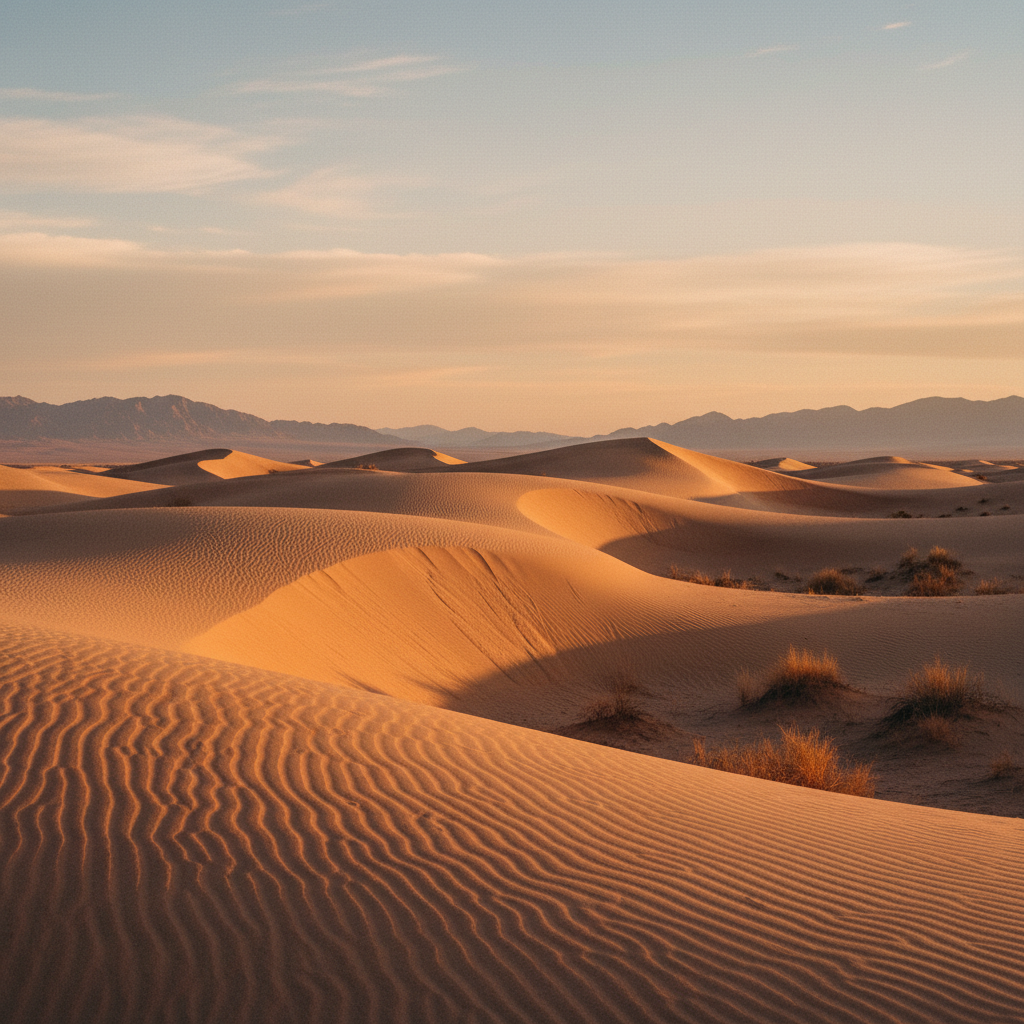
This massive five-square-mile star dune system rises up to 500 feet from the Mojave Desert floor, famous for its rare singing sands, endemic beetles, and off-road riding bowls.
Amargosa Big Dune Recreation Area rises as a massive, five-square-mile star dune system from the flat floor of the Amargosa Desert. Administered by the Bureau of Land Management, this island of pale, wind-swept sand towers up to 500 feet above the surrounding Mojave hardpan, roughly 19 miles south of Beatty and just off US Highway 95. The dune is a geological anomaly created over millennia by wind and water from the seasonal Amargosa River, which deposit fine mineral grains that are constantly reshaped by shifting desert winds. It is also culturally significant to the Timbisha Shoshone and Southern Paiute peoples, who have held this landscape sacred since time immemorial, recognizing it as a vital convergence of underground water, unique plants, and desert wildlife.
Beyond its dramatic physical presence, the dune is one of only three locations in Nevada where the sand actually sings. Under arid, hot conditions, the friction of sliding grains cascading down the steep slopes produces a low, resonant vibration that can sound like a distant propeller plane, a low hum, or a deep, booming rumble. This acoustic phenomenon is accompanied by a highly fragile, isolated ecosystem. The dunes are designated as an Area of Critical Environmental Concern due to the presence of four endemic beetle species found nowhere else on Earth, including the rare Giuliani's dune scarab and the Big Dune beetle. To protect these specialized insects, which depend on sparse desert shrubs for food and breeding, the Bureau of Land Management has established protected zones, including buck-and-rail fencing on the north side, while still keeping the vast majority of the dune open to recreation.
Recreational access here caters to both quiet explorers and high-energy off-road enthusiasts. For those traveling with off-highway vehicles, sand rails, and ATVs, the open bowls and steep ridges provide a sprawling playground where engines roar and tires carve deep arcs into the sand. Dispersed primitive camping is permitted on the gravel flats along the outskirts of the dunes, though visitors must be entirely self-sufficient, as there are no water, shade, or toilet facilities on-site. For hikers, ascending the shifting crests on foot requires a slow, deliberate effort, but the summit rewards climbers with sweeping views of the Funeral Mountains and the distant borders of Death Valley National Park. Pop-culture enthusiasts might also recognize these sweeping sands from the 1987 science-fiction film Cherry 2000, where the dunes stood in for a post-apocalyptic, sand-buried future.
Bring plenty of water, sunscreen, and eye protection, as there are absolutely no facilities or shade at the dunes. To hear the sand 'sing,' visit during dry, hot periods in the late spring or early autumn, and slide down a steep, dry face on the dune's slip face to trigger the acoustic vibration.