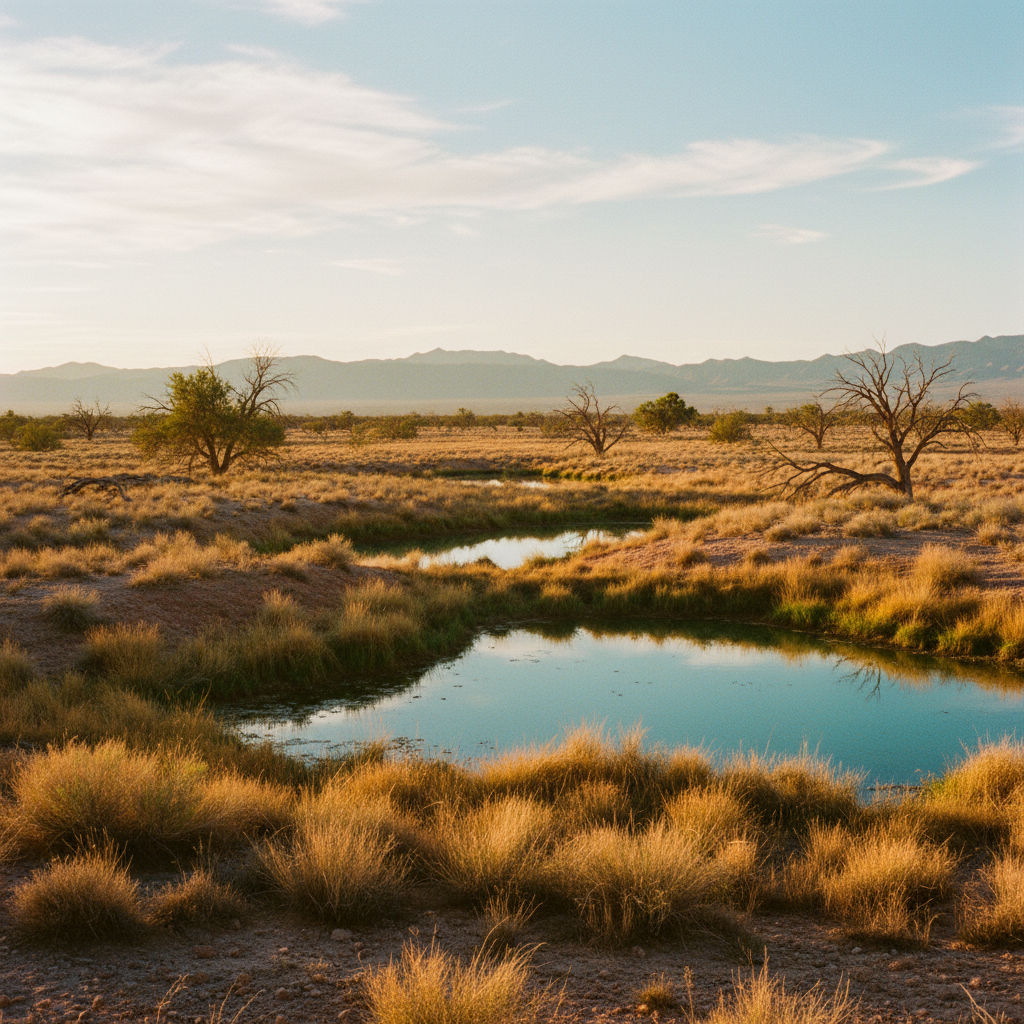
Ash Meadows National Wildlife Refuge is the largest remaining oasis in the Mojave Desert, where ancient fossil water bubbles up through dozens of springs to support the highest concentration of endemic species in North America. This hyper-biodiverse wetland provides a stark, turquoise contrast to the surrounding saltbush plains of southwestern Nevada.
Ash Meadows National Wildlife Refuge is a hydrological anomaly in the parched expanse of the Amargosa Desert. Located in southwestern Nevada, about 90 miles northwest of Las Vegas, this 23,000-acre refuge is the largest remaining oasis in the Mojave Desert. The lifeblood of the refuge is ancient fossil water that fell as precipitation over 100 miles to the northeast during the last ice age, slowly filtering through a vast underground carbonate aquifer. When this subterranean flow encounters a geologic fault line, the water is forced to the surface, bubbling up through more than thirty perennial springs and seeps. This constant, warm flow creates a lush network of turquoise pools, gurgling streams, and marshy channels that stand in vivid contrast to the surrounding white alkali flats and creosote scrub. The area is the traditional territory of the Newe (Timbisha Shoshone) and Nuwuvi (Southern Paiute) peoples, who have relied on these waters for thousands of years.
The extreme isolation of these spring systems has turned Ash Meadows into an evolutionary crucible, supporting at least twenty-six endemic species of plants, fish, insects, and snails found nowhere else on Earth. This is the highest concentration of endemic species in the United States, earning the refuge a designation as a Ramsar Wetland of International Importance. Among the most famous residents is the Ash Meadows Amargosa pupfish, a tiny survivor whose breeding males turn a brilliant, iridescent blue during the spring and summer. Visitors can easily watch these resilient fish darting through the clear waters of Crystal Spring. This pool is roughly fifteen feet deep, maintaining a constant temperature of 87 degrees Fahrenheit while discharging 2,800 gallons of water per minute. A wheelchair-accessible wooden boardwalk leads from the visitor center directly to the spring, winding past native ash trees and saltbush to protect the fragile desert pavement.
Within the boundaries of the refuge lies Devils Hole, a detached forty-acre unit of Death Valley National Park. This water-filled geothermal limestone cavern is the only natural home of the critically endangered Devils Hole pupfish, considered the rarest fish in the world. The water here remains a constant 93 degrees Fahrenheit, and while scuba divers have mapped the cavern to a depth of over 500 feet, its true bottom has never been found. The pool is heavily fenced to protect the hyper-sensitive habitat, but a viewing platform allows visitors to look down into the cavern's mouth. Farther along the gravel roads of the refuge, the Point of Rocks boardwalk offers another prime viewing area at Kings Pool, where interpretive scopes help visitors spot pupfish and endemic springsnails. The refuge was established on June 18, 1984, after a historic intervention by The Nature Conservancy, which purchased the land to save it from a proposed 20,000-lot residential development, forever preserving this delicate desert sanctuary.
Walk the Crystal Spring boardwalk during the early morning or late afternoon when the desert heat softens, and look closely at the shallow edges of the turquoise pool to spot the vibrant blue males of the Ash Meadows Amargosa pupfish.