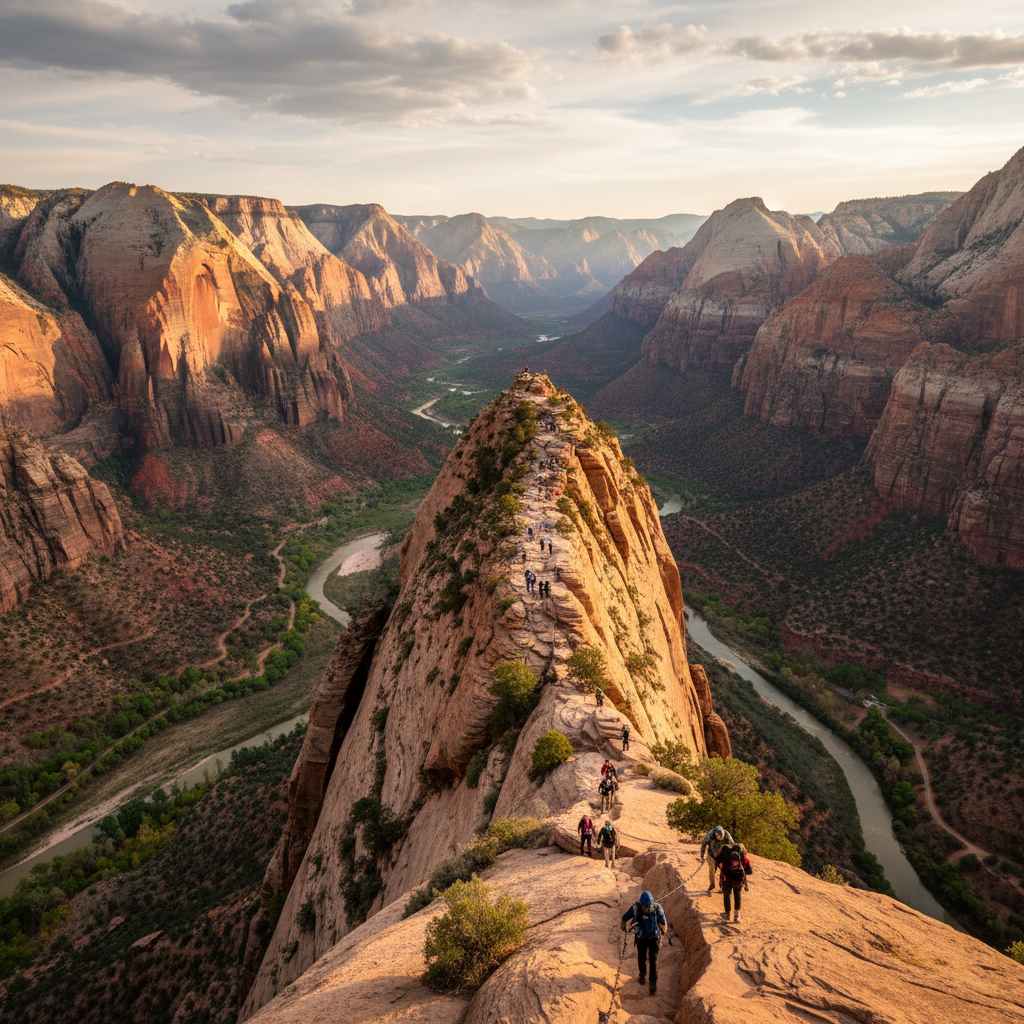
The chains, the exposure, and the narrow sandstone spine of Zion's most famous and challenging trail.
Angels Landing, historically known as the Temple of Aeolus, is a 1,488-foot tall Navajo Sandstone monolith rising abruptly from the floor of Zion Canyon. The landmark received its modern name in 1916 when Methodist minister Frederick Vining Fisher, exploring the canyon with friends, famously remarked that only an angel could land on its narrow summit. A decade later, in 1926, National Park Service employees Thomas Chalmers Vint and Walter Ruesch designed and constructed the dramatic trail, an engineering marvel that was officially added to the National Register of Historic Places in 1987. The route begins at the Grotto Trailhead, crossing the Virgin River on the traditional lands of the Southern Paiute and Pueblo peoples, before ascending the West Rim Trail. The path is paved and carved directly into the canyon wall, transitioning from the level riverbanks into the cool, shaded depths of Refrigerator Canyon, a sheltered slot that offers a brief respite from the desert heat.
The physical challenge of the climb intensifies at Walter's Wiggles, a series of 21 tight, engineered switchbacks named after Ruesch, Zion's first superintendent, who oversaw their construction in 1926. This steep, stone-walled staircase delivers hikers to Scout Lookout, a broad sandstone shoulder located 5,290 feet above sea level. For many, Scout Lookout serves as the final destination, offering expansive views of the canyon, the Organ, and the sheer walls of the Great White Throne. Beyond this point, the trail transforms into a rugged, class 3 scramble along a narrow, exposed sandstone fin known as the hogsback. This final half-mile is defined by vertical drop-offs of up to 1,000 feet on either side, where hikers must navigate carved steps and natural ledges while holding onto heavy iron chains bolted directly into the rock. The air here carries the scent of sun-baked stone and distant pine, and the wind often whips across the ridge, adding a visceral sense of exposure.
Reaching the 5,790-foot summit reveals a panoramic, 360-degree view of Zion Canyon, with the Virgin River ribboning far below and the tiny shapes of park shuttles visible on the canyon floor. To manage safety and severe crowding on the narrow spine, the National Park Service implemented a seasonal permit lottery system in April 2022, which is strictly enforced at Scout Lookout. The summit itself consists of weathered Navajo Sandstone, a geologic remnant of a massive Jurassic desert that covered this region roughly 170 million years ago, subsequently uplifted by tectonic forces and carved by millions of years of river erosion. Today, the peak stands as one of the most famous and demanding hikes in the National Park System, requiring steady footing, physical endurance, and a deep respect for the sheer verticality of the canyon walls.
A permit is required to hike past Scout Lookout to the summit of Angels Landing. Apply via the seasonal lottery months in advance, or try the day-before lottery on Recreation.gov. Pack sticky-soled hiking shoes, plenty of water, and gloves to protect your hands on the metal chains.