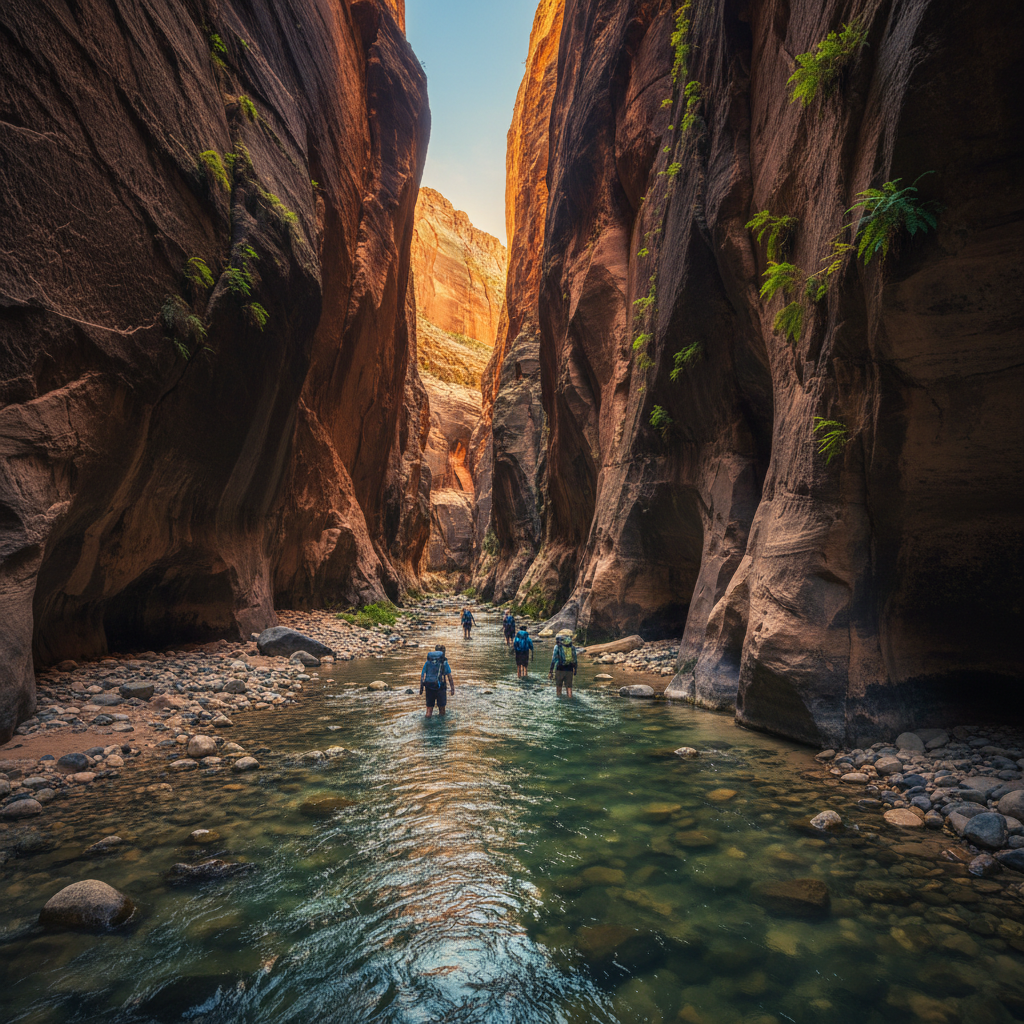
You do not hike The Narrows, you wade it. This route follows the Virgin River through sixteen miles of sheer Navajo Sandstone walls.
The Narrows is the narrowest and most celebrated section of Zion Canyon, where the North Fork of the Virgin River has carved a deep, vertical corridor through Navajo Sandstone. Located in southwestern Utah, this dramatic gorge features sheer cliffs that rise up to 1,500 feet above a riverbed that shrinks to just twenty to thirty feet wide in its tightest corridors. Geologist Grove Karl Gilbert named the canyon in 1872 during the Wheeler Survey, though Southern Paiute guides had navigated these waters for centuries, later guiding Mormon pioneer Nephi Johnson into the main canyon in 1858. The canyon walls reveal millions of years of geological history, showing distinct cross-bedding and colorful iron oxide streaks where water has slowly seeped through the porous stone.
Experiencing this geological marvel requires stepping directly into the cold, flowing waters of the Virgin River, as there is no dry trail. Hikers choose between two distinct approaches. The popular bottom-up route begins at the Temple of Sinawava, at the end of the paved one-mile Riverside Walk. This day hike requires no permit and allows visitors to wade upstream as far as Big Spring, a strenuous ten-mile round trip. Along the way, hikers pass Mystery Falls and enter Wall Street, a famous two-mile stretch where towering vertical walls block out the sun and the river covers the canyon from side to side. For a more remote adventure, the top-down route is a sixteen-mile wilderness trek that starts at Chamberlain’s Ranch, a high-plateau trailhead located an hour and a half outside the park. This route requires a wilderness permit and can be completed as a grueling single-day hike or a two-day backpacking trip with overnight stays at designated primitive campsites along the canyon floor.
Wading through the river is a physical challenge that demands focus, as the riverbed is covered in slick, unstable, bowling-ball-sized rocks. The water temperature rarely rises above sixty degrees Fahrenheit, even in the heat of summer, making neoprene socks and specialized sticky-rubber canyoneering boots highly recommended. Despite the harsh, subterranean environment, life thrives in the canyon. Seep-fed hanging gardens of ferns, mosses, and scarlet monkeyflowers cling to the sandstone walls, creating vibrant green oases against the deep red rock. Safety is an absolute priority here, as flash floods pose a constant, lethal threat. Distant storms, sometimes occurring miles away on the upper plateau, can rapidly transform the gentle river into a raging torrent of mud and debris. Hikers must consult the backcountry desk or the park's daily weather forecast to assess the flash flood potential before committing to the canyon.
Do not attempt this hike in standard running shoes or hiking boots. Rent sticky-rubber canyoneering boots, neoprene socks, and a thick wooden walking stick from an outfitter in Springdale. The extra traction and ankle support will prevent injuries on the slick, submerged river rocks.