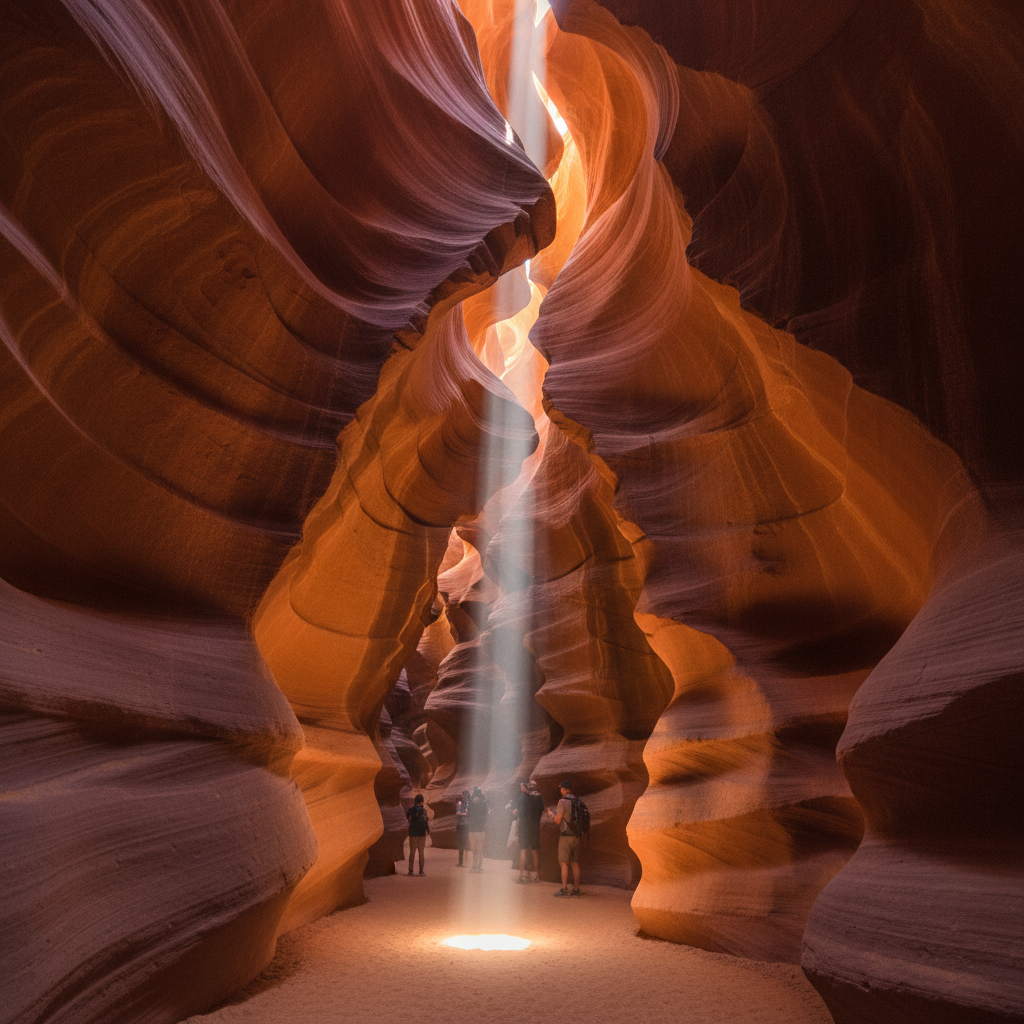
The most photographed slot canyon in America, where shafts of midday light pierce narrow, swirling sandstone corridors.
Antelope Canyon, located on Navajo Nation land just east of Page, Arizona, is a geological masterpiece carved from 190-million-year-old Navajo Sandstone. Stepping out of the desert sun and descending into these narrow corridors, the air cools immediately as your eyes adjust to the deep, reflected light bouncing off walls of flowing rock. The sandstone walls, sculpted into impossibly smooth curves and fins by millions of years of water erosion, invite touch. In Upper Antelope Canyon, known in Navajo as Tsé bighánílíní, or 'the place where water runs through rocks,' the experience is defined by the sun. Around midday, especially from March through October, concentrated beams of sunlight pierce the narrow ceiling, illuminating the fine red dust suspended in the air and casting solid-looking shafts of light onto the canyon floor.
The canyon is a testament to the violent, sculpting power of water. For thousands of years, seasonal flash floods have ripped through this wash, carrying abrasive sand and sediment that scour the soft rock. This process of erosion, both sudden and patient, carved the narrow, corkscrewing passages that reach depths of up to 120 feet. The result is a place of profound quiet and organic shapes, though it remains a dynamic environment where flash floods still pose real dangers. This is sacred ground for the Navajo Nation, a spiritual place that must be entered with deep respect. Navajo elders historically paused before entering the canyon to ensure they were in the right frame of mind, treating the stone corridors as a natural cathedral where nature, history, and spirituality converge.
Exploring this geological wonder requires a required guided tour led by a Navajo guide, a system established to protect both the fragile environment and visitors. These guides share cultural history, point out formations like the Eagle or the Heart, and help visitors capture the canyon's complex lighting. While Upper Antelope Canyon is famous for its flat, ground-level entry and dramatic light beams, Lower Antelope Canyon, or Hazdistazí, meaning 'spiral rock arches,' offers a more physical adventure. Accessing the lower canyon requires descending steep metal ladders into a tighter, V-shaped system that stretches for over 1,300 feet. For those seeking fewer crowds, adjacent sections like Antelope Canyon X offer a quieter, equally dramatic alternative to the main corridors, where the play of light and shadow continues in peaceful isolation.
To capture the deep reds and purples your eyes see, adjust your phone’s camera settings to a 'Vivid Warm' or equivalent profile before you enter. Standard automatic settings often wash out the canyon's true colors.