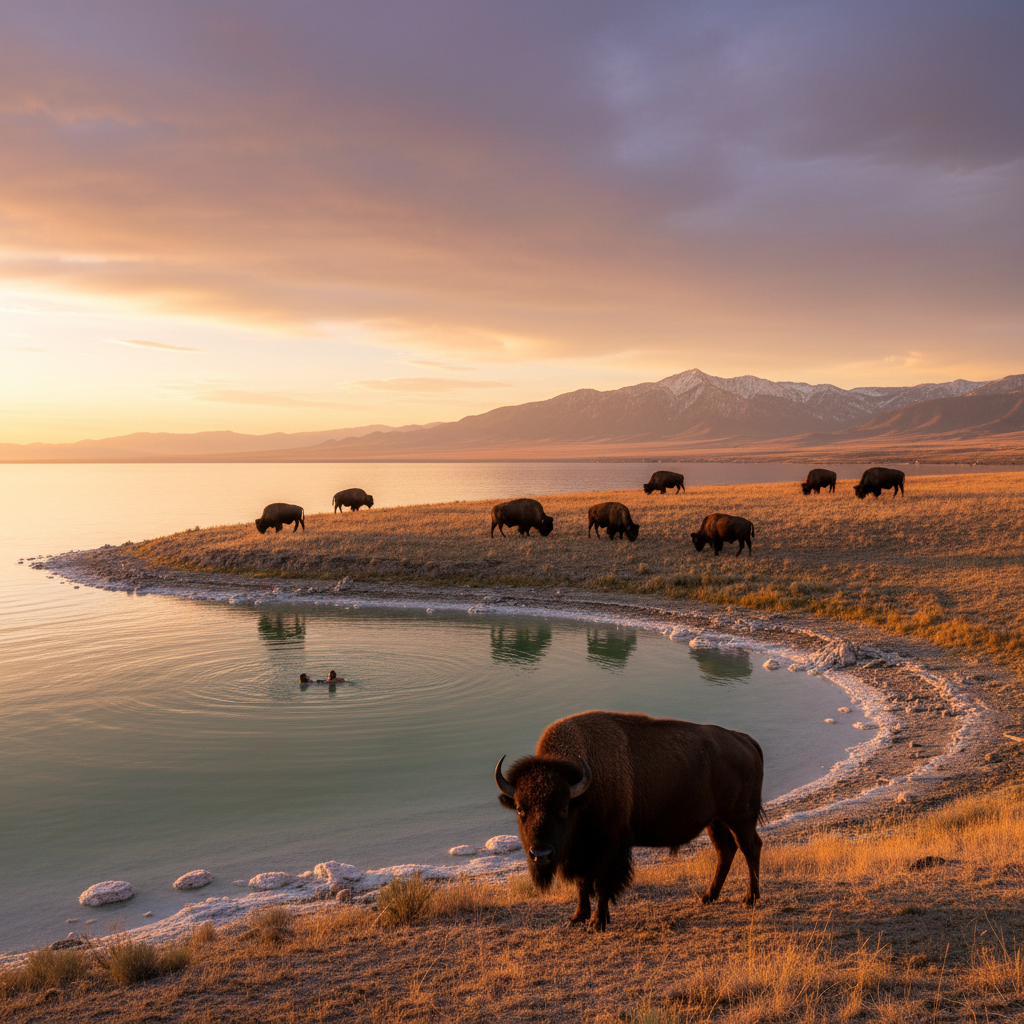
A mountainous sanctuary in the Great Salt Lake where free-roaming bison, ancient geology, and historic homesteads meet a vast, hyper-saline inland sea.
Antelope Island State Park preserves a stark, mountainous landmass rising from the hyper-saline waters of the Great Salt Lake, known to the Western Shoshone as Pa'ri-bi-na, or elk place. Spanning 28,000 acres, this forty-two-square-mile sanctuary is accessed via a seven-mile causeway from Syracuse, Utah. The island's spine is defined by craggy peaks of 1.7-billion-year-old metamorphic gneiss from the Farmington Canyon Complex, some of the oldest exposed rock in North America. Its highest point, Frary Peak, reaches 6,596 feet, offering clear views across the desert basin toward the Wasatch Range. The surrounding water, several times saltier than the ocean, supports a specialized ecosystem of green algae, brine shrimp, and billions of brine flies. This concentrated food source draws millions of migratory shorebirds, including American avocets, phalaropes, and eared grebes, making the island a critical sanctuary along the Pacific Flyway.
The island's most famous residents are the five hundred to seven hundred American bison that roam the dry, native grasslands. This herd traces its lineage back to twelve privately owned animals brought to the island in 1893, making it one of the oldest and largest public herds in the nation. Every late October, the park hosts its annual bison roundup, where horsemen and spectators gather to herd the animals from the southern rangelands to northern holding pens for health checks and vaccinations. Beyond bison, the park supports populations of pronghorn, bighorn sheep, mule deer, bobcats, and coyotes. Human history is preserved on the southeastern shore at the Fielding Garr Ranch. Established in 1848 by a Mormon pioneer, the ranch house remains the oldest Anglo-built structure in Utah still standing on its original foundation, operating continuously as a sheep and cattle ranch until the state purchased the land in 1981.
Exploring the park requires stepping onto the dry, sage-scented earth. The 6.6-mile round-trip hike up Frary Peak climbs 2,100 feet through steep, rocky terrain, while the shorter trail to Buffalo Point offers an easier route to watch the sun drop behind the Promontory Mountains. At Bridger Bay, the beach is composed of tiny, rounded oolitic sand grains formed from calcium carbonate, where the hum of harmless brine flies creates a constant, low-frequency white noise. Visitors should plan for the stark seasonal shifts: spring brings green hills and the birth of bison calves, but also swarms of biting gnats, while late autumn offers crisp air, quiet trails, and the dramatic sight of the bison roundup. In the evening, as the sun dips below the western horizon, the saline water acts as a mirror, turning the lake into a sheet of liquid bronze and casting the island's ancient ridges in deep violet shadows.
Biting gnats (no-see-ums) emerge from April through June and are immune to standard DEET. Bring a fine-mesh head net and wear lightweight long sleeves if you plan to hike during these spring months.