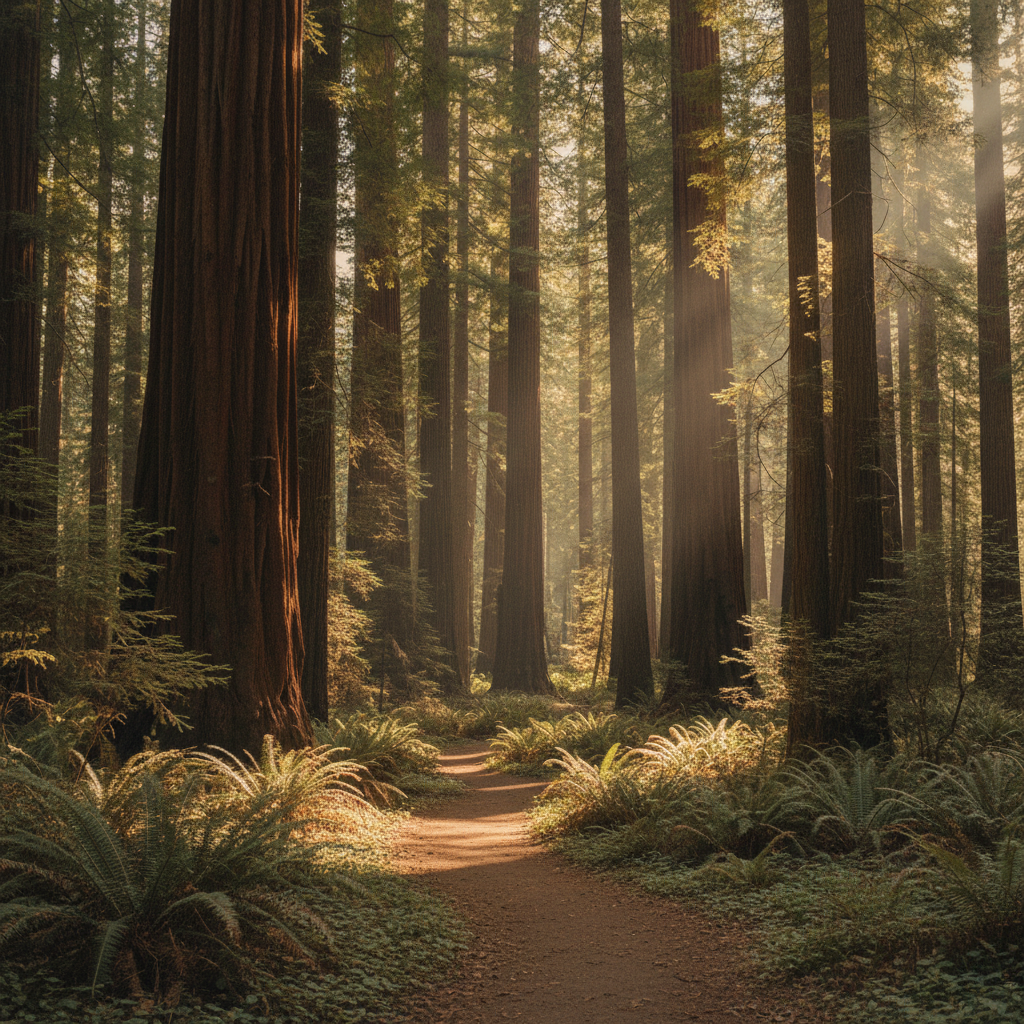
An ancient old-growth coast redwood grove in Sonoma County, preserved by a nineteenth-century lumberman and home to the 1,400-year-old Colonel Armstrong Tree.
Armstrong Redwoods State Natural Reserve preserves 805 acres of ancient coast redwoods (*Sequoia sempervirens*) in Sonoma County, just north of Guerneville. This grove represents a precious remnant of the primeval temperate rainforest that once blanketed the Northern California coast before the nineteenth-century logging boom. Within this protected valley, the trees thrive in a microclimate fueled by heavy winter rains and dense summer fog rolling in from the nearby Pacific Ocean. The reserve is home to several famous trees, including the Parson Jones Tree, which stands as the tallest in the grove at more than 310 feet, and the Colonel Armstrong Tree, estimated to be over 1,400 years old. Another notable specimen is the Icicle Tree, recognized for its massive, mysterious burl formations that hang like frozen wood several stories above the forest floor.
The history of this grove is closely tied to Colonel James Boydston Armstrong, a Union Army veteran and surveyor who arrived in Sonoma County in 1874. Despite operating a nearby sawmill that produced millions of board feet of lumber annually, Armstrong recognized the profound ecological and aesthetic value of this specific parcel. In 1878, he deeded a 440-acre tract to his daughter Kate, envisioning it as a preserved arboretum. Following Kate's death in 1898 and the Colonel's death in 1900, his surviving daughter, Lizzie Armstrong Jones, along with her husband William Ladd 'Parson' Jones and local landowner Harrison LeBaron, campaigned tirelessly to realize his dream. Their efforts eventually led Sonoma County to purchase the land in 1917, which was subsequently acquired by the State of California in 1934. Officially reclassified as a State Natural Reserve in 1964, the park receives the highest level of resource protection, minimizing recreational development to keep the delicate old-growth ecosystem intact.
Exploring the reserve is straightforward, with options ranging from level walks to demanding ridge hikes. The flat, wheelchair-accessible Pioneer Nature Trail runs along the valley floor, connecting the park entrance directly to the major redwood specimens and the historic outdoor Redwood Forest Theater, built in 1934. For those seeking more rigorous physical exertion, the East Ridge Trail and Pool Ridge Trail climb steeply out of the canyon, offering significant elevation gain and views looking down into the canopy of the giants. These trails connect the main redwood grove with the adjacent, expansive wilderness of Austin Creek State Recreation Area. Throughout the park, the forest floor is carpeted with redwood sorrel, sword ferns, and trillium, while the thick, tannin-rich bark of the older trees bears the black char marks of historical fires, such as the major burn of 1923, highlighting their remarkable resistance to decay and flames.
To skip the vehicle entrance fee and avoid searching for parking in the small interior lot, park for free in the lot just outside the main entrance kiosk and walk into the grove. Arriving early on a weekday morning offers the quietest experience, when coastal fog often hangs low in the canopy.