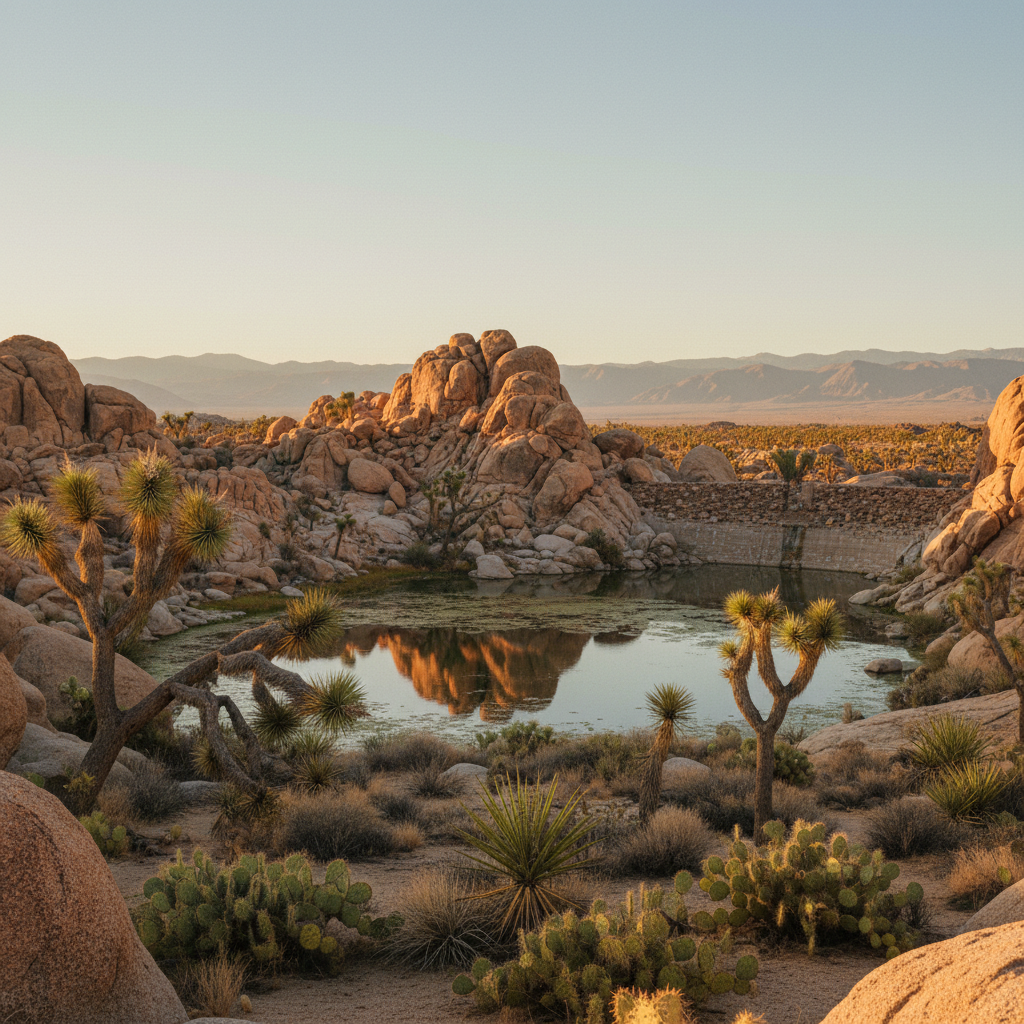
Walk this 1.1-mile loop to a historic desert reservoir, where early twentieth-century ranching history and ancient rock art meet among the monzogranite boulders of Joshua Tree.
Barker Dam Loop is a 1.1-mile trail that winds through the high desert of Joshua Tree National Park, tracing the edge of the Wonderland of Rocks. The trailhead begins near the Hidden Valley area, leading hikers into a narrow corridor of massive monzogranite boulders, sandy desert washes, and clusters of Mojave yucca, creosote, and pinyon pines. This relatively flat, easily navigated loop is famous for delivering hikers directly to one of the few places in the park where standing water can collect, creating a stark contrast against the surrounding arid landscape. The path serves as a portal into both the geological marvels of the Mojave Desert and the layered history of human survival in a parched terrain.
The center of the loop features Barker Dam, also known as Big Horn Dam, a historic water catchment structure added to the National Register of Historic Places in 1975. Initially constructed in 1900 by cattleman C.O. Barker and other local ranchers, the original nine-foot-tall dam was built of concrete and faced with native stone on its downstream side to capture seasonal runoff for livestock. In 1949, homesteading pioneer William F. Keys raised the structure by an additional six feet to increase its storage capacity, renaming it Big Horn Dam. Today, visitors who examine the top of the concrete wall can still read the hand-scratched inscription commemorating the work of Willis, W.F., and Phyllis Keys. Below the main dam, a double-ring concrete water trough built by the Keys family remains, along with a secondary lower dam that often supports a small thicket of cattails fed by slow seepage.
Beyond the dam, the loop continues past a massive granite overhang that houses a collection of ancient Native American petroglyphs and pictographs, left by the desert's earliest inhabitants. These rock carvings depict bighorn sheep, snakes, and geometric patterns, though their unusually vibrant colors are the result of a mid-twentieth-century film crew. While shooting a movie in the area, a production team painted over the ancient designs to make them stand out on camera, a controversial act of vandalism that permanently altered the site. Despite this modern intrusion, the loop remains a vital habitat for local fauna, particularly during wetter seasons when the reservoir fills. Desert bighorn sheep, bighorn owls, coots, and migrating birds frequently gather at the water's edge, while desert tortoises and lizards rustle through the surrounding creosote bushes.
Look for the hand-carved 1949 inscription by the Keys family on top of the dam, and keep an eye out for desert bighorn sheep that occasionally descend from the Wonderland of Rocks at twilight.