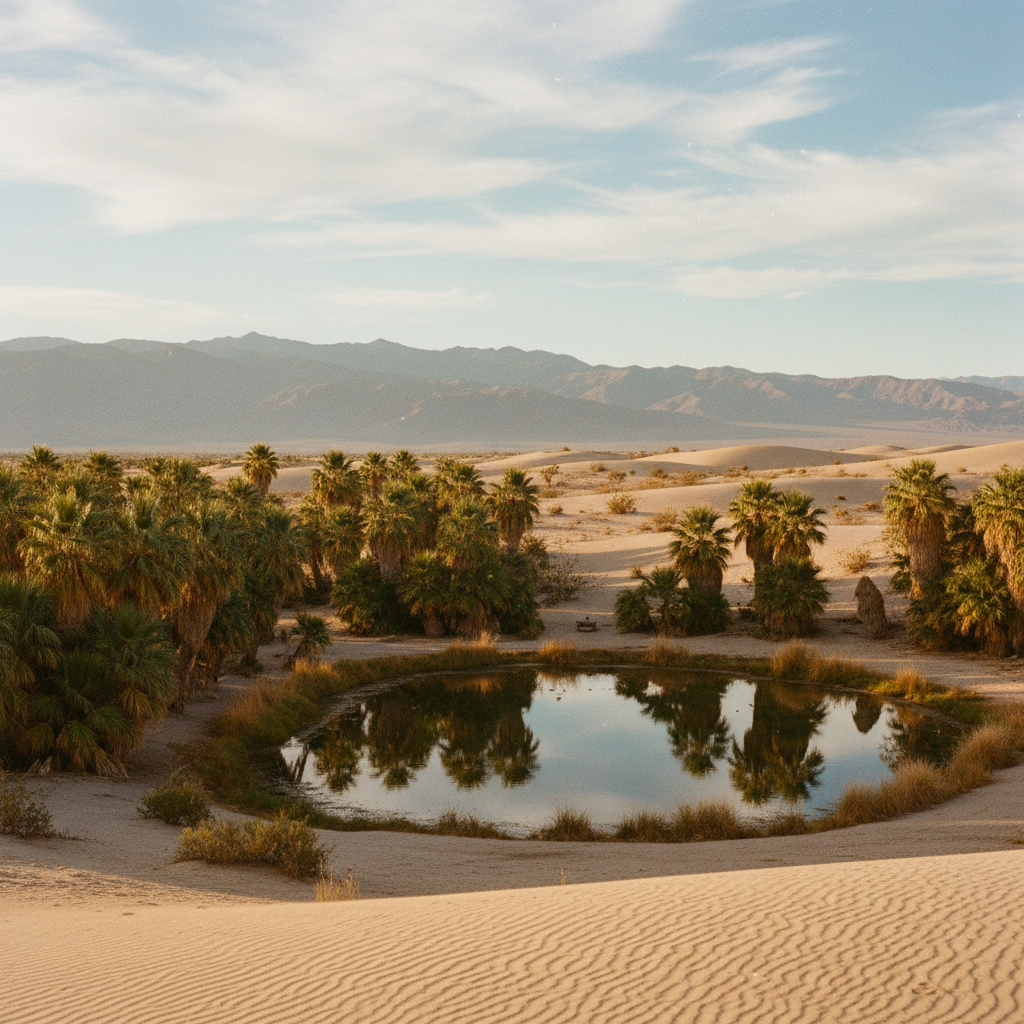
Follow a line of towering California fan palms to a historic spring-fed oasis in the Mojave Desert, where life has flourished for thousands of years.
The Oasis of Mara, situated at the northern entrance of Joshua Tree National Park in Twentynine Palms, is a historic desert spring that has sustained human life for over nine thousand years. To the Serrano people, who originally settled the area, this oasis is known as Mara, meaning 'the place of little springs and much grass'. According to Serrano oral history, a medicine man instructed the people to travel to this spring and plant a California fan palm (Washingtonia filifera) each time a baby boy was born. In their first year here, they planted twenty-nine palms, giving rise to both the grove and the eventual name of the surrounding city. Over the centuries, the Serrano were joined by the Chemehuevi and later a small band of Cahuilla, who cultivated corn, beans, pumpkins, and squash using the life-giving waters that rise naturally along the Pinto Mountain Fault.
The physical existence of this desert sanctuary relies entirely on a massive geological fracture. The Pinto Mountain Fault runs directly beneath the oasis, acting as an underground barrier that forces deep groundwater up to the surface. In 1855, Colonel Henry Washington, a desert land surveyor, recorded the presence of twenty-nine palms during his official survey, confirming the legendary count. By the late 1800s, however, the arrival of gold prospectors and cattlemen disrupted this delicate ecosystem. Water was siphoned away to support mining operations like the nearby Anaconda Mine, and trees were cut down, forever altering the natural hydrology. Today, although the water table has dropped and water must occasionally be piped in to sustain the groves, the oasis remains a critical ecological refuge and a sacred site for the Twenty-Nine Palms Band of Mission Indians.
Visitors can explore this historic site via a flat, half-mile paved loop trail that begins at the Joshua Tree National Park Headquarters and Oasis Visitor Center. This fully accessible trail winds under the towering palms and through a dense understory of honey mesquite, which is frequently draped in reddish desert mistletoe. The sticky berries of the mistletoe serve as the primary food source for the Phainopepla, a glossy black bird with a distinct feathered crest that assists in dispersing the plant's seeds. Other native flora, such as arrow-weed and Mojave seablite, thrive in the heavy, alkaline soil of the surrounding playas. As you wander past the interpretive displays, look up into the palm fronds to spot roosting turkey vultures or listen for the rustle of Gambel's quail scurrying through the brush, experiencing a rare desert landscape defined by its persistent pockets of water.
Visit in the early morning or late afternoon to see the low-angle light filtering through the palm fronds and to maximize your chances of spotting migrating turkey vultures or nesting phainopeplas. Because this paved loop is wheelchair-accessible and pet-friendly, it is one of the very few trails in the national park where you can walk your dog on a leash.