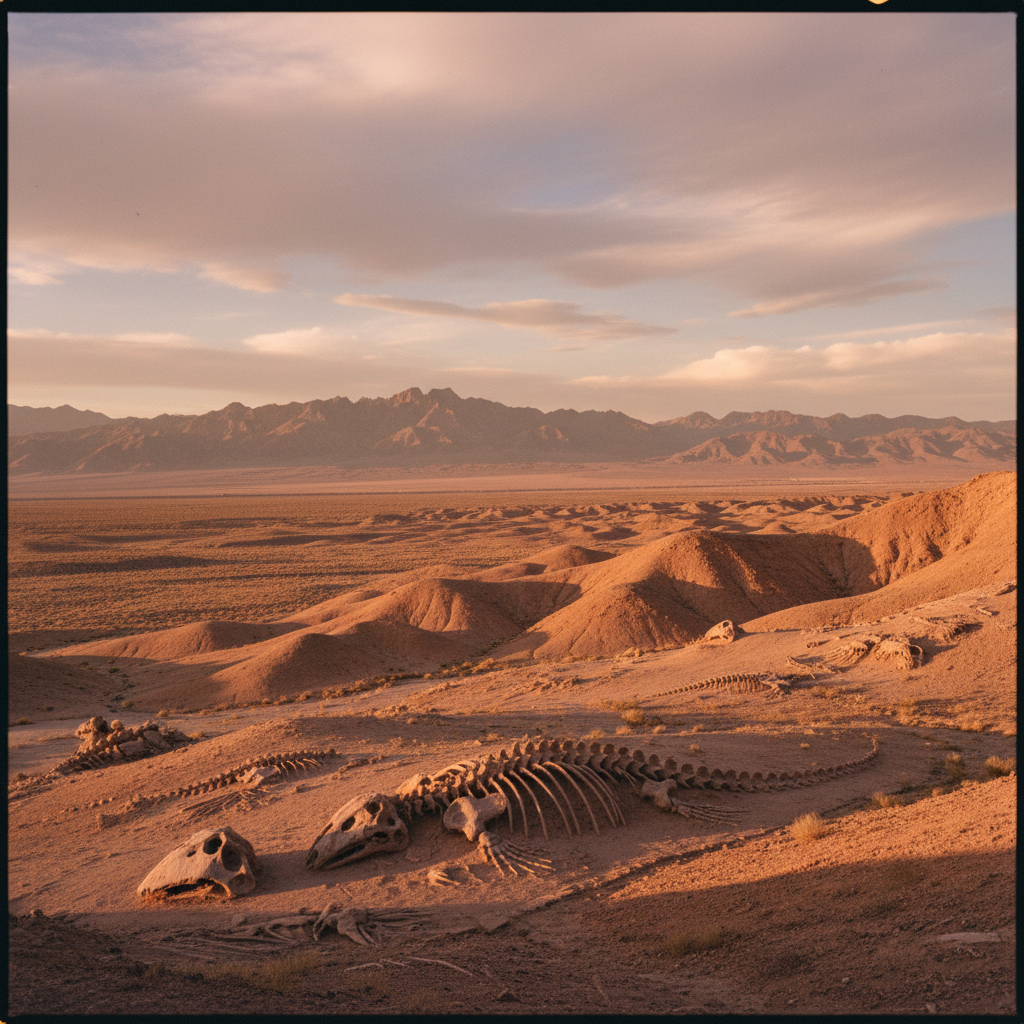
A remote Nevada state park preserving a late-nineteenth-century silver-mining ghost town and the world's largest concentration of Triassic ichthyosaur fossils.
Berlin-Ichthyosaur State Park, situated in the Shoshone Mountains of Nye County, Nevada, preserves a singular convergence of deep geological time and late-nineteenth-century frontier history. Located at an elevation of nearly 7,000 feet, this high-desert sanctuary is accessed via Nevada State Route 844, roughly 23 miles east of the small community of Gabbs. The park is most famous for housing the world's largest concentration of Shonisaurus popularis fossils, a massive marine reptile that served as Nevada's state fossil. These creatures, which grew up to 55 feet in length, swam in the warm Triassic ocean that covered central Nevada approximately 225 million years ago. First discovered in 1928 by geologist Dr. Siemon Muller, the fossil beds were systematically excavated starting in 1954 under the direction of paleontologists Dr. Charles Camp and Dr. Samuel Welles. Rather than removing the bones to a distant museum, researchers left them in situ. Today, the park's Fossil House protects these articulated vertebrae and rib cages, allowing visitors to look through large viewing windows or join a ranger-led tour to stand directly above the ancient, stony seabed where these giants lay entombed.
Just down the canyon from the fossil quarry lies the remarkably intact townsite of Berlin, a silver-mining camp established in 1897 that now stands in a state of arrested decay. Unlike many ghost towns that have been heavily reconstructed, Berlin's wooden cabins, assay office, machine shop, and schoolhouse are stabilized but otherwise left to weather naturally in the dry desert air. At its peak around 1905, the town supported a population of nearly 300 people, including miners, woodcutters, and charcoal makers. The centerpiece of the townsite is the towering 30-stamp mill, which was built using equipment hauled from the nearby Knickerbocker and Pioneer mills to crush ore from the adjacent Diana Mine. The Diana Mine itself features more than three miles of underground tunnels, and the park offers guided tours of its cool, dark drifts during the summer months. Walking the unpaved paths of the townsite, visitors can read interpretive signs based on the childhood memories of Firmin Bruner, who grew up in Berlin during its brief boom before the mine closed permanently in 1911.
For those wishing to linger in this quiet corner of the Great Basin, the park offers 14 well-spaced campsites suitable for tents and recreational vehicles up to 25 feet in length. The campground is shaded by pinyon pines and Utah junipers, with drinking water typically available from mid-April through October. A scenic nature trail connects the campground directly to the Fossil House, while other footpaths wind through the historic ruins of the Union mining camp just up the canyon. Because the park is exceptionally remote, visitors should arrive with a full tank of fuel and plenty of supplies, as the nearest services are in Gabbs or farther north along US Highway 50 at Middlegate Station. Spending an evening here, under some of the darkest night skies in the American West, reveals a profound silence where the only sounds are the rustle of sagebrush and the occasional call of a coyote, bridging the gap between the human history of the silver rush and the unfathomable depth of the Triassic era.
Call ahead or check the Nevada State Parks website to confirm tour times for the Diana Mine and the Fossil House, as schedules vary seasonally. Be sure to arrive with a full tank of gas and plenty of water, as the nearest fuel is in Gabbs, over 20 miles away.