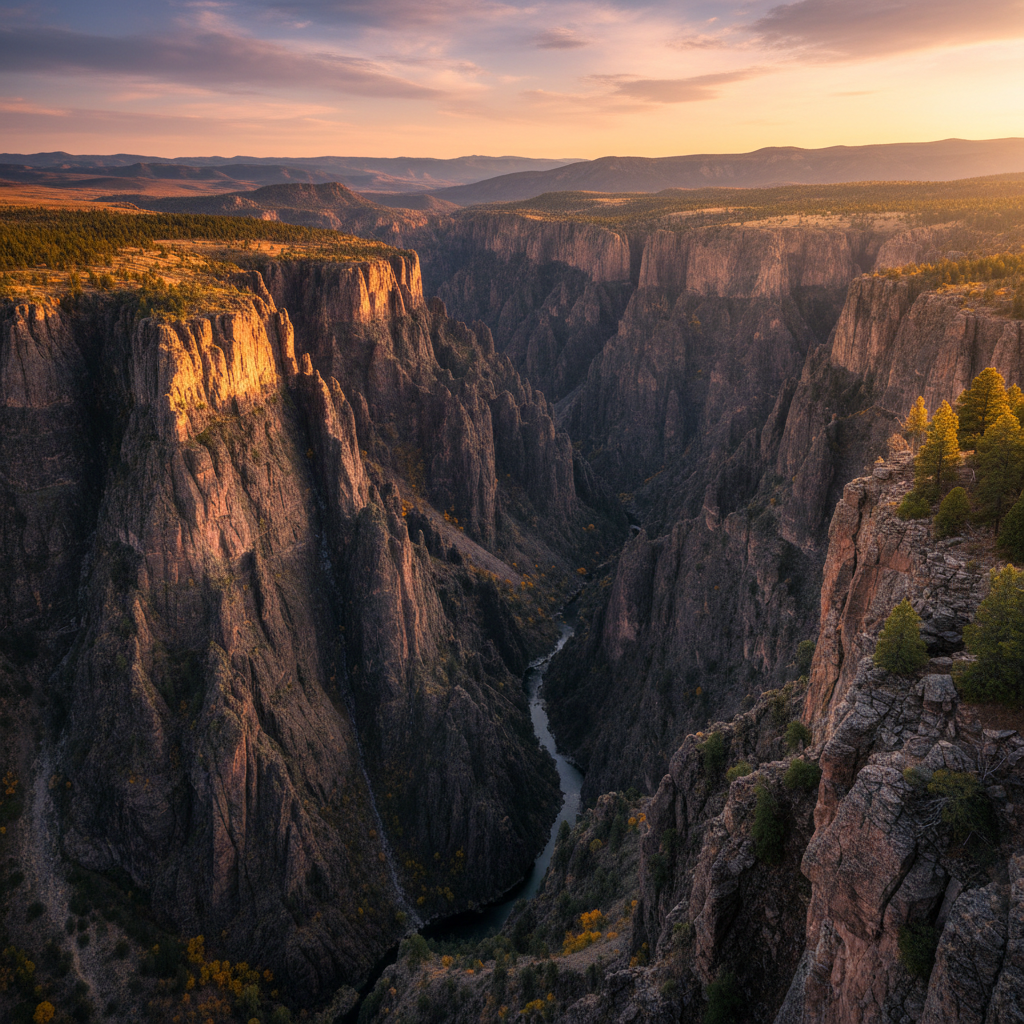
A vertical abyss of 1.7-billion-year-old stone, carved so deep and narrow that parts of the canyon floor receive only 33 minutes of sunlight a day.
Black Canyon of the Gunnison National Park is defined by an abrupt, vertical geometry that feels less like a classic valley and more like a massive, jagged tear in the Colorado plateau. At Chasm View, the canyon walls drop nearly two thousand feet to the riverbed below, so close together that the opposite rim seems almost within reach. The rock here is a dark, 1.7-billion-year-old Precambrian basement complex of gneiss and schist, some of the oldest exposed stone in North America. Slicing through these gloomy, dark-gray cliffs are intricate, wild bands of pink pegmatite, which cooled slowly in ancient fissures to form stark, crystalline dikes that resemble fossilized lightning. The sheer narrowness of the gorge means that certain sections, like the Narrows, receive as little as 33 minutes of direct sunlight each day, leaving the depths cast in perpetual, heavy shadow.
The architect of this vertical abyss is the Gunnison River, which drops an average of 43 feet per mile through the park, and a staggering 240 feet per mile at its steepest descent near Chasm View. For two million years, the river has acted as a relentless saw, armed with abrasive sand and gravel, carving downward through the incredibly hard Precambrian rock of the Gunnison Uplift. This process of extreme resistance created a canyon that is deeper than it is wide in several places, a stark contrast to the wider, terraced canyons of the American West. The Tabeguache band of the Ute people hunted along the rims for centuries but avoided the treacherous depths of the gorge, a caution shared by early explorers. In the early 1880s, Denver and Rio Grande Railroad surveyors, led by Byron Bryant, struggled through the chasm, declaring parts of it entirely inaccessible and impassable.
Experiencing the canyon today is primarily a study of its rims. The paved South Rim Road offers twelve distinct overlooks, including Pulpit Rock, Cross Fissures, and Painted Wall View, where Colorado's tallest sheer cliff rises 2,250 feet from the river. From these high vantage points, visitors can watch peregrine falcons, the fastest birds on earth, diving at speeds exceeding 200 miles per hour along the thermal updrafts of the rock face. For the exceptionally fit and prepared, descending into the inner canyon via unmaintained wilderness routes like the Gunnison Route or the loose, scree-filled Long Draw is a grueling, non-technical scramble that requires a wilderness permit. Down at the river level, the roaring of the water is deafening, and the towering walls rise so steeply that the sky is reduced to a thin, bright ribbon far above.
To escape the crowds of the South Rim, make the drive around to the unpaved North Rim. The dirt road leads to uncrowded overlooks like Exclamation Point, which provides a direct, face-to-face view of the Painted Wall's immense pegmatite bands, and offers a quieter, more intimate connection with the sheer drop.