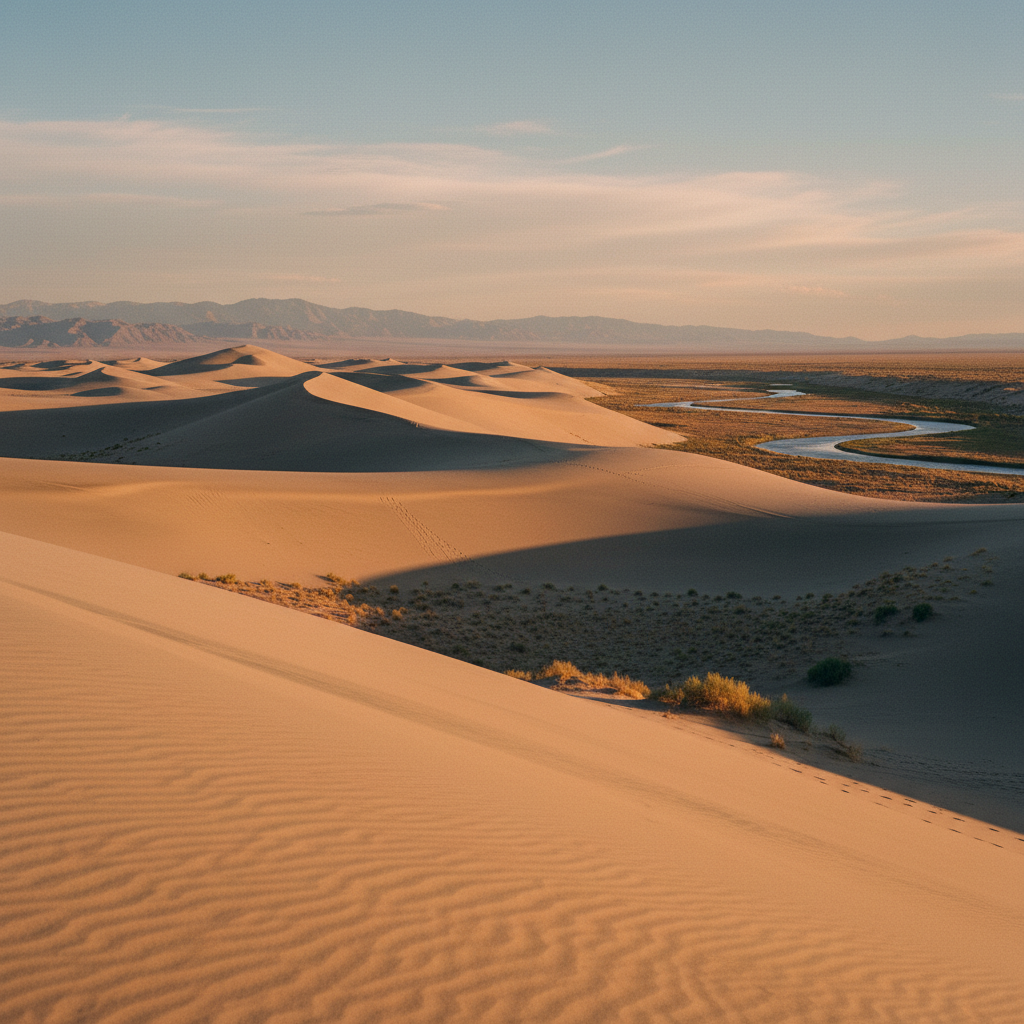
Home to the tallest single-structured sand dune in North America, this 4,800-acre desert park features towering golden slopes, spring-fed lakes, and a public observatory.
Bruneau Dunes State Park protects a shifting, otherworldly landscape in southwestern Idaho's Owyhee County, centered around the tallest single-structured sand dune in North America. Rising 470 feet above the desert floor, this massive mountain of sand stands in stark contrast to the surrounding sagebrush plains of the Eagle Cove Depression, an ancient meander of the Snake River. Established in 1967 and expanded to 4,800 acres through the 1980s, the park preserves a geological marvel that has captivated travelers for generations. Long before it became a state park, the region was the seasonal home of the Bruneau Shoshone, a western band of the Northern Shoshone who camped along the banks of the Snake River during the winter months and gathered resources across these high plains.
The formation of these towering dunes began approximately 15,000 years ago during the catastrophic Bonneville Flood, when the ancient Pleistocene Lake Bonneville overtopped its basin in Utah and sent a colossal wall of water carving through the Snake River drainage. This flood deposited vast quantities of sand and sediment in the Eagle Cove basin. Unlike most dune systems in the Western Hemisphere that migrate along the edges of natural bowls, the Bruneau dunes form near the very center of their basin. Statistically balanced winds, blowing from the southeast 28 percent of the time and from the northwest 32 percent of the time, keep the sand from dispersing, constantly sweeping it back toward the center. This opposing wind pattern also created a unique, 300-foot-deep vortex crater between the main dune's two humps. In the 1970s, NASA researchers arrived at the park to study this specific crater, using its wind dynamics to better understand similar crater-like dune formations observed on Mars.
At the base of the golden slopes lie Big Lake and Small Lake, two quiet bodies of water that appeared spontaneously in the 1950s. Their sudden creation was a twentieth-century phenomenon, triggered when the construction of the C.J. Strike Dam on the Snake River raised the local water table. Today, these spring-fed lakes host bluegill and bass, drawing non-motorized kayakers and anglers to the desert floor. Nearby, the Steele-Reese Education Center and the Bruneau Dunes Observatory, completed in 1998, take advantage of the park's natural topography. Tucked within the low-lying basin, the park is shielded from the city lights of Mountain Home, making it an exceptional dark-sky site. During public viewing nights from late spring to early autumn, visitors can peer through the observatory's CDK 700 27-inch reflector telescope to view distant star clusters and planets. For those visiting during the heat of the day, renting a sandboard from the Visitor Center offers a thrilling way to carve down the steep, fine-grained slopes of the main dune, where motorized vehicles are strictly prohibited to protect the delicate desert ecosystem.
Rent a sandboard at the Visitor Center early in the day before the summer sand temperature climbs too high. For stargazing, check the observatory schedule in advance to secure a spot for the weekend night viewings, where you can look through the powerful 27-inch telescope under exceptionally dark desert skies.