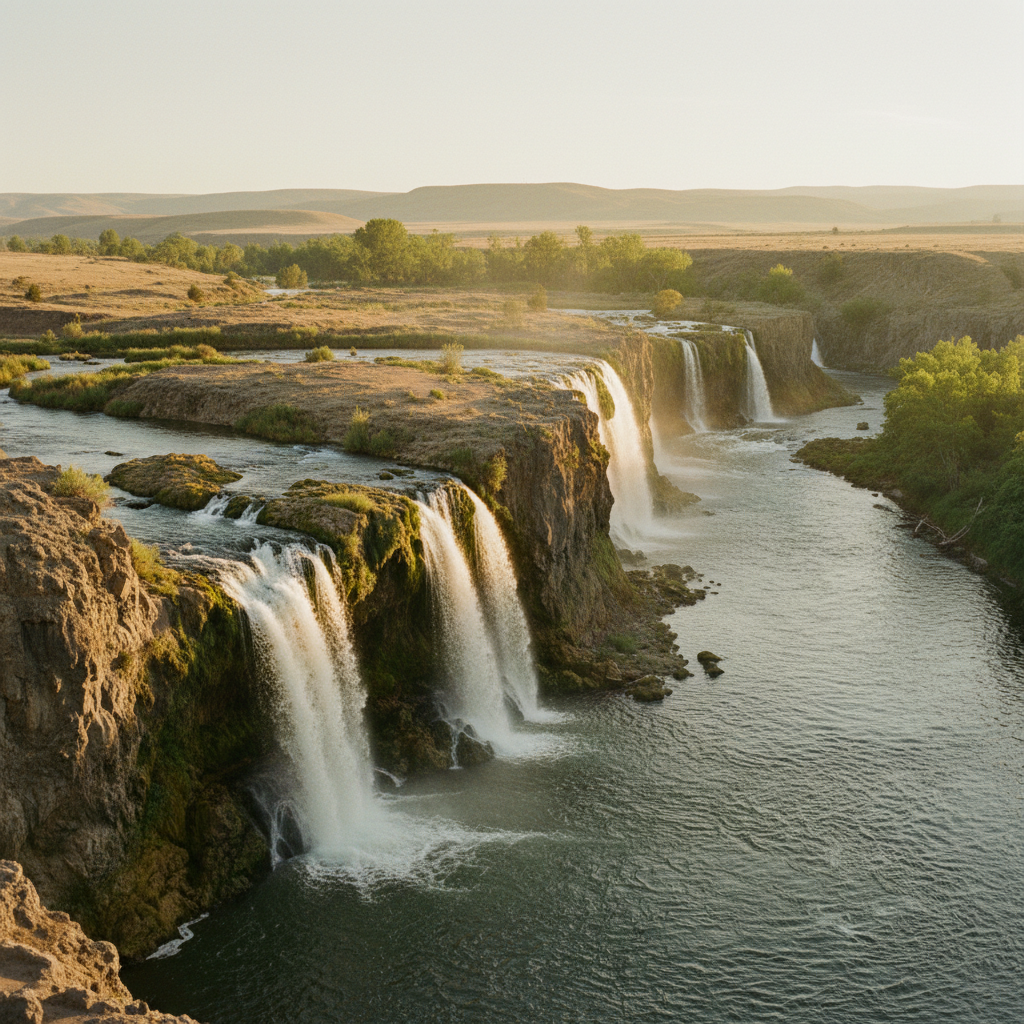
A scattered archipelago of seven volcanic state park units where a massive subterranean aquifer erupts from the canyon walls of the Snake River.
Thousand Springs State Park is a sprawling, multi-unit sanctuary along the Snake River Canyon (traditionally known as Bia Ogwaide by the Shoshone-Bannock people) where the massive Snake River Plain Aquifer dramatically bursts through volcanic basalt cliffs. For thousands of years, nomadic Shoshone, Bannock, and Paiute tribes camped along these canyon edges, fishing for salmon and steelhead drawn to the oxygen-rich, 58-degree spring waters. The park's seven distinct units (Malad Gorge, Kelton Trail, Billingsley Creek, Ritter Island, Earl M. Hardy Box Canyon Springs Nature Preserve, Niagara Springs, and Crystal Springs) are connected by the Thousand Springs Scenic Byway. In 2022, a new state-of-the-art visitor center opened at the Billingsley Creek unit, a collaborative effort with the adjacent Hagerman Fossil Beds National Monument, offering a central hub for travelers looking to understand the complex hydrology of the Magic Valley.
Each unit of the park reveals a different facet of this subterranean water system, which begins nearly 100 miles away as snowmelt from the Pioneer Mountains sinks into the porous lava fields near Craters of the Moon. At Malad Gorge, the Malad River plunges 250 feet through the Devil’s Washbowl, a churning, narrow chasm crossed by a steel footbridge that offers a dizzying view of the white water below. Just east of the gorge, the Kelton Trail unit preserves deep wagon-wheel ruts carved into the volcanic rock, left by pioneers traveling the historic Oregon Trail and the 1860s freight route between Boise and Kelton, Utah. Further south, the Earl M. Hardy Box Canyon Springs Nature Preserve features the eleventh-largest spring in the United States, where crystal-clear, electric-blue water rises from the canyon floor and rushes down a steep, boulder-strewn gorge to join the Snake River.
Human history and hydrology merge at Ritter Island, once a private agricultural estate purchased in 1918 by Minnie Miller, a pioneering businesswoman who bred prize-winning Guernsey cattle. Today, visitors can tour her historic stone farmhouse and pristine white dairy barn before walking the two-mile loop trail around the island, where the cascading Minnie Miller Springs and Lemmon Falls spill directly out of the lush canyon vegetation. Directly across the river, Niagara Springs offers a stark contrast, where icy water gushes violently from fissures in the 350-foot-deep canyon wall, creating a roaring wall of white spray. From paddling a kayak through the calm, emerald channels around Ritter Island to fly-fishing for rainbow trout at Billingsley Creek or standing in the cool mist of Niagara Springs, the park provides an intimate, sensory encounter with the life-giving force of the Idaho desert's subterranean ocean.
Begin your journey at the Billingsley Creek Visitor Center to pick up a map of the seven far-flung units. For the best paddling, launch a kayak or paddleboard at Ritter Island and navigate the calm, spring-fed channel clockwise around the island, passing directly beneath the cascading Minnie Miller Springs. Keep in mind that Ritter Island has seasonal hours and is typically closed to vehicle access from autumn through mid-spring.