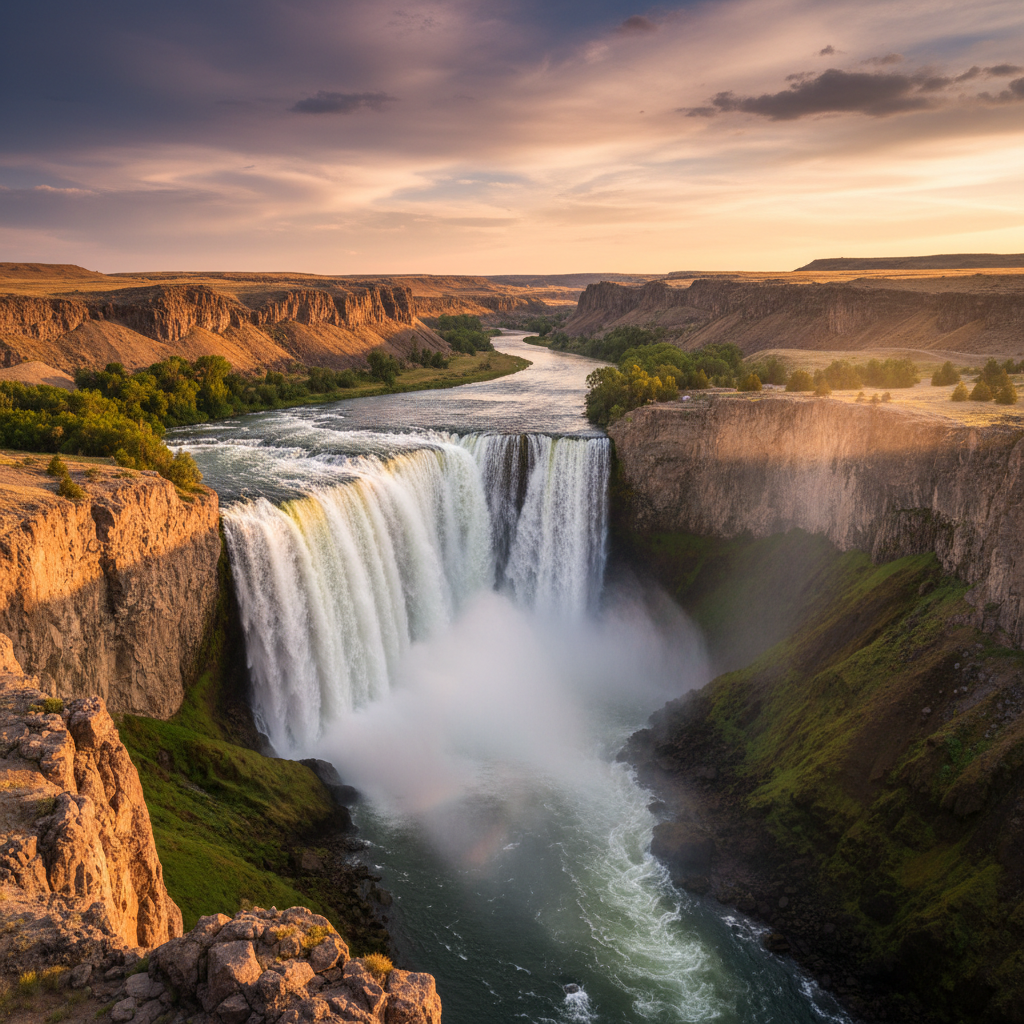
Twin Falls' Niagara of the West. A 212-foot canyon-carving cascade that stands taller than its eastern namesake.
Shoshone Falls plunges 212 feet over a horseshoe-shaped basalt rim that stretches nearly 1,000 feet across the Snake River Canyon. Taller than Niagara Falls by 45 feet, this geological giant represents the raw force of water carving through the volcanic crust of southern Idaho. The falls were sculpted roughly 14,000 to 17,000 years ago during the Pleistocene Ice Age, when the cataclysmic outburst of the Bonneville Flood tore through the region and scoured the deep basalt canyon. Today, the Snake River pours over these dark, tiered cliffs of rhyolite and basalt, throwing a permanent column of mist into the air and generating a deep, resonant rumble that vibrates through the surrounding canyon walls.
For thousands of years, the waterfall served as a critical ecological and cultural boundary. The Lemhi Shoshone and other regional tribes gathered here for trading and salmon fishing, as the sheer height of the falls created an impassable barrier for migrating fish, dividing the Snake River into two distinct aquatic ecosystems. European travelers along the Oregon Trail in the mid-19th century frequently detoured from their route to witness the spectacle. By the early 20th century, the river's flow began to be harnessed for the development of southern Idaho. The Shoshone Falls Power Plant, completed in 1907, still operates just upstream, and massive agricultural diversions twenty miles upriver channel water to irrigate over 500,000 acres of farmland. Consequently, the volume of water cascading over the rim varies dramatically. During the spring snowmelt from April to June, flows typically peak between 10,000 and 12,000 cubic feet per second, occasionally surging past 20,000 cubic feet per second in wet years, while late summer and autumn diversions can reduce the massive basalt amphitheater to a series of quiet, trickling seeps.
The modern park encompassing the falls spans 218 acres, a legacy that began in 1932 when Frederick and Martha Adams donated 68 acres to the City of Twin Falls with the strict requirement that the land remain a public park. Today, the city charges a five-dollar vehicle entry fee from March 1 through September 30, while winter access is free. Paved paths and ADA-accessible viewing platforms line the canyon rim, offering direct views of the roaring main cascade and the smaller side channels. Adjacent to the falls, the park grounds include shaded picnic areas, grassy lawns, and a boat launch, with a trail leading to the calm waters of Dierkes Lake, a popular spot for swimming, fishing, and paddling. For a brief period each spring, the park hosts Shoshone Falls After Dark, a ticketed event where the entire 900-foot-wide rock face is illuminated by a choreographed light show, casting vibrant colors through the rising mist against the night sky.
Plan a visit during the spring snowmelt from April through early June to experience the maximum flow. Check the live water flow camera on the City of Twin Falls website before departing, as upstream agricultural diversions can reduce the roaring cascade to a dry rock face by late summer.