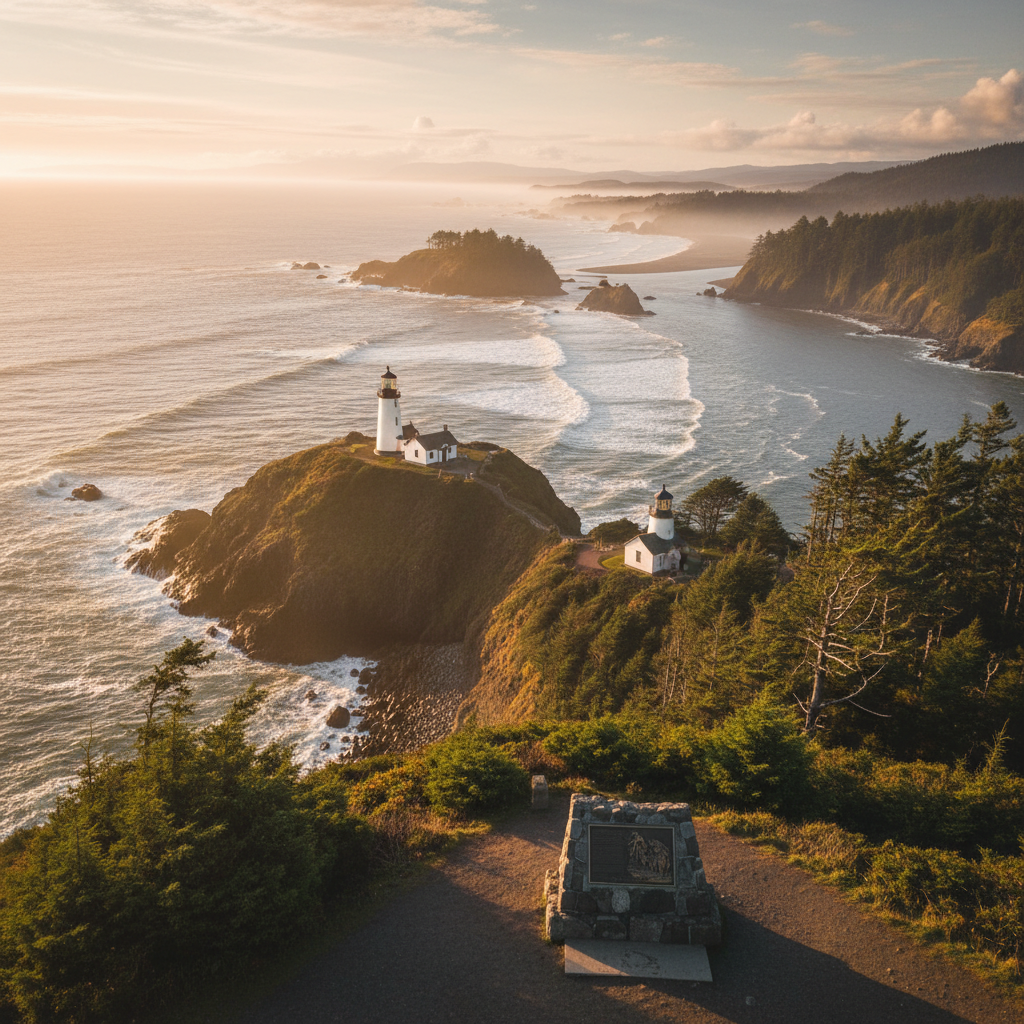
Where the Columbia meets the Pacific. Two lighthouses, Chinook history, and Lewis & Clark legacy.
Cape Disappointment State Park occupies 2,023 acres of dramatic basalt headlands, old-growth spruce forest, and shifting dunes where the Columbia River meets the Pacific Ocean. Long before British fur trader Captain John Meares named the headland in 1788 out of frustration for missing the river's mouth, the Chinookan people knew this turbulent convergence as Kah'eese. The park's rugged cliffs are actually ancient basalt flows that erupted on the ocean floor millions of years ago, cooling rapidly into dense, wave-pounded rock. Today, this boundary is defined by the collision of the river's massive freshwater outflow with the heavy swells of the Pacific, creating the formidable Columbia River Bar. The constant, deep roar of the surf against the headlands provides a continuous soundtrack, while the air remains thick with ocean mist and the scent of damp Sitka spruce.
The park's maritime and military history is preserved through its iconic structures and concrete ruins. Perched on the southern cliffs, Cape Disappointment Lighthouse has stood since 1856, making it the oldest operating lighthouse on the West Coast, built to guide mariners through the treacherous Graveyard of the Pacific. Two miles to the north, the taller, white-towered North Head Lighthouse was commissioned in 1898 to assist vessels approaching from the north. Between these two beacons lie the remnants of Fort Canby, a military defense site established during the Civil War. Visitors can explore the overgrown concrete bunkers of Battery Harvey Allen, which now houses the Lewis and Clark Interpretive Center. Inside, exhibits trace the 1805 arrival of the Corps of Discovery, who spent their final, grueling days of westward travel mapping these very cliffs.
Exploring the park requires navigating its eight miles of hiking trails, which wind through moss-draped coastal rainforests of hemlock and spruce. The Cape Disappointment Trail leads hikers past the ruins of old gun batteries to the edge of Deadman's Cove, a sheltered inlet littered with massive drift logs and named for the shipwreck victims who once washed ashore here. Nearby, Waikiki Beach offers a rare pocket of protected sand, popular for beachcombing and storm watching. The park also hosts a portion of the Confluence Project, featuring outdoor art installations designed by architect Maya Lin that invite reflection on the intersection of Indigenous history and ecological change. From watching winter gales lash the basalt cliffs to walking the quiet paths near Benson Beach, the landscape remains a powerful monument to the raw forces of the Pacific Northwest coast.
Be sure to see both lighthouses. The trail to the Cape Disappointment light is a sheltered, mossy walk through old-growth forest, while the North Head light offers a raw, wind-blasted view up the Long Beach Peninsula. Pack a windbreaker and a real rain jacket, even in the height of summer, as the weather here shifts rapidly.