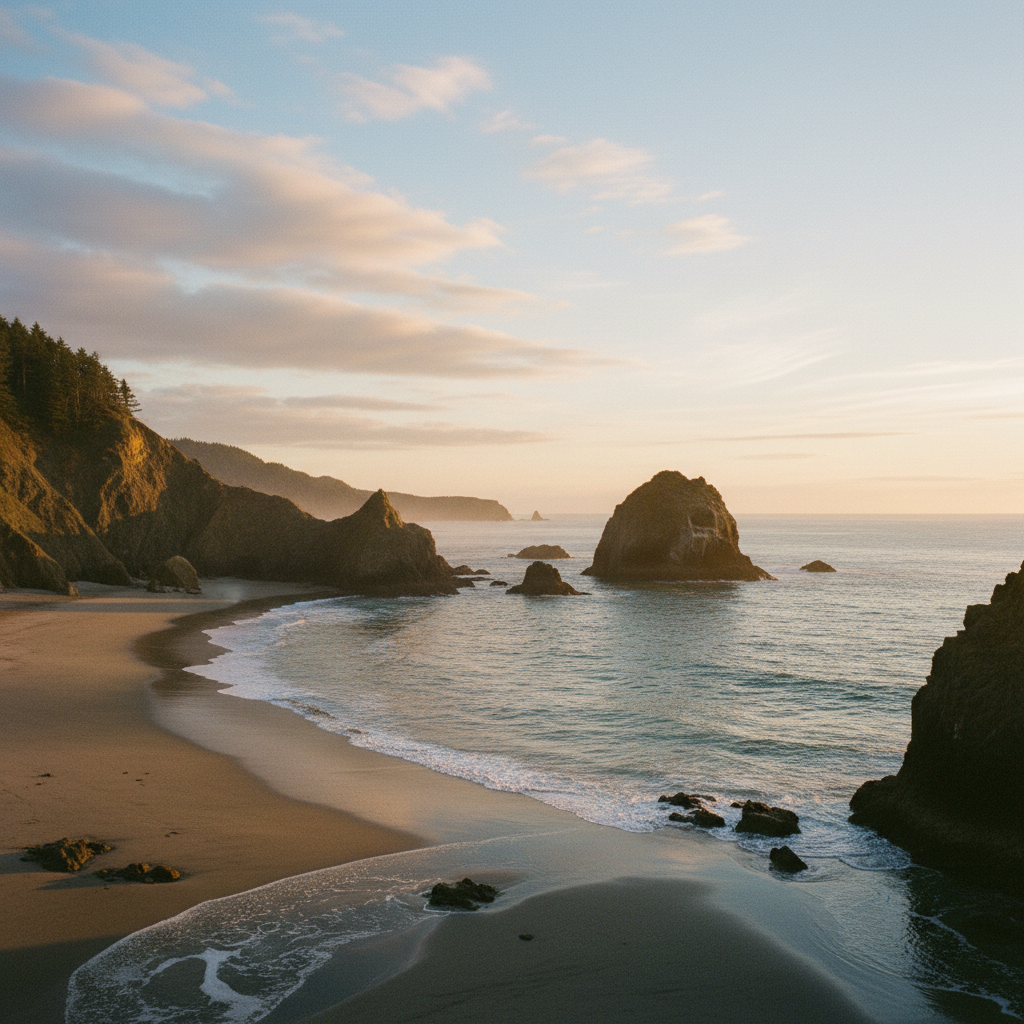
A steep trail through old-growth Sitka spruce drops you into Dead Man's Cove, a moody, cliff-walled pocket of the Washington coast where drift logs pile high and tide pools teem with life.
The descent into Dead Man's Cove begins in the deep, dripping shade of Cape Disappointment's coastal forest. Walking the trail, the damp air smells of salt, rotting cedar, and wet earth. The canopy of ancient Sitka spruce and salal is thick enough to swallow the coastal wind, leaving only the deep, rhythmic thud of the Pacific pounding the cliffs. As the path drops steeply, the trees part to reveal a small crescent of dark sand, framed by sheer basalt cliffs and strewn with massive, silvered drift logs. In the center of the cove rises a rocky, tree-topped sea stack, holding a single, resilient Sitka spruce that has weathered decades of winter gales. It is a scene that feels less like a public park and more like a secret edge of the continent, where the land reluctantly yields to the cold northern sea.
This dramatic landscape is shaped by the violent collision of the Columbia River and the Pacific Ocean. Known as the Graveyard of the Pacific, this stretch of coast has claimed hundreds of ships, and the cove's grim name is a direct nod to those maritime tragedies, when bodies from shipwrecks washed ashore into this natural trap. Long before explorers like Lewis and Clark arrived, this was the territory of the Chinook people, who navigated these treacherous waters in cedar canoes. The basalt cliffs flanking the cove are remnants of ancient lava flows that poured across the continent millions of years ago, cooled by the ocean into hard, dark walls that now protect this pocket of beach from the worst of the unrelenting swells.
Visiting the cove requires timing and a willingness to get your boots muddy. At low tide, the ocean retreats to expose tide pools carved into the basalt shelf, where bright green anemones, purple sea stars, and tiny hermit crabs cling to the rock. You can scramble over the massive driftwood piles, worn smooth by the surf, or sit on a log and watch the fog roll in, obscuring the nearby Cape Disappointment Lighthouse. The atmosphere is thick with Pacific Northwest moodiness: gray, damp, and intensely quiet, save for the roar of the waves. It is a place for quiet observation, where the raw, cold energy of the coast is palpable, and the boundary between the forest and the sea is blurred by the constant drift of salt spray.
Check the tide charts before setting out. At high tide, the sandy beach completely disappears, leaving only wave-battered rocks. Wear sturdy boots with good traction; the short descent from the main trail is often muddy, steep, and slick with wet clay and exposed tree roots.