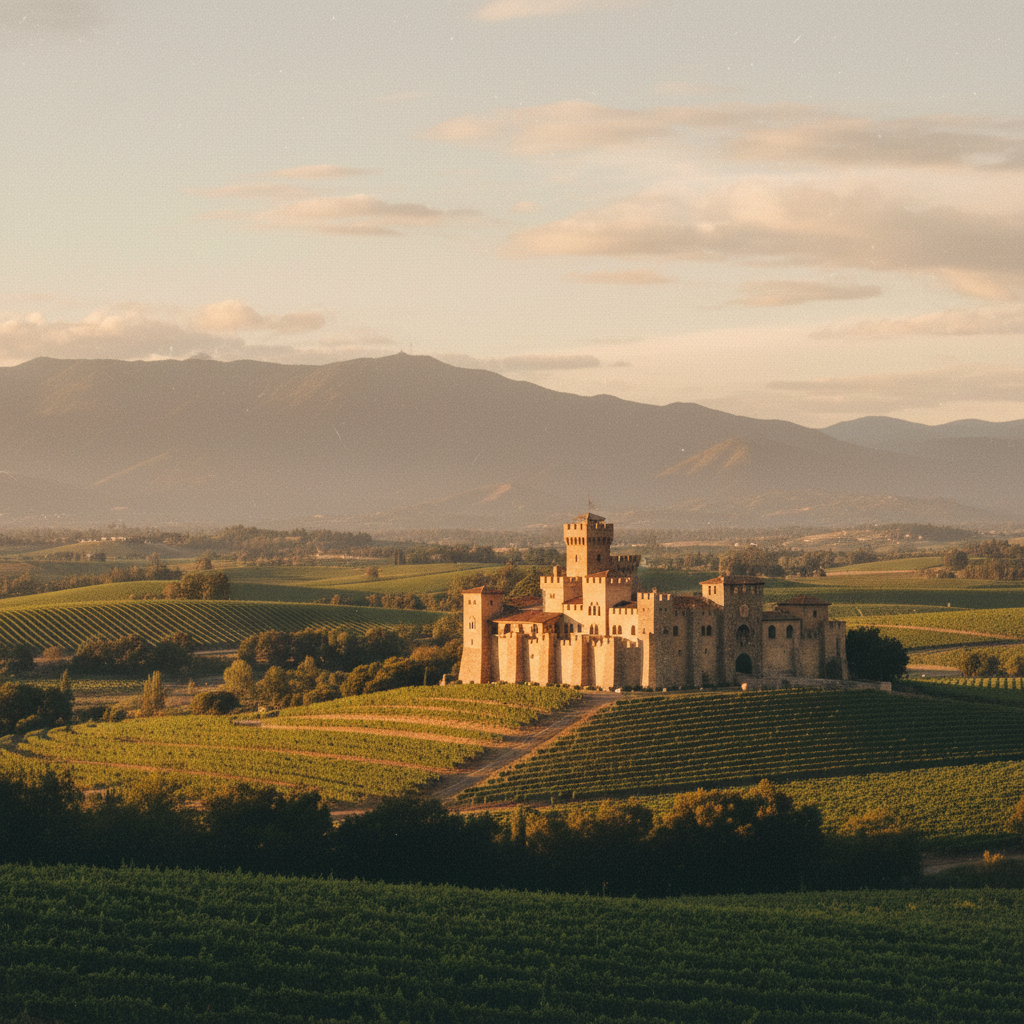
Cross a drawbridge into a fully realized 14th-century Tuscan castle in Calistoga, where hand-carved stone walls and deep underground vaults house bold, Italian-style wines.
The approach up the winding, olive-lined driveway in Calistoga feels like a sudden departure from Northern California. Rising from the valley floor against a backdrop of dark pine is a massive medieval fortress, complete with battlements, high stone towers, and a dry moat. Crossing the drawbridge, the immediate sensation is one of cool, heavy mass. The air inside the stone walls is instantly chilled and smells of damp earth, oak barrels, and aging Sangiovese. Light filters through narrow arrow loops, casting long shadows across hand-hewn timber doors and rough-cut stone floors. This is not a superficial facade: it is a structurally authentic 14th-century Tuscan castle, built with an obsessive level of craftsmanship that commands your attention before you even taste a drop of wine.
The castle is the vision of winemaker Dario Sattui, who spent decades researching medieval Italian architecture, measuring castles throughout Europe to replicate their proportions. Construction spanned fifteen years, utilizing more than one million antique bricks imported from ruined European structures alongside hand-chiseled stone. Below the surface lies a subterranean labyrinth of rooms across four levels, where vaulted brick ceilings were constructed using medieval techniques without modern steel supports. The estate sits on the volcanic soils of the northern Napa Valley, where the hot daytime sun of Calistoga is tempered by cool evening breezes pulling through the Chalk Hill Gap. This microclimate is ideal for Cabernet Sauvignon and Sangiovese, which age quietly in the deep, dark cellars beneath the castle's massive foundations.
Exploring the grounds is a slow, tactile journey. You wind up spiral stone staircases to the ramparts, where the view opens up over the estate vineyards and the rugged peaks of Mount Saint Helena. In the central courtyard, peacocks strut across the cobblestones, their sharp cries echoing off the high walls. Below ground, the experience shifts to a quieter, more intimate scale. You wander through the barrel rooms, a vaulted tasting hall adorned with hand-painted Italian frescoes, and even a fully realized medieval torture chamber. Tastings here are focused, featuring Italian-style wines like Pinot Grigio and bold Cabernet blends. The atmosphere is a strange and beautiful collision of old-world European romance and the precise agricultural craft of modern Napa Valley, leaving you with the distinct feeling of having stepped through a rift in time.
Book the earliest morning tour of the day to catch the golden light coming over the eastern hills and avoid the mid-day crowds. Be sure to select a tour option that includes the subterranean caves and barrel rooms; the basic tasting-only reservation limits your access, and the architectural scale of the underground brick vaults is the real highlight here.