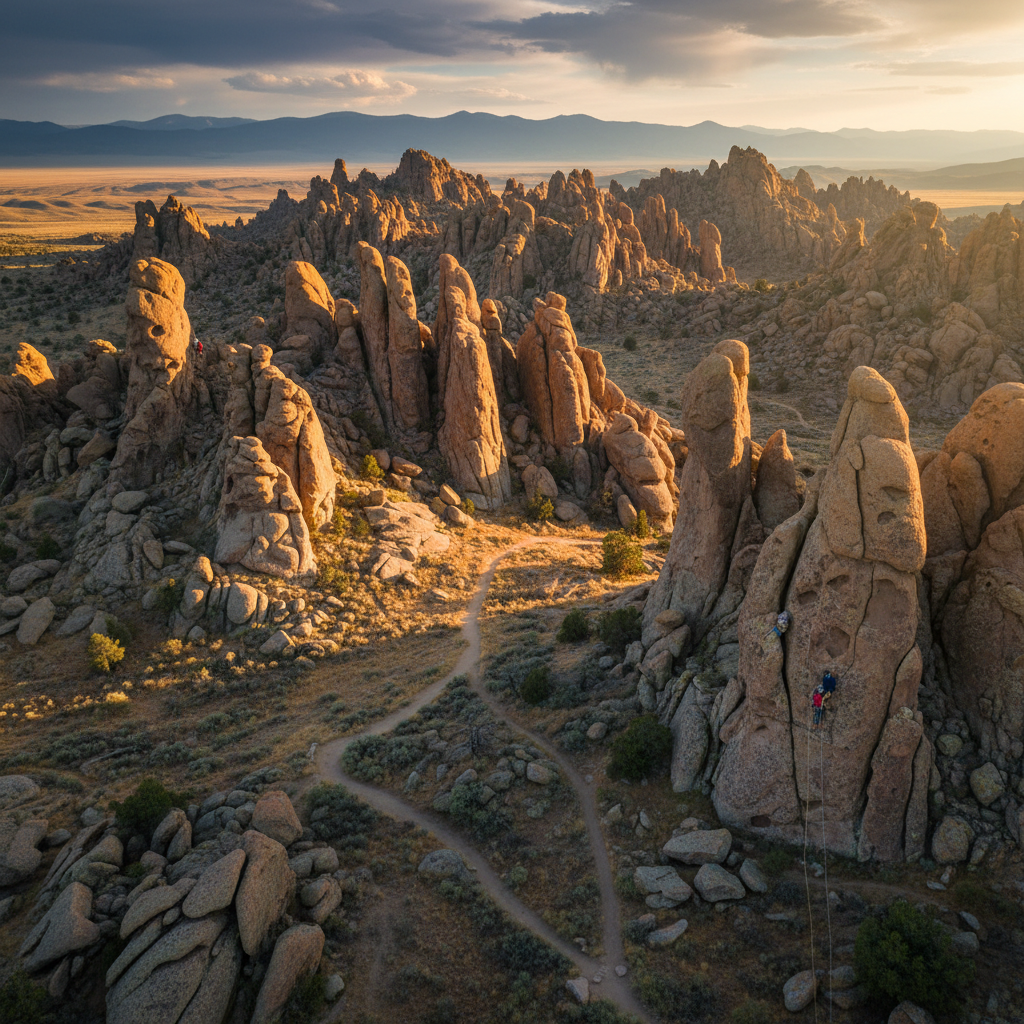
Granite spires and historic pioneer inscriptions on the California Trail in southern Idaho.
The City of Rocks National Reserve, also known as the Silent City of Rocks, spans over 14,000 acres of south-central Idaho near the Utah border, where massive granite monoliths rise abruptly from the high desert floor. These dramatic formations represent two distinct geological eras: the younger granitic rock of the Oligocene Almo Pluton, dating back 28 million years, and the ancient Archean Green Creek Complex, which exceeds 2.5 billion years in age, making it some of the oldest exposed rock in North America. For thousands of years before European contact, this labyrinth of stone served as the seasonal homeland for Shoshone and Bannock bands, including the Pine Nut Eaters and Rabbit Eaters, who gathered pinyon pine nuts from the surrounding woodlands each autumn. Today, the Shoshone-Bannock Tribes maintain a deep spiritual connection to these sacred rocks, collaborating with the reserve on cultural preservation and interpretive projects, including artwork by tribal member Derek No Sun Brown at the visitor center in nearby Almo.
During the mid-nineteenth century, the reserve became a crucial landmark along the California Trail. Emigrant James F. Wilkens first recorded the name "City of Rocks" in his journal on August 10, 1849, describing a valley of granite structures resembling steeples, houses, and haystacks. Between 1843 and 1869, nearly a quarter-million travelers navigated their wagon trains through this passage, resting at Circle Creek before pushing over Granite Pass. Many of these pioneers left enduring records of their journeys, writing their names and dates in axle grease on the smooth granite surfaces of Camp Rock and Register Rock. These historic inscriptions remain visible today, preserved alongside faint wagon ruts etched into the soil, offering a tangible connection to the overland migration that shaped the American West.
In the modern era, the reserve has earned international acclaim as one of the premier granite face-climbing destinations in the United States, featuring over 1,000 traditional and bolt-protected routes. Climbers refer to the area simply as "The City," drawn to the high-friction granite of formations like Bath Rock, Flaming Rock, and Morning Glory Spire. The park's climbing history is deeply tied to the 1980s, when pioneer climber Tony Yaniro developed some of the country’s most challenging routes here. Beyond climbing, the reserve features a network of hiking, mountain biking, and equestrian trails that wind through the corridors of the stone city. Jointly managed by the National Park Service and the Idaho Department of Parks and Recreation, the reserve was designated an International Dark Sky Park in January 2023, protecting its exceptionally clear night skies from light pollution and allowing stargazers to view the cosmos framed by ancient stone spires.
Look for historic 19th-century pioneer signatures written in axle grease on Camp Rock and Register Rock. For stargazing, visit during a new moon to experience the reserve's designated International Dark Sky.