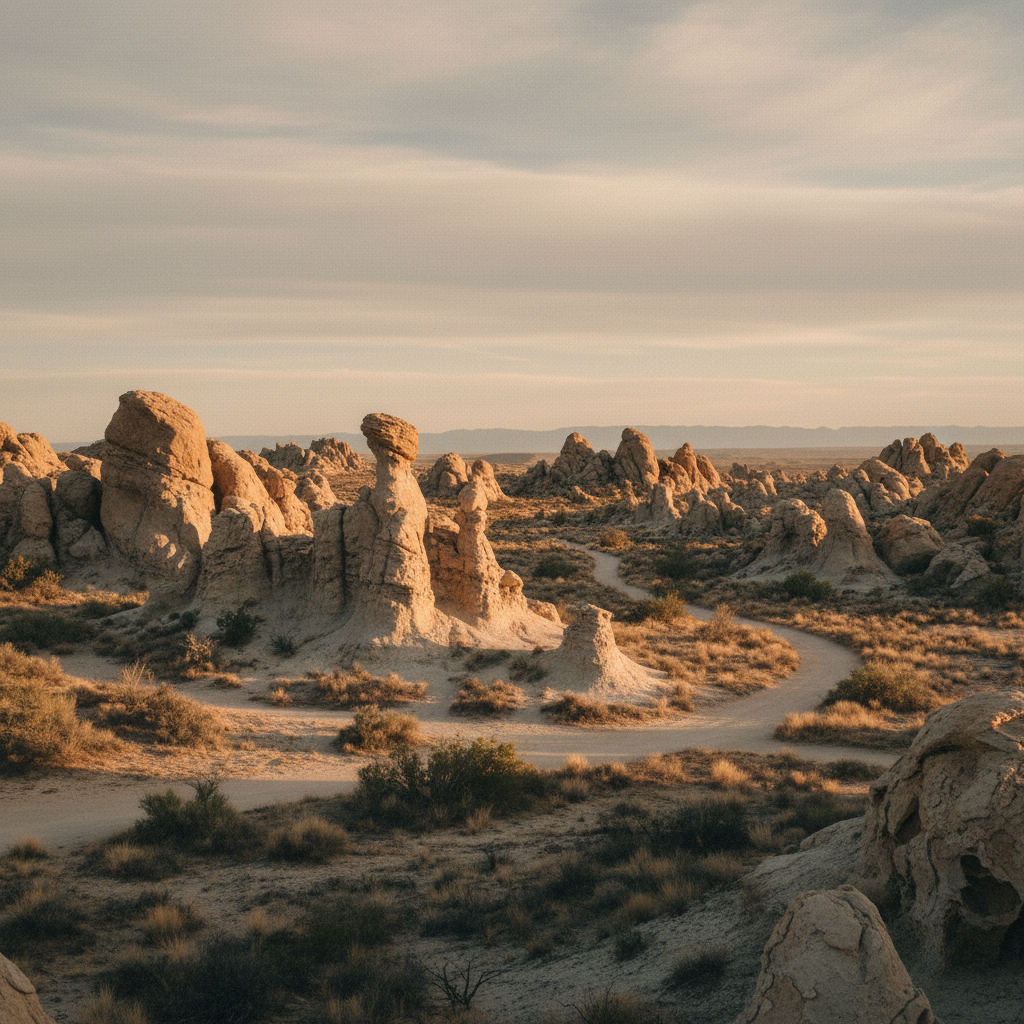
A geological labyrinth of 40-foot volcanic tuff pinnacles rising from the Chihuahuan Desert, featuring ancient Mimbres history, scenic hiking trails, and a state-of-the-art astronomical observatory.
City of Rocks State Park rises abruptly from the Chihuahuan Desert grasslands of southwestern New Mexico, a geological anomaly of monolithic stone columns and pinnacles that mimic a sprawling metropolitan grid. Located midway between Deming and Silver City at an elevation of 5,200 feet, the park encompasses a one-square-mile core of towering rock formations. These columns, some reaching heights of 40 feet, are separated by paths, lanes, and plazas that feel remarkably like city streets. Walking through the park reveals a labyrinth of cool, shaded alleyways and hidden chambers, where the light-brown and pink tuff is draped in vibrant patches of green and yellow lichen. Unlike jagged mountain peaks, these stone giants are smooth, rounded, and highly tactile, creating a natural playground that feels both ancient and deeply quiet.
This stone metropolis was forged by a single, cataclysmic event 34.9 million years ago. A massive eruption of the Emory Caldera, a supervolcano centered near Hillsboro Peak in the southern Black Range, ejected hundreds of cubic miles of ash and pumice. This superheated material settled over the landscape, welding together under immense pressure to form a thick, dense layer of rock known as Kneeling Nun Tuff. As the volcanic sheet cooled, it contracted and cracked, forming a grid of vertical fissures. Over the subsequent eons, water seeped into these cracks, expanding during winter freeze-thaw cycles, while wind and plant roots slowly widened the gaps. This patient erosion sculpted the solid tuff into the freestanding towers and pinnacles that stand today, a process that continues to shape the landscape on a geological timescale.
Human history has left its own quiet marks among the stone corridors. The Mimbres people settled this area between 750 and 1250 AD, leaving behind arrowheads, precise geometric pottery, and deep, conical grinding holes known as Indian wells worn directly into the flat rock surfaces where rainwater still collects. Centuries later, Spanish explorers passed through, carving mysterious crosses into the soft volcanic tuff. Today, visitors can explore the park via several hiking and mountain biking paths, including the 3.6-mile Hydra Trail loop and the 5.1-mile Table Mountain Trail, which climbs to a high vantage point overlooking the Cooke’s Range. Near the visitor center, a desert botanical garden showcases native Chihuahuan flora, including cow’s tongue cactus, bunny ear cactus, ocotillo, and towering century plants that bloom in the summer heat.
The true magic of the park reveals itself after dark, as City of Rocks is widely celebrated for its exceptionally clear, dark skies. It is home to the Gene and Elisabeth Simon Observatory, the first astronomical observatory built within a New Mexico state park, which features a high-powered 14-inch Meade telescope for viewing distant galaxies and planets. To fully experience this nocturnal landscape, visitors can reserve one of the park's campsites, many of which are positioned directly inside the rock alcoves. These unique sites are bordered on three sides by towering, sun-warmed stone walls, providing natural windbreaks and a profound sense of isolation. As the desert temperature drops, the rocks release their stored heat, and the sky overhead fills with a brilliant, unfiltered canopy of stars.
Book a non-electric campsite, such as Site 30, to secure a spot positioned directly inside the rock formations where you are surrounded by 40-foot stone walls. If you are visiting between May and October, check the park schedule for public viewing nights at the Gene and Elisabeth Simon Observatory to look through their 14-inch telescope.