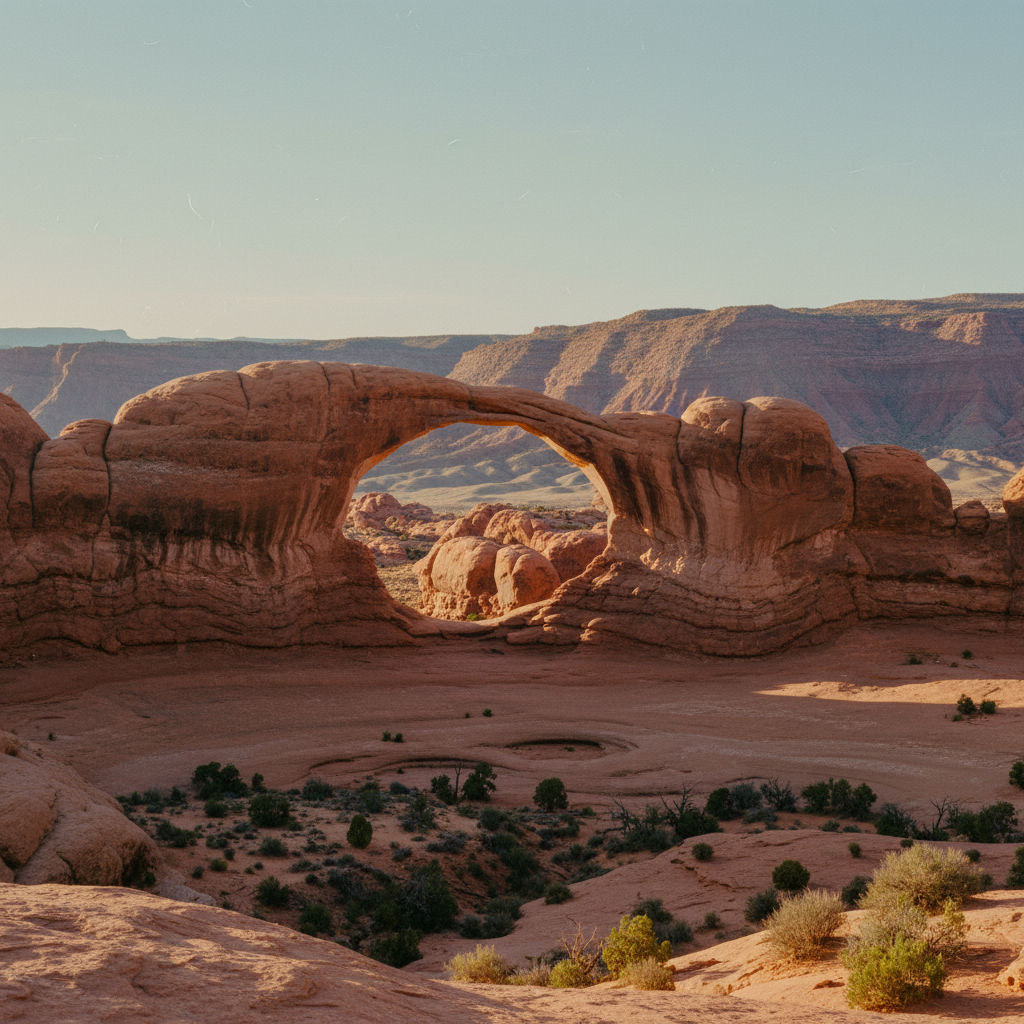
Corona Arch is a colossal Navajo sandstone span rising in Bootlegger Canyon, just west of Moab. Reached via a three-mile slickrock trail that crosses an active railway line and climbs safety cables, this massive freestanding arch is one of the largest and most dramatic geologic formations outside the national park boundaries.
Corona Arch, historically known on older maps as Little Rainbow Bridge, is a colossal freestanding span of Jurassic-age Navajo sandstone located within Bureau of Land Management territory. Situated in Bootlegger Canyon just west of Moab, Utah, this massive geological structure measures 140 feet across and 105 feet high. The arch showcases the classic rounded profile of wind-sculpted and water-carved desert stone, formed through the same weathering processes that shaped the famous spans in nearby Arches National Park. Because Corona Arch sits on public BLM land rather than within national park boundaries, it remains a rare, highly accessible destination where hikers can travel with their dogs, offering a dramatic alternative to the heavily regulated national park trails.
The journey to the arch begins at a trailhead off Potash Road (Utah State Route 279), directly across from the Gold Bar Campground along the Colorado River. The trail spans three miles round trip, ascending approximately 440 feet of elevation across sandy washes and broad slickrock benches. Early in the hike, visitors register at a BLM box before crossing the active tracks of the Cane Creek branch railway, constructed in 1964 to transport potash from the local downriver mine. As the trail climbs, hikers can spot Pinto Arch high on the northern canyon rim before navigating the route's signature obstacles. These include two safety-cable handrails anchored directly into steep slickrock slopes and a five-step steel ladder bolted into a sandstone ledge. Just past these obstacles, the trail loops around a massive sandstone amphitheater, passing beneath Bowtie Arch, a classic pothole arch formed where a deep plunge pool eroded through the roof of a cave.
The sheer scale of Corona Arch once made it a magnet for extreme sports, earning a brief period of viral notoriety as the site of a massive pendulum rope swing. Following a series of severe accidents, including a fatality in 2013, the Bureau of Land Management instituted temporary restrictions on roped activities to protect both visitor safety and the physical integrity of the sandstone. In August 2017, the BLM permanently banned all rope swinging, highlining, and rappelling on the arch, restoring the natural quiet of Bootlegger Canyon. Today, the canyon remains a place of profound stillness, where the red-and-buff buttresses of the arch frame the desert sky. The surrounding landscape carries deep historical significance, situated on the ancestral lands of the Ute, Southern Paiute, and Navajo peoples, whose ancient presence is recorded in the Fremont-style petroglyphs carved into the cliffs along the nearby Colorado River corridor.
While dogs are welcome on this BLM trail, the hot desert slickrock can easily blister their paws. Bring protective dog booties, a leash, and at least a gallon of water for your pet, as there is zero shade along the exposed route.