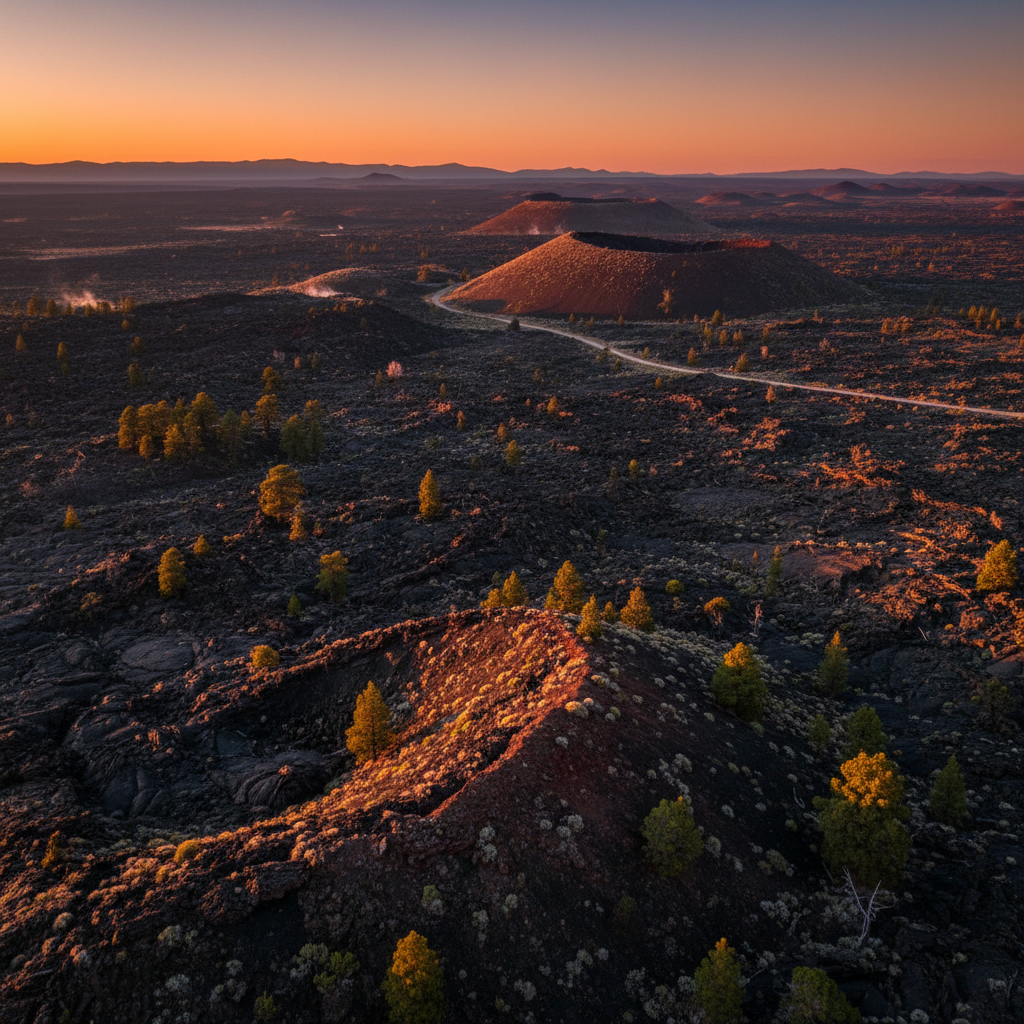
Step onto a vast ocean of black basalt, where cinder cones rise from the sagebrush and ancient volcanic fires have left a stark, beautiful scar across the Idaho desert.
Driving into this basalt wilderness from the dusty flats of the Snake River Plain feels like crossing an invisible shoreline. The horizon suddenly fractures into a dark, undulating sea of wrinkled rock, jagged fissures, and cinder cones that rise like miniature volcanoes from the sagebrush. The air smells of sun-baked earth and the dry, medicinal scent of desert scrub, but the heat radiating from the black basalt is entirely its own. When you step out of your car, the silence is immediate and heavy, broken only by the dry hiss of wind through the porous rock and the distinct, glass-like crunch of black cinders under your boots. It is a landscape stripped of soft edges, a raw and beautiful monument to the molten forces that tore through the earth's crust.
This volcanic expanse is the result of deep crustal stretching along the Great Rift, a series of deep cracks where magma welled up to the surface over thousands of years. The lava flows here are remarkably young, with the most recent eruptions occurring just two thousand years ago, leaving behind classic formations of ropey pahoehoe and jagged aa lava. Despite the hostile appearance, life has claimed this black rock. Tenacious limber pines bend with the relentless Idaho wind, while tiny dwarf buckwheat blooms in the cinder fields during the brief spring. For generations, the Shoshone and Bannock peoples traveled through these fields, navigating the lava paths. In 1924, the area was designated a national monument, celebrated as a weird and scenic landscape that preserves one of the most complete volcanic rifts on the continent.
To truly feel the scale of this place, you must leave the pavement of the seven-mile Loop Road. Climb the steep, shifting slope of Inferno Cone, where the wind threatens to steal your hat and the summit rewards you with a panoramic view of the Pioneer Mountains rising above the black desert. Below, trails lead to the Caves Area, where you can descend into the cool, dark chambers of ancient lava tubes like Indian Tunnel or Boy Scout Cave, where ice persists deep into the summer. As the sun dips, the black basalt absorbs the last light, turning deep shades of charcoal, indigo, and rust. The park is an International Dark Sky Park, and when night falls, the stars emerge with astonishing clarity, casting a faint, silvery glow over a landscape that feels entirely detached from the modern world.
To explore the lava tubes, obtain a free cave permit at the visitor center first. Bring a strong flashlight (phone lights are insufficient in the pitch-black chambers) and wear sturdy, closed-toe shoes to navigate the jagged, uneven cave floors. If visiting in summer, explore the caves during the midday heat for a natural retreat.