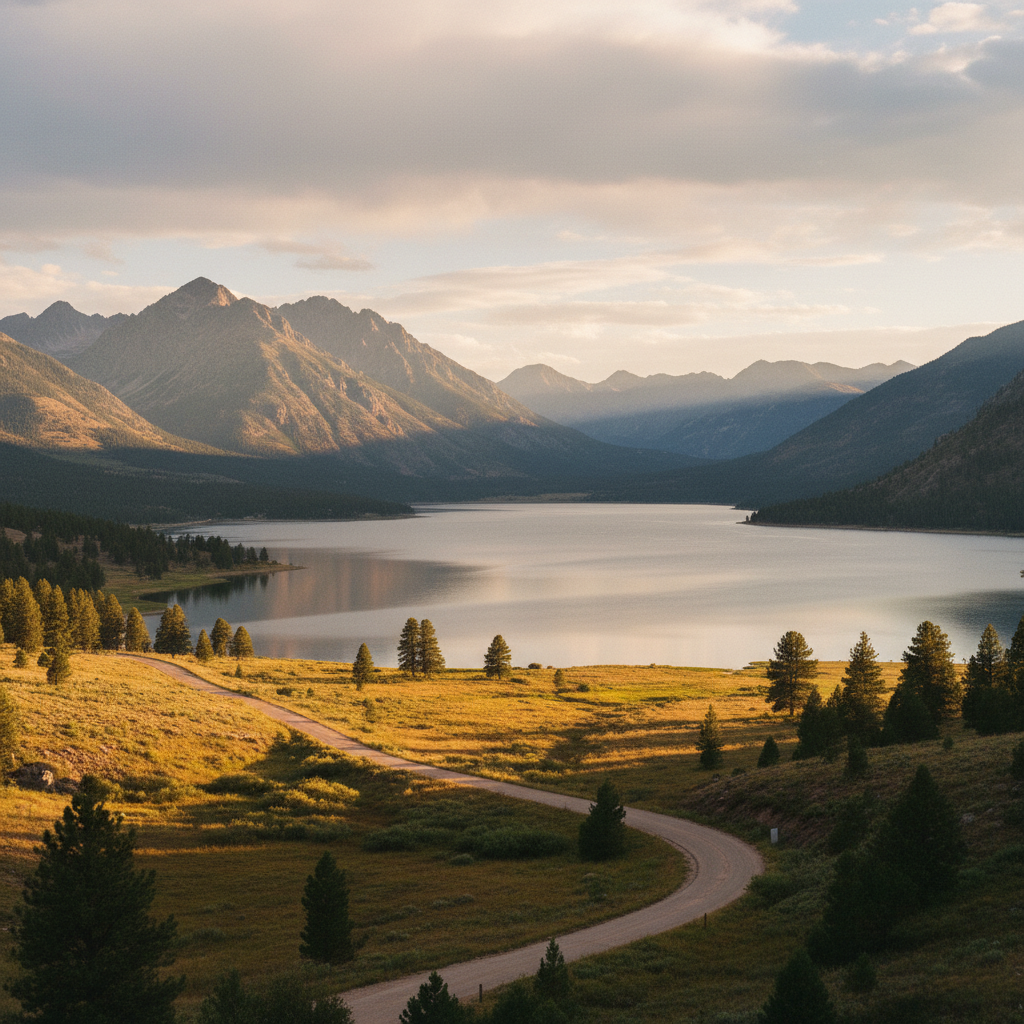
This 2,400-acre alpine reservoir in the high Moreno Valley is framed by the Sangre de Cristo Mountains, offering a premier cold-water fishery for trout and salmon.
Eagle Nest Lake State Park surrounds a 2,400-acre alpine reservoir that sits at an elevation of 8,300 feet in the high Moreno Valley of northeastern New Mexico. Framed by the Cimarron Range and the high peaks of the Sangre de Cristo Mountains, including the pyramid of Wheeler Peak, the park is defined by its deep, cold waters and wide-open skies. The reservoir is not a remnant of ancient glacial activity, but rather the result of early twentieth-century human engineering. In 1916, brothers Charles and Frank Springer, prominent local lawyers and ranchers associated with the historic CS Ranch, began construction of the Eagle Nest Dam on the Cimarron River. Completed in 1918, the concrete arch dam tamed the turbulent river, created a reliable irrigation source for downstream farmers, and ultimately transformed the arid valley into a permanent highland oasis. Before the dam was built, the St. Louis, Rocky Mountain and Pacific Railroad had attempted to extend its line through this rugged pass to Taos, leaving behind an unfinished tunnel blasted into the rock just south of the dam site.
The state of New Mexico purchased the lake in 2002, officially dedicating the area as a state park on July 3, 2004. Today, the park serves as a premier destination for cold-water anglers, renowned for its diverse and robust fish populations. The lake is regularly stocked with rainbow trout, brown trout, and Snake River cutthroat trout, alongside a thriving population of kokanee salmon. Anglers also target yellow perch and massive common carp. However, the presence of predatory northern pike has altered the lake's management: because these aggressive fish pose a threat to the trout and salmon, state regulations mandate that anglers harvest and keep any northern pike they catch. The park features a modern visitor center, opened in 2009, which houses interpretive exhibits detailing the engineering of the dam, the history of the Moreno Valley, and the area's ranching heritage. A network of shoreline paths allows visitors to explore the lake's edge, where the thin mountain air carries the scent of sagebrush and ponderosa pine.
Seasonal rhythms dictate the experience at Eagle Nest Lake, with each quarter of the year offering a distinct encounter with the mountain landscape. During the summer months, the water remains too cold for swimming but is ideal for hand-launched kayaks, canoes, and motorized fishing boats trolling the deep channels. Autumn brings a dramatic shift as the surrounding slopes of the Moreno Valley turn gold with changing aspens, and the lake's inlets boil with the crimson bodies of spawning kokanee salmon. This annual run, peaking in late September, draws a spectacular gathering of bald eagles and ospreys that swoop down to feed on the migrating fish. By winter, the valley falls into a profound quiet. The lake freezes into a thick sheet of ice, typically from January through March, transforming the reservoir into a village of ice-fishing shelters. Huddled over augured holes in the ice, winter anglers brave the subzero wind to pull trout and perch from the dark depths, maintaining a year-round connection to this high-altitude sanctuary.
To witness a dramatic wildlife spectacle, visit in late September when the kokanee salmon run up the Cimarron River inlet. This natural event turns the shallow waters crimson and attracts dozens of migrating bald eagles and ospreys looking for an easy meal.