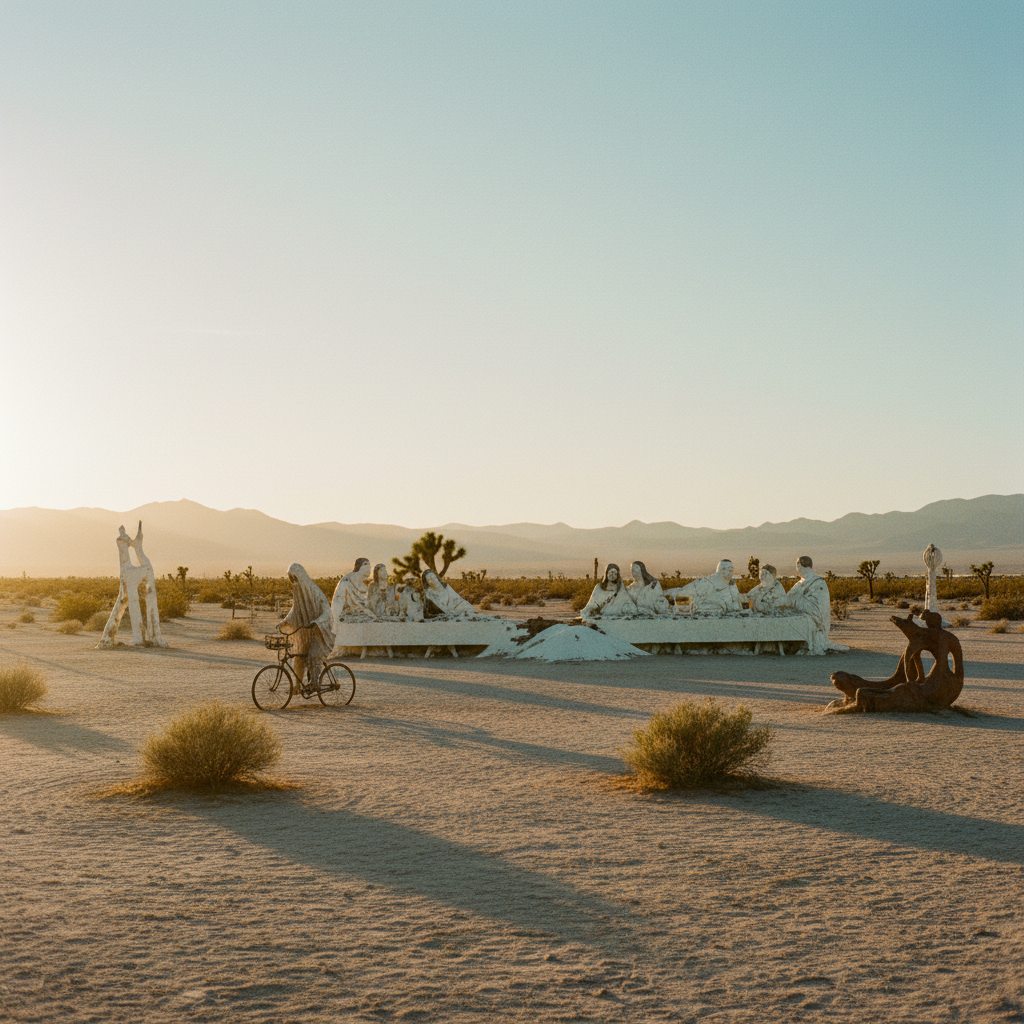
Ghostly life-sized figures and colossal cinder-block sculptures rise from the Mojave Desert floor near Rhyolite, forming the surreal landscape of the Goldwell Open Air Museum.
Goldwell Open Air Museum began as a singular, spectral vision in 1984 when Belgian artist Albert Szukalski arrived in the Mojave Desert to create a "genesis piece" that would forever alter this stretch of Nye County. Attracted by the stark landscape's resemblance to the Middle Eastern deserts of the Holy Land, Szukalski draped plaster-soaked burlap over live human models, waiting for the plaster to harden before slipping them out to leave hollow, rigid shrouds. The resulting installation, "The Last Supper", features ghostly, life-sized figures arranged in a haunting echo of Leonardo da Vinci's classic fresco. Though Szukalski initially estimated these fiberglass-coated ghosts would only survive the harsh desert elements for two years, they remain standing decades later, anchoring what has evolved into a nearly eight-acre open-air sculpture park.
Over the years, other prominent Belgian artists joined Szukalski's "art situation", contributing their own monumental works to the arid flats near the ghost town of Rhyolite. In 1984, Szukalski also created "Ghost Rider", a plaster figure preparing to mount a real chrome bicycle. Nearby, Hugo Heyrman's 1992 creation, "Lady Desert: The Venus of Nevada", rises as a twenty-five-foot-tall woman constructed from pink cinder blocks, her blocky form designed to evoke a physical pixel against the horizon. Fred Bervoets contributed "Tribute to Shorty Harris" in 1994, a twenty-four-foot silhouette crafted from sheet steel depicting the legendary local prospector alongside an unexpected penguin companion. Visitors will also find Dre Peters's "Icara", a hand-carved wooden female counterpart to the mythological Icarus, and Sofie Siegmann's "Sit Here!", a whimsical, brightly tiled mosaic couch that was restored and relocated to the site in 2007.
The museum officially organized as a nonprofit organization in 2000 following Szukalski's death, spearheaded by founders Charles Morgan and Suzanne Hackett-Morgan. Today, the site continues to foster creative experimentation under the leadership of president Michelle Graves, who succeeded Hackett-Morgan after her three decades of stewardship. Beyond the permanent outdoor installations, the property features the Red Barn Art Center, a 2,250-square-foot multi-purpose studio and exhibition space that has historically hosted artist-in-residence programs. Located just off State Route 374 near the historic Bullfrog townsite, the museum is open twenty-four hours a day, seven days a week, with no admission fee, though donations are welcomed. Visiting during the low-angled light of dawn or dusk reveals the true depth of the sculptures, as the shifting desert shadows stretch across the gravel, making the hollow figures appear to breathe.
Visit at dusk when the low-angled sun casts long, dramatic shadows through the hollow plaster figures of "The Last Supper". Be sure to look for the tiny, rusted Bullfrog jail ruins located just a short walk past the Red Barn Art Center.