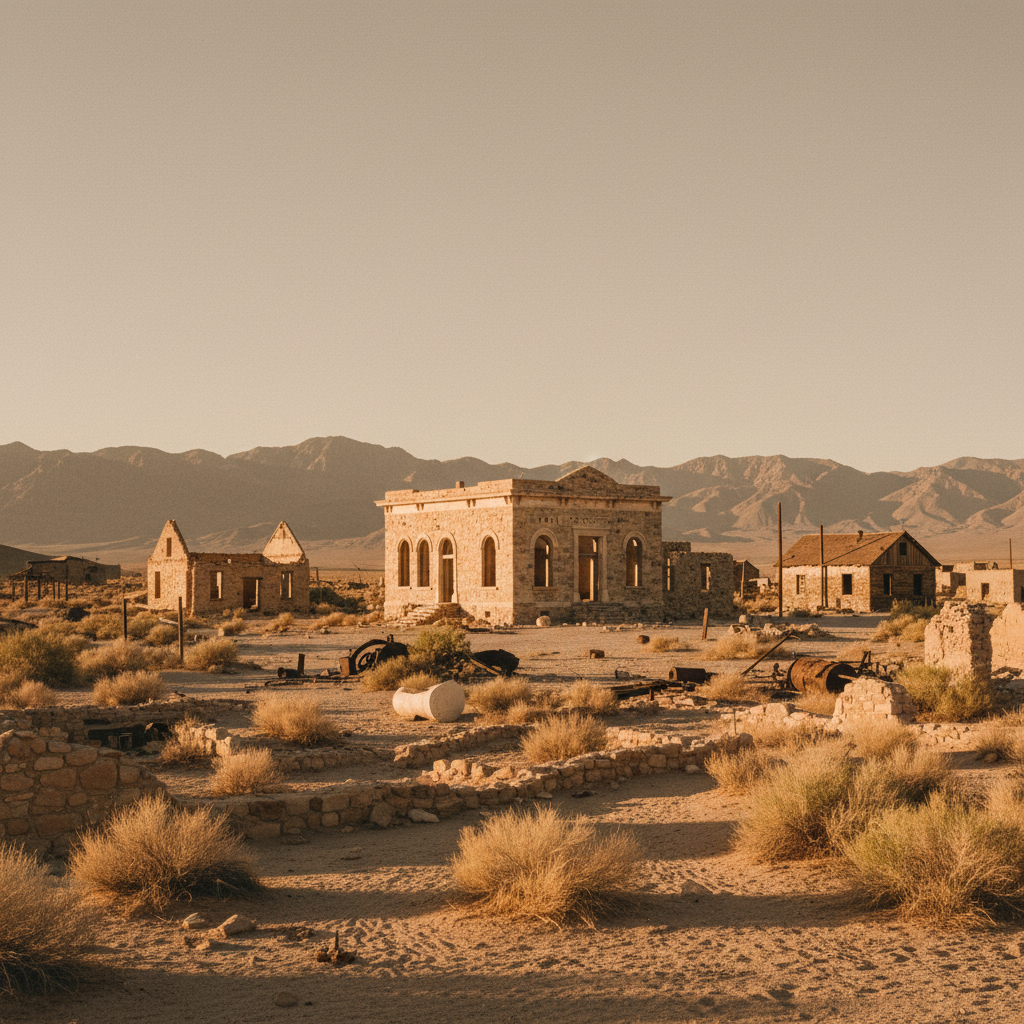
The concrete skeleton of the three-story Cook Bank and a house built of 50,000 beer bottles stand as silent monuments to Nevada's most dramatic boom-and-bust gold rush.
Rhyolite arose almost overnight in the Bullfrog Hills following an August 1904 gold discovery by prospectors Frank "Shorty" Harris and Ernest "Ed" Cross. By 1905, a townsite was platted, and within two years, this remote patch of Nye County became a bustling metropolis of several thousand residents, fueled by the staggering output of the Montgomery-Shoshone Mine. Industrialist Charles M. Schwab bought the mine in 1906, investing heavily in infrastructure that quickly brought electric lights, water mains, telephone lines, and three competing railroads to the desert basin. The town boasted its own stock exchange, an opera house, a hospital, a school, and dozens of saloons, earning it the nickname "Queen City of the Bullfrog District".
The most iconic ruin remaining today is the John S. Cook and Company Bank building, located at the corner of Golden Street and Broadway. Built in 1907 at a cost of 90,000 dollars, this three-story concrete structure was once the height of desert luxury, featuring imported Italian marble floors, rich mahogany woodwork, and stained-glass windows. Today, only its hollowed-out facade stands against the desert sky, the basement that once housed the town post office now filled with sand. A short walk away stands Tom Kelly's Bottle House, constructed in 1905 by an elderly Australian miner. Lacking traditional building materials, Kelly gathered 50,000 glass beer and liquor bottles from local saloons, embedding them in mortar to build a three-room home complete with gingerbread trim. The house was later restored by Paramount Pictures in 1925 for use as a silent film set, preserving it as one of the oldest and largest bottle houses in the United States.
Rhyolite's decline was as swift as its rise, triggered by the financial panic of 1907 and the realization that the local ore was overvalued. The Montgomery-Shoshone Mine closed in 1911, and by 1920, the town's population had dwindled to just fourteen residents. Visitors today can explore the remarkably intact California Mission-style train depot, which was built by the Las Vegas and Tonopah Railroad and later served as a casino and museum in the mid-twentieth century. The site is currently managed by the Bureau of Land Management, offering a free and self-guided look at the skeletal remains of the schoolhouse, the crumbling jail, and the rusted shells of early automobiles. Just south of the townsite, the Goldwell Open Air Museum adds a surreal modern layer to the landscape, showcasing ghostly plaster sculptures created by Belgian artist Albert Szukalski in 1984.
Visit the site in the late afternoon when the low sun illuminates the glass walls of the Tom Kelly Bottle House and casts long shadows through the empty windows of the Cook Bank, then walk down to the Goldwell Open Air Museum to see the plaster sculptures glowing against the twilight.