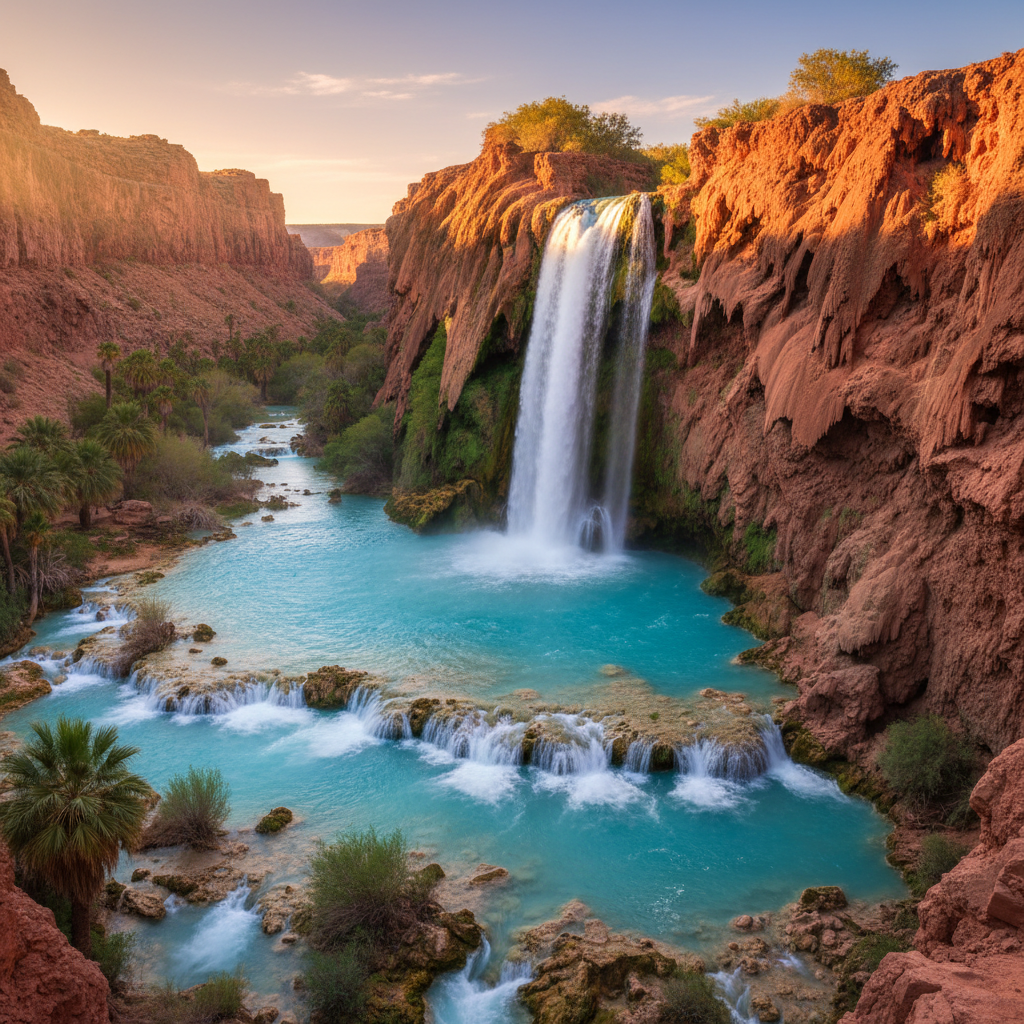
A legendary blue-green waterfall tumbling over red sandstone deep within the sovereign lands of the Havasupai Tribe.
Havasu Falls drops nearly 100 feet (30 meters) over a sheer cliff of red Supai sandstone into a wide, deep pool of brilliant turquoise water. Located within the Havasupai Indian Reservation in a tributary canyon of the Grand Canyon, this iconic cascade is the centerpiece of a landscape shaped by water and mineral deposition. The water of Havasu Creek remains a constant 70 degrees Fahrenheit (21 degrees Celsius) year-round, fed by subterranean springs that emerge from the limestone aquifer of the Redwall Limestone. The striking blue-green color of the creek is the result of a high concentration of dissolved calcium carbonate and magnesium, which reflects sunlight in a unique spectrum. As the water flows and loses carbon dioxide to the air, the calcium carbonate precipitates out, forming extensive terraces, pools, and natural dams of travertine limestone that are constantly shifting and rebuilding, especially after the flash floods that periodically sweep through the canyon.
The Havasupai Tribe, whose name translates to the 'People of the Blue-Green Water,' has inhabited this region for more than 800 years, cultivating crops in the canyon during the spring and summer and moving to the plateau in the winter. Their reservation, established in 1880 and expanded in 1975, is a sovereign nation where tribal members protect and manage their ancestral lands. Visitors must respect that they are entering a living community, Supai Village, which lies eight miles down the trail from the trailhead at Hualapai Hilltop. Supai remains one of the most remote communities in the United States, with no road access, meaning mail, groceries, and supplies are still transported into the canyon by mule trains or helicopters. The village serves as the administrative hub of the reservation, featuring a tribal office, a small grocery store, a cafe, and the Havasupai Lodge, which offers basic accommodations for those who secure lodge permits.
Reaching Havasu Falls requires a demanding ten-mile hike from the trailhead at Hualapai Hilltop, beginning with a steep descent of switchbacks down the canyon wall before flattening out into a gravelly, sun-baked wash. The trail winds through towering sandstone cliffs, passing Supai Village at mile eight, before continuing another two miles to the campground, which stretches along Havasu Creek between Havasu Falls and Mooney Falls. To manage the fragile desert ecosystem, the Havasupai Tribe strictly regulates access, requiring all visitors to obtain a pre-paid three-night permit. For the 2026 season, the tribe replaced the old lottery system with a direct booking platform, featuring an early-access presale in late January and a general sale starting February 1. All visitors must check in and collect their permits and wristbands at the Grand Canyon Caverns Inn on Route 66 near Peach Springs before driving to the trailhead. Beyond Havasu Falls, adventurous hikers can negotiate the steep, wet descent down Mooney Falls using a series of chains, bolts, and ladders carved into the travertine cliff, or continue another three miles downstream to the terraced cascades of Beaver Falls.
Check-in is no longer at the trailhead: you must stop at the Grand Canyon Caverns Inn on Route 66 near Peach Springs to collect your permit and wristbands before driving to Hualapai Hilltop. Pack high-quality water shoes with sticky rubber soles for navigating the wet ladders down to Mooney Falls and wading through the travertine pools at Beaver Falls.