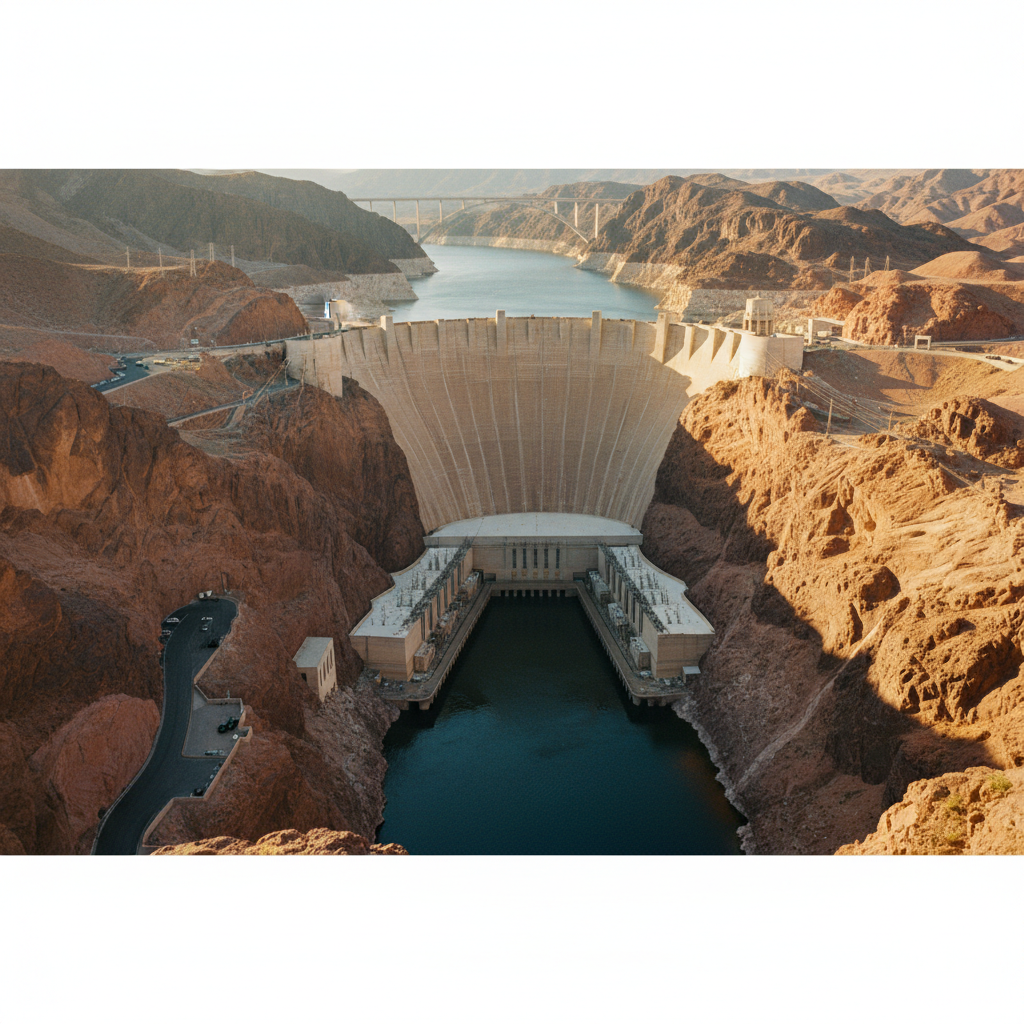
A monumental arch-gravity structure of 3.25 million cubic yards of concrete, Hoover Dam tames the Colorado River inside the volcanic walls of Black Canyon, standing as a legendary testament to early twentieth-century engineering and bold Art Deco design.
The Hoover Dam stands as a monumental achievement of early twentieth-century American engineering, a massive concrete arch-gravity structure wedged into the sheer volcanic rock of Black Canyon on the Nevada-Arizona border. Authorized by the Boulder Canyon Project Act of 1928 and completed in 1936, two years ahead of schedule, the dam was built by a consortium called Six Companies, Inc., under the relentless direction of superintendent Frank Crowe. To construct this 726.4-foot-tall behemoth, workers excavated millions of tons of rock and diverted the wild Colorado River through four massive bypass tunnels carved into the canyon walls. Pouring the 3.25 million cubic yards of concrete required a revolutionary method: rather than a single continuous pour, which would have taken over a century to cool and cure, engineers poured the concrete in a series of interlocking trapezoidal columns, running 582 miles of steel piping through the blocks to circulate ice-cold water from a dedicated refrigeration plant.
Beyond its sheer utilitarian function, the dam is a masterpiece of Art Deco design, largely credited to Los Angeles architect Gordon B. Kaufmann. Kaufmann stripped away traditional ornamental flourishes in favor of clean, streamlined modernist lines that emphasize the dam's monumental scale. On the Nevada side, the plaza features the striking Winged Figures of the Republic, two 30-foot-tall bronze statues sculpted by Oskar J.W. Hansen. These figures sit on a base of black diorite, surrounded by a terrazzo floor that functions as a highly precise celestial map. This star map preserves the exact alignment of the night sky on December 14, 1935, the day President Franklin D. Roosevelt dedicated the dam, serving as a permanent astronomical record for future generations. Hansen also designed the bas-relief plaques on the elevator towers, which honor the construction workers and depict the multi-faceted benefits of the project: flood control, navigation, irrigation, and power.
Visitors can explore both the exterior crest and the deep interior of the dam through guided tours operated by the Bureau of Reclamation. Descending 530 feet into the canyon walls via elevator, the tour leads to the massive Nevada powerplant wing, where eight of the dam's seventeen commercial generators hum with the force of water dropping through massive steel penstocks. The generator room, with its polished terrazzo tile floors and clean industrial geometry, showcases the massive turbines that produce roughly four billion kilowatt-hours of hydroelectric power annually, distributed to municipal utilities and rural cooperatives across Nevada, Arizona, and California. Back on the surface, the pedestrian walkways along the crest offer a dizzying view of the 500-foot drop to the riverbed below, flanked by the intake towers that channel water from Lake Mead, the nation's largest reservoir by volume, which stretches out behind the dam in a stark contrast of deep blue water against sun-scorched desert stone.
To experience the full Guided Dam Tour, which takes you into the historic tunnels and elevator shafts, you must purchase tickets in person on-site, as they are not sold online and frequently sell out early in the day. Arrive by 8:30 AM to secure your spot. For parking, skip the $10 Nevada-side garage if you do not mind a short walk; instead, drive across the dam into Arizona and park for free in Lot 13 or 14.