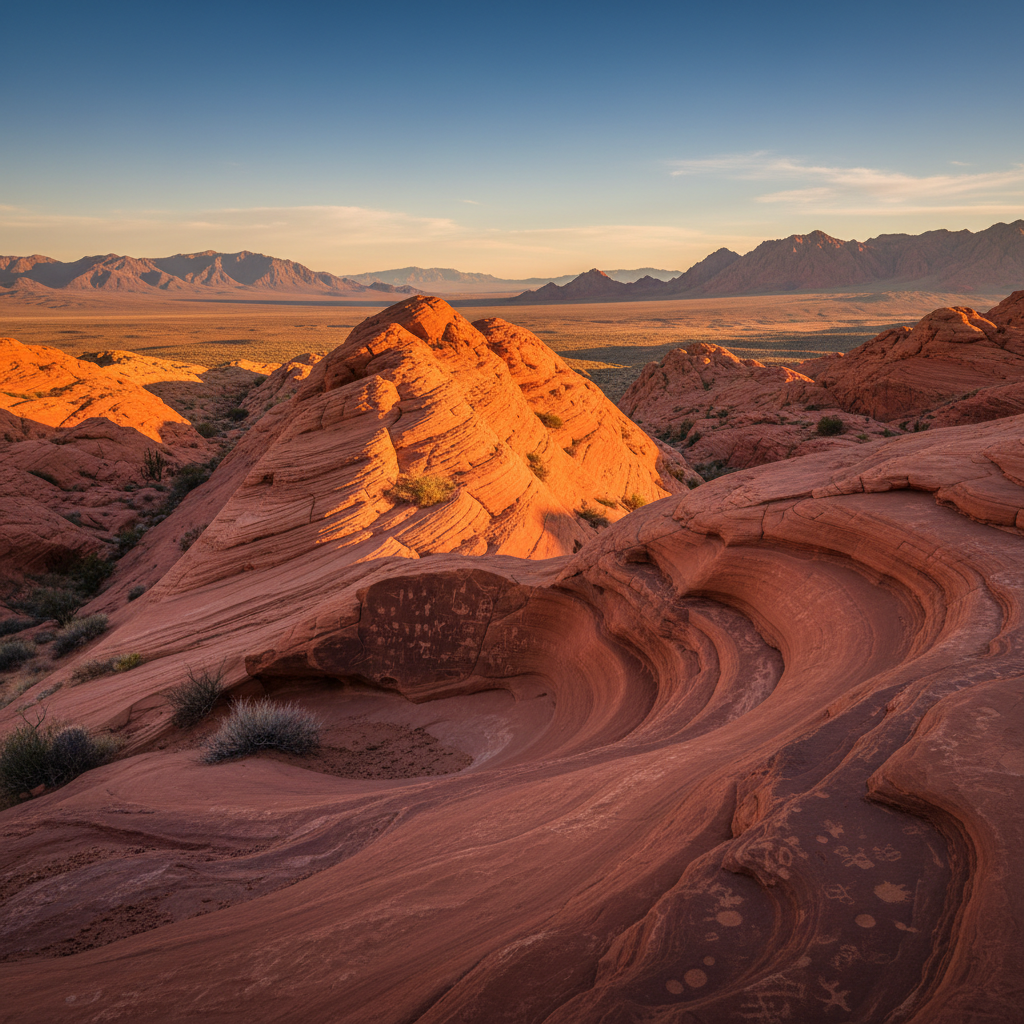
Nevada's oldest state park preserves 46,000 acres of swirling Aztec sandstone, ancient petroglyphs, and deep slot canyons in the Mojave Desert.
Valley of Fire State Park, Nevada's oldest and largest state park, encompasses nearly 46,000 acres of crimson Aztec sandstone and ancient gray limestone. Established in 1935, the park lies within the Mojave Desert, roughly 50 miles northeast of Las Vegas. Its name originated in the 1920s when an official from the American Automobile Association witnessed the late afternoon sun striking the scarlet ridges, describing the landscape as looking as though it were on fire. The core geological story is one of dramatic contrast: Jurassic-era sand dunes, which solidified into Aztec sandstone 150 million years ago, are flanked by much older Paleozoic limestone mountains. Over millennia, complex thrust faulting and relentless erosion by wind and water sculpted these rocks into a labyrinth of canyons, arches, and whimsical formations like the Beehives and Seven Sisters.
Human history is etched directly into these fiery walls, spanning thousands of years of indigenous presence. Prehistoric hunter-gatherers of the Basketmaker culture arrived in the region roughly 2,500 years ago, followed by the Ancestral Puebloans, who farmed the nearby Moapa Valley from 300 BC to 1150 AD. These early peoples used the sandstone canyons for shelter, hunting, and sacred ceremonies, leaving behind an extensive gallery of rock art. At Atlatl Rock, a metal staircase allows close-up viewing of petroglyphs, including a rare depiction of an atlatl, a prehistoric throwing stick used to launch spears before the invention of the bow and arrow. Further along the scenic drive, a sandy path leads through Mouse's Tank, a natural rock basin named after a Southern Paiute renegade where walls are densely carved with ancient petroglyphs.
Exploring the park today requires navigating a landscape of shifting colors and extreme temperatures. The scenic Valley of Fire Road, designated as a Nevada Scenic Byway, winds past massive outcrops to the northern reaches of the park. Here, the Fire Wave trail leads hikers across swirling, multi-colored bands of pink, orange, and white sandstone that resemble a petrified wave. Nearby, the White Domes loop descends into a narrow slot canyon where the temperature drops noticeably between towering walls, passing the stone ruins of a 1960s film set. To preserve the safety of visitors during the extreme heat of the Mojave summer, the park closes several of its most exposed trails, including the Fire Wave and White Domes loops, annually from May 15 to September 30. Visitors can find relief and deeper context at the state-of-the-art visitor center, which underwent a major reconstruction completed in late 2025.
Avoid hiking exposed trails like the Fire Wave or White Domes during the summer, as they are legally closed from May 15 to September 30 due to extreme heat. For the best photography, visit Atlatl Rock and the Beehives during the golden hour just before sunset when the sandstone appears to glow from within.